Author: Chike Ozohili

  • Zenith Bank Records 114% Growth, 1.33trn In Q3 2023

    Zenith Bank Records 114% Growth, 1.33trn In Q3 2023

    Zenith Bank Plc has announced its unaudited results for the third quarter ended 30 September 2023, recording a remarkable triple-digit growth of 114% from N620.6 billion reported in Q3 2022 to N1.33 trillion in Q3 2023.

    According to the bank, the performance demonstrates the Group’s resilience and strong market share despite a very challenging macroeconomic environment.

    According to the bank’s unaudited third quarter financial results presented to the Nigerian Exchange (NGX),the triple-digit growth in the topline also enhanced the bottom line, as the Group recorded a 149% Year on Year (YoY) increase in profit before tax, growing from N202.5 billion in Q3 2022 to N505 billion in Q3 2023.  Profit after tax also grew by 149% from N174.3 billion to N434.2 billion in the same period.

    The growth in the topline arose from both interest income and non-interest income.  Interest income grew in the current period by 72% to N670.9 billion from N390.8 billion in Q3 2022, while non-interest income grew by 186% from N212 billion to N607.2 billion.

    The growth in profit is similarly attributable to the twin effects of the improvement in interest and non-interest income. Interest income increased because of the growth in risk assets as well as the effective pricing thereon. The non-interest income growth is largely driven by the revaluation gain due to the unification of exchange rates during the year.

    The cost-to-income ratio reduced from 55.8% in Q3 2022 to 37.8% in the current period.  Impairment levels increased due to the deliberate incremental provisions necessitated by the conservative approach towards the heightened risk environment and the creation of a counter-cyclical buffer needed to deal with any impending volatility of exchange rates.  This caused the cost of risk to deteriorate from 1.3% in Q3 2022 to 5.5% in Q3 2023, however this is an improvement from Q2 2023 where cost of risk printed at 8.8% because of prudent management of risk assets.

    Total assets grew by 48% from N12.3 trillion to N18.2 trillion in the period ended 30 September 2023, mainly driven by growth in customers’ deposits. Customers’ deposits grew by 49% from N8.98 trillion in December 2022 to N13.38 trillion in September 2023.  The growth in customers’ deposits cuts across both corporate and retail segments with the savings portfolio (all currencies) growing from N2.7 trillion in December 2022 to N4.6 trillion in September 2023.

    The Group is optimistic of finishing the year 2023 strong, with focus on sustainable quick wins that would boost growth across all business segments and enhance stakeholder value.
  • No Plans To Re-Denominate Naira, Says CBN

    No Plans To Re-Denominate Naira, Says CBN

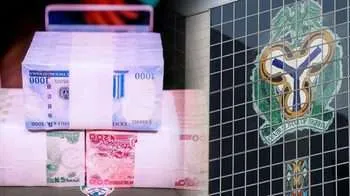
    The Central Bank of Nigeria (CBN) has insisted that it has no plans to re-denominate the Naira, saying such reports are misleading.  

    According to a statement by the Director, Corporate Communications of the Apex Bank Dr. Isa AbdulMumin, he wondered why a narrative that had been refuted by the Bank continues to gain traction.

    “The attention of the Central Bank of Nigeria (CBN) has been drawn to the wide circulation of a text message suggesting that the Bank plans to redenominate the country’s legal tender, the Naira, with effect from January 2024.

    “We are concerned that this narrative, which we had refuted before now, appears to be gaining traction with several debates on the implication of such a policy for the Nigerian economy.

    “We wish to reiterate that the contents of the message are misleading,” it said.

    The Apex Bank noted that the “authors of the message, in their mischief, modified text eked from an old policy move by a previous CBN Governor in 2007 to make it appear recent.

    “For the avoidance of doubt, there is currently no plan by the Bank to restructure and redenominate the naira as it considers reforms”, according to laid down procedures in line with the provisions of the CBN Act, 2007.

    The regulator advised Nigerians to ignore the news report, “as it is speculative and calculated to cause panic in the polity.”

  • Lagos-Ibadan, Warri–Itakpe Rail Lines To Begin e-Ticketing Wednesday

    Lagos-Ibadan, Warri–Itakpe Rail Lines To Begin e-Ticketing Wednesday

    The federal government has launched the e-ticket platform for Lagos-Ibadan and Warri-Itakpe rail lines.

    The e-ticketing platform takes effect from Wednesday, November 1st, 2023.

    Speaking at the launch Monday in Abuja, Minister of Transportation, Saidu Akali said the initiative will ease access to tickets and end ticket racketeering.

    “The essence of E-ticketing is to make it easy for our passengers to buy tickets, for security purposes and to stop ticket racketeering.”

    On his part, the Managing Director of the Nigerian Railway Corporation (NRC), Engr. Fidet Okharia said the initiative will increase revenue generation for the country.

    “I am so happy about this project, apart from the fact that e-ticketing will end issues of ticket racketeering, it will also increase the revenue from the routes.

    “Already for the last one week, revenue on Warri-Itakpe has increased from N3 million to N4 million and will even further increase,” he stated.

    Fare Solution Ltd is handling the contract on the Warri-Itakpe rail line while Global Software and Digital Solutions are handling the contract for the Lagos-Ibadan rail line.

    The contract for the e-ticketing of the rail routes was approved by the Federal Executive Council (FEC) early in 2023 at the cost of N1.96 billion for both companies.

  • Equity Market Sustains Growth, Gains N618bn

    Equity Market Sustains Growth, Gains N618bn

    The local equity market Tuesday crossed the N38 trillion mark, sustaining a bullish run to gain N618 billion.


    The trading result showed that gains recorded in the shares of Airtel Africa, Cadbury Nigeria Plc, UBA, FBNHoldings, FTNCocoa and others impacted positively on the market activities.


    Market capitalisation of listed equities appreciated by 1.65 per cent to N38.038 trillion from N37.420 trillion reported the previous day.


    The NGX All Share Index also appreciated by 1124.48 basis points to 69236.19 points from 68111.71 traded yesterday.


    An analysis of the investment showed that Airtel Africa led gainers table in percentage terms, increasing by 10 per cent to close at N1540.10 per unit, Cadbury Nigeria Plc followed with a gain of 9.92 per cent to close at N13.85 per share. Northern Nigeria Flour Mills also appreciated by 9.92 per cent to close at N19.95 per share, Chams Plc added 9.90 per cent to close at N2.22 per unit, ABC Transport added 9.92 per cent to close at N0.79 per share.


    On the contrary, Betaglass topped losers chart dropping by 9.93 per cent to close at N60.30 per share, UPL followed with a drop of 9.74 per cent to close at N2.12 per unit, EllahLakes fell by 5.56 per cent to close at N3.50 per share, Sovereign Insurance declined by 8.82 per cent to close at N0.31 per unit, Learn Africa down by 8.79 per cent to close at N3.01 per share.


    Volume of trades increased by 52.876 million, representing 12.29 per cent as investors traded traded 483.269 million shares valued at N6.044 billion in 8027 deals against 430.393 million shares valued at N8.257 billion exchanged hands the previous day in 7656 deals.


    Transactions in the shares of Japaul Gold led market activities with 155.594 million shares valued at N181.858 million, United Bank for Africa followed with account of 33.932 million shares worth N688.200 million, Zenith Bank traded 29.899 million shares cost N996.447 million, AccessCorp traded 27.435 million shares valued at N468.662 million while Chams Plc exchanged 22.516 million shares cost N4.806 million.

  • Airtel Africa Records $2.623bn Revenue, Posts $13m Loss In 1H 2023

    Airtel Africa Records $2.623bn Revenue, Posts $13m Loss In 1H 2023


    Airtel Africa Plc has reported a revenue of $2.623 billion at the end of first half financial year results ended September 30, 2023.

    The company revenue increased by 2.3 per cent against $2.565 billion reported in the same period of 2022.

    The company recorded a loss after tax of $13 million against profit of $330 million posted in the corresponding period of last year.

    According to a statement from the company “Loss after tax was $13 million driven largely by a foreign exchange loss of $471million recorded in finance cost before tax and $317million after tax because of the devaluation of the Nigerian naira in June 2023.

    Total customer base grew by 9.7 per cent to 147.7 million, as the penetration of mobile data and mobile money services continued to rise, driving a 23.0 per cent increase in data customers to 59.8 million and a 23.1 per cent increase in mobile money customers to 36.5 million.

    Mobile money transaction value increased by 45.3 per cent in constant currency, with second quarter 2024 annualised transaction value of  $116 billion in reported currency.

    Across the Group mobile services, revenue grew by 18.3 per cent in constant currency,
    driven by voice revenue growth of 11.5 per cent and data revenue growth of 28.1 per cent while Mobile money revenue grew by 30.9 per cent in constant currency.

    The Board declared an interim dividend of 2.38 cents per share, an increase of 9 per cent, in-line with the company progressive dividend policy.

    Group chief executive officer, Olusegun Ogunsanya on the trading update said “I am pleased to report a strong operating performance for the Group despite foreign exchange headwinds in many of our markets and specifically in Nigeria. The resilient growth in voice, data and mobile money usage levels reflects the inherent demand for these essential services across our footprint, and our six-pillar ‘win-with’ strategy continues to ensure we capture this growth opportunity by expanding our customer base and providing the platform to enable increased usage across the network. This strong momentum is supported by continued cost efficiencies which enabled further EBITDA margin expansion.


    As reported in July 2023, our results for the first quarter were significantly impacted by the changes to the Forex market in Nigeria, introduced by the Central Bank. Whilst the changes are required for the long-term benefit of the Nigerian economy, the immediate impact of the naira devaluation continues to weigh on our reported financial performance in the period.

    Our focus remains to enhance long term value by continuing to drive sustained and efficient growth. Over the last five years we have delivered constant currency revenue and EBITDA CAGR of 17.1 per cent  and 20.7 per cent respectively, allowing us to further derisk the balance sheet and improve profitability across the Group.

    Looking forward, he said “the delivery of affordable and reliable telecom and mobile money services across our markets remains our key focus. Our strong operating performance continues to make us a stronger and bigger company, which is well positioned to deliver against the growth opportunities these markets offer. Despite the challenges of rising diesel prices in Nigeria, we aim to limit the impact with continued operational leverage and further cost efficiency to deliver on improved EBITDA margin in the financial 2024 versus financial year 2023.”

  • Nigeria’s Equity Market Rakes In N564bn

    Nigeria’s Equity Market Rakes In N564bn

    Domestic equity market on Monday opened in bullish note, gaining N564 billion as gain recorded in the shares of Dangote Cement, Nigerian Breweries, Stanbic IBTC, Geregu Power, Flour Mills Nigeria Plc, FBNHoldings impacted positively on the trading activities.

    Investors’ rekindled interest in stocks led to the appreciation of NGX All Share by 975.13 basis points to 68111.71 points from 67136.58 points traded the previous day.

    Also, Market capitalisation of listed equities increased by N564 billion or 1.52 per cent to N37.420 trillion from N36.885 trillion it closed on Friday.

    An analysis of the investment showed that Northern Nigeria Flour Mills led gainers table in percentage terms, gaining 10 per cent to close at N18.15 per unit, Chellaram followed with a gain of 9.77 per cent to close at N3.82 per share, UACN added 9.84 per cent to N14.35 per share, Nahco gained 9.42 per cent to N26.05 per unit, TIP increased by 9.43 per cent to close at N1.16 per unit.

    On the contrary, Meryer paint recorded the highest loss, declining by 9.87 per cent to close at N2.74 per unit, Abbey Building trailed with a loss of 9.71 per cent to close at N1.86 per share, Regal insurance dropped by 8.33 per cent to N0.33 per share, RTBriscoe dipped by 6.00 per cent to N0.47 per share, Jaiz Bank down by 5.95 per cent to close at N1.58 per unit.

    Volume of trades during the day increased by 216.247 million, representing 100.98 per cent as investors traded 430.393 million shares valued at N8.257 billion in 7656 deals against 214.146 million shares valued at N5.178 billion in 5325 deals.

    Transactions in the shares of Universal insurance led market activities with 94.753 million shares valued at N23.105 million, United Bank for Africa followed with account of 51.263 million shares valued at N1.002 billion, Transnational Corporation of Nigeria traded 32.476 million shares cost N200.849 million, Zenith Bank exchanged 24.421 million shares cost N818.460 million while Chams traded 19.243 million shares cost N37.506 million.

  • Naira To Reach ‘Fair Value’ Of N750/$ By Year’s End – FG

    Naira To Reach ‘Fair Value’ Of N750/$ By Year’s End – FG

    The Federal Government is planning to introduce new foreign exchange rules — including a crackdown on illegal currency trading — that it hopes will result in the naira closing its more-than-45 per cent gap with the unofficial rate and reaching a “fair price” by year-end, a top official has said.

    The government plans to clear a backlog of dollar demand estimated at about $6.7 billion, bolster the naira forward market, and set transparent rules for the operations of the official market, Taiwo Oyedele, chair of the presidential committee on fiscal policy and tax reforms, said in an interview with Bloomberg.

    The government sees a “fair price” for the dollar at N650 to N750, Oyedele said.

    In the parallel market, it traded at N1,165 per dollar yesterday, already beginning to recede from the former high of about N1,130 to the dollar.

    The government plans to clear a backlog of dollar demand estimated at about $6.7 billion, bolster the naira forward market, and set transparent rules for the operations of the official market, Oyedele said.

    It also aims to expand the official market to include all legitimate transactions, while snuffing out the illicit “black market” for foreign currency, he said.

    “We think all of that will happen before December, and maybe in a matter of a couple of weeks we will begin to see the results, such that before the end of the calendar year, naira should find its true value, not the one that is being done currently in the parallel market,” Oyedele said.

  • FG Moves To Establish Building Material Hubs

    FG Moves To Establish Building Material Hubs

    The Federal government has disclosed its plans to establish building materials manufacturing hubs nationwide to actualize the Action Plan for housing and urban development.

    The establishment of the hub, which the FG said was in line with the ministry’s housing reform initiatives, was aimed at delivering decent, affordable, and quality housing to Nigerians across all income segments.  

    The Minister of Housing and Urban Development, Mr. Ahmed Dangiwa, disclosed this recently during a courtesy visit by a delegation from the International Financial Corporation (IFC), led by Dr. Dahlia Khalifa – Regional Director, Central Africa, and Anglophone West Africa, in Abuja.

    Represented by the Minister of State, Alhaji Abdullahi Gwarzo,  Dangiwa said: “Establishing Building Materials Manufacturing Hubs across the country, implementing a Nationwide Urban Renewal and Slum Upgrading programme is one of the actionable strategies to achieve the renewed hope agenda in housing development.

    “Also, the development of New Cities that are integrated and inclusive, using a demand-driven strategy that will ensure prompt offtake of units built,” he said.

    The minister further listed other strategies put in place to achieve the renewed hope agenda including strengthening the institutional capacity of agencies under its supervision including the Federal Mortgage Bank of Nigeria (FMBN) and the Federal Housing Authority (FHA).

    Dangiwa added that plans to increase the risk of supply of decent and affordable housing, establishing a National Social Housing Fund (NSHF), and implementing land reforms to enhance easy and cost-effective access to land were also in place.

    He commended the work of the IFC in providing funding for developmental projects across Africa.

    Dangiwa further assured the corporation of the ministry’s commitment to transparency and accountability in their collaborations.

    “Our sole goal is to deliver on Mr. President’s objective of providing decent and quality accommodation to all Nigerians, especially the 80 percent falling within the medium and low segments.  We aim to build livable communities and leverage the housing sector to lift 100 million Nigerians out of poverty”, he said.

    Earlier, the Senior Country Manager of the IFC, Mr Kalim Shah, had noted that housing was a major focus of the IFC across Africa where they service both the supply and demand sides of the industry.

    He said the purpose of the visit was to understand what the ministry was doing and see how the group could partner and support their efforts to enhance the delivery of affordable housing to Nigerians.

    “We see some honest desire on the part of the new government to provide affordable housing to the people, and we’ve come as partners to see how we can support what you’re doing. As an arm of the World Bank, our focus is primarily on private sector investment, so we are looking for areas where we can work with the ministry in line with your vision for decent and affordable housing solutions to Nigerians, “he said.

    Also speaking,  the Senior Investment Officer, Public-Private Partnership of IFC, Alexander Leigh, said the corporation wished to engage the ministry in a bid to identify the specific areas of need and know how to provide solutions.

    He added that the IFC considers factors like access to land and its administration, construction costs, the situation of beneficiaries to occupy the houses, and affordability in its dealings with countries, and expressed excitement at the ministry’s efforts to address such issues.

  • Israel/Hamas Conflict Could Distort Global Commodity Markets –World Bank

    Israel/Hamas Conflict Could Distort Global Commodity Markets –World Bank

    Although the global economy is in a much better position than it was in the 1970s to cope with a major oil-price shock, an escalation of the latest conflict in the Middle East—which comes on top of disruptions caused by the Russian invasion of Ukraine—could push global commodity markets into uncharted waters, the World Bank has said.

    In its latest Commodity Markets Outlook, released on Monday morning, The Washington based lender said the effects should be limited if the conflict doesn’t widen.

    The Bank note that oil prices are expected to average $90 a barrel in the current quarter before declining to an average of $81 a barrel next year as global economic growth slows.

    “Overall commodity prices are projected to fall 4.1% next year. Prices of agricultural commodities are expected to decline next year as supplies rise. Prices of base metals are also projected to drop 5% in 2024. Commodity prices are expected to stabilize in 2025.

    “The conflict’s effects on global commodity markets have been limited so far. Overall oil prices have risen about 6% since the start of the conflict. Prices of agricultural commodities, most metals, and other commodities have barely budged.

    “The outlook for commodity prices would darken quickly if the conflict were to escalate,” it said.

    The report stated that effects would depend on the degree of disruption to oil supplies.

    According to the global Bank, in a “small disruption” scenario, the global oil supply would be reduced by 500,000 to 2 million barrels per day—roughly equivalent to the reduction seen during the Libyan civil war in 2011.

    Under this scenario, the oil price would initially increase between 3% and 13% relative to the average for the current quarter—-to a range of $93 to $102 a barrel, the report said.

    “In a “medium disruption” scenario—roughly equivalent to the Iraq war in 2003—the global oil supply would be curtailed by 3 million to 5 million barrels per day. That would drive oil prices up by 21% to 35% initially—to between $109 and $121 a barrel. In a “large disruption” scenario—comparable to the Arab oil embargo in 1973— the global oil supply would shrink by 6 million to 8 million barrels per day. That would drive prices up by 56% to 75% initially—to between $140 and $157 a barrel.

    “The latest conflict in the Middle East comes on the heels of the biggest shock to commodity markets since the 1970s—Russia’s war with Ukraine. That had disruptive effects on the global economy that persist to this day. Policymakers will need to be vigilant. If the conflict were to escalate, the global economy would face a dual energy shock for the first time in decades—not just from the war in Ukraine but also from the Middle East,” said World Bank’s Chief Economist and Senior Vice President for Development Economics, Indermit Gill.

    The World Bank’s Deputy Chief Economist and Director of the Prospects Group, Ayhan Kose, noted that “Higher oil prices, if sustained, inevitably mean higher food prices. If a severe oil-price shock materializes, it would push up food price inflation that has already been elevated in many developing countries. At the end of 2022, more than 700 million people—nearly a tenth of the global population—were undernourished. An escalation of the latest conflict would intensify food insecurity, not only within the region but also across the world.”

  • Despite Slight Appreciation, Naira Still Weak – Report

    Despite Slight Appreciation, Naira Still Weak – Report

    In spite of the slight appreciation of the Naira at the weekend, the World Bank has listed Nigeria’s local currency as being among the worst-performing currencies in Sub-Saharan African in the first ten months of 2023.

    According to figures obtained from Aboki forex, the naira was bought and sold for 1,140/$ and 1,150/$1 at the weekend on the parallel section of the foreign exchange market as against the 1,310/$ on Thursday.

    Over the past two weeks, the Naira has been hitting new lows, as it sold as low as N1300/$ at the black market, and N848/$ at the official market. However, within the past few days, the currency has been on an upward swing, as it appreciated to N789.84/$ on Friday.

    But in a report by the World Bank the Nigerian Naira has posted a year-to-date depreciation of about 40 per cent, making it the weakest currency in Sub-Saharan Africa, alongside the Angolan Kwanza.

    Other currencies with significant losses include the South Sudanese pound which has depreciated by about 33 per cent YTD, the Burundian Franc which has depreciated by 27 per cent YTD, the Congolese Franc (18 per cent), Kenyan Shilling (16 per cent), Zambian Kwacha (12 per cent), Ghanaian Cedis (12 per cent), and Rwandan Franc (11 per cent).

    In the report, it highlighted that between March 2020 and June 2023, there was a widening disparity between the parallel market exchange rate and the official exchange rate.

    The disparity widened to as much as 80 per cent in November 2022 and dropped to 60 per cent in June 2023.

    The prioritization of strategic sectors and the imposed price ceilings and trade restrictions pushed transactions to the parallel market, which started to account for a large share of the foreign exchange transactions in the country, including for remittances, tourism, and exports of non-oil products.

    After the unification and liberalization of the exchange rates in June 2023, the NAFEX rate converged to the parallel one, closing the gap.

    However, resistance toward the increasing pressure on the Nigerian naira coupled with limited supply of FX at the official window has led to the reemergence of the parallel market premium.

    Figures obtained from the Central Bank of Nigeria on movement of foreign reserves showed that the country’s external reserves recorded $76.82m accretion in one week, after it moved up from $33.249bn on October 19, 2023 to $33.326bn as of the end of October 26, 2023.

    It had earlier lost $841.75m in three months after it fell from $34.07bn as of July 7, 2023, to $33.23bn as of October 5, 2023.

    Meanwhile, an economist and Chief Executive Officer, Centre for the Promotion of Private Enterprise, Dr Muda Yusuf, attributed the naira appreciation to the Supreme Court judgment that brought finality to the litigation around the presidential election. He said the judgment removed uncertainty in the economy.

    “The pronouncement that the President made about efforts to boost the liquidity in the forex market may have also affected the level of confidence and influenced expectations because if people have expectations that liquidity will improve and the naira will appreciate, they would quickly begin to offload the dollars they have at a lower rate.

    “We need to seize the opportunity to push down the demand for foreign goods. We must reduce the demand for the dollars. We can have the naira appreciate better.”