Author: Chike Ozohili

  • Digital Payments, Key To Microfinance Banking Growth, Innovation, Experts Say

    Digital Payments, Key To Microfinance Banking Growth, Innovation, Experts Say

    Leaders and experts in the financial technology sub-sector have said digital payments hold the key to the success and stay of Nigeria microfinance banking sector of the country’s economy.

    The experts spoke at Africa’s leading integrated payments and digital commerce company, Interswitch TechConnect event held in Port-Harcourt where they explored the transformative impact of digital payments in the microfinance sector.

    Keynote speaker and Group Head, Financial Services Business, Digital Infrastructure & Managed Services (Interswitch Systegra) Tyoyila Aga emphasized the pivotal roles latest trends in digital payment solutions, such as mobile wallets, QR codes, and contactless payments play in shaping the future landscape of microfinance banking.

    Aga noted that digital payments innovation is big for the microfinance sector as it comes with opportunities for growth, and ultimately, financial inclusion, hence the reason Interswitch is at the forefront of driving the growth of digital payments across the country and beyond.

    He said, “We are excited to have come this far in propagating the good news around what digital payment innovation holds for our microfinance sector. At Interswitch, we are all about innovation and as a company committed to driving the digital transformation of Nigeria’s financial services, we are proud to play a leading role in shaping the future of microfinance banking.”

    Attendees who spoke to our correspondent said they gained valuable insights into the technological advancements that are revolutionizing financial services and the potential these innovations hold for financial inclusion and economic empowerment.

    The event also featured panel discussions, where industry leaders engaged in conversations on different strategies for growth in the microfinance sector, sharing their perspectives on leveraging digital technologies to drive growth in the financial sector.

    The discussion covered topics ranging from cybersecurity and regulatory compliance to the integration of emerging technologies, providing attendees with a comprehensive understanding of the multifaceted aspects of digital transformation.


  • BIP: Dangote Sugar Employs 7,000 Nigerian Youths Yearly -Official 

    BIP: Dangote Sugar Employs 7,000 Nigerian Youths Yearly -Official 

    The Dangote Sugar Refinery (DSR) employs no fewer than 7,000 workers yearly in its Backward Integration Project (BIP) in Numan, Adamawa State.  

    Speaking during a media tour of the company in Numan, the company’s Group General Manager, Operations, Bello Abdullahi Dan-Musa, said that despite employing thousands of abled- youths as direct employees, the company also employed more than 7,000 youths at the peak of the production season.  

    It would be noted that Dangote Group is Nigeria’s biggest employer of labour after the Government.  

    Only recently, he said the company paid over N500 million to the out-growers for the sugarcane they produced under the DSR Numan out-growers scheme.   

    The current capacity of the DSR Numan refinery of 4,800 Tons of Cane Per Day (TCD), he said, is being upgraded to 6,000 TCD by the end of 2023, 9,800TCD by 2024, and subsequently to 15,000TCD.    

    According to Mr. Dan-Musa, Dangote Sugar Refinery Numan has contributed immensely in the realization of the Backward Integration programme of the Federal Government.  “Dangote Sugar Refinery is Nigeria’s largest producer of household and commercial sugar” he said.  

    President of the Dangote Group, Aliko Dangote, had said that upon completion of the BIP projects, his sugar company will be able to create about three hundred thousand direct and indirect jobs, with positive multiplier effects on the national economy. 

    Speaking during the media tour, Chief Executive Officer/Managing Director, Chinnaya Sylvain Judex, said the expansion drive has reached a significant mileage. 

    According to him, the company has acquired state-of-the-art machines to support its production process, adding that its facilities are environmentally friendly.  

    Mr. Judex said its Backward Integration goal is to become a global force in sugar production, by producing 1.5M MT/PA of refined sugar from locally grown sugar cane for the domestic and export markets.  

    He said the company operates an independent power system, and that excess energy will be redirected to the national grid.  

    According to him, the power, from the Dangote Sugar Refinery, Numan, when redirected to the National Grid has the potential to contribute immensely to the rapid development of the economy of the entire Northeast. 

    Mr. Judex added that the energy will bring about accelerated development and industrialization in the region.   

    Meanwhile, the Paramount Ruler of Bachama Kingdom in Adamawa state, Dr. Daniel Ismailia has commended the company for its numerous Corporate Social Responsibility activities in the host communities. 

    Speaking when a team of journalists from the state visited his office, he described the intervention of the company as huge.  

    The Paramount Ruler said the presence of the company has helped bring down the rate of criminalities in the state. 

    He commended the company for creating thousands of job opportunities for the people of Adamawa State, and Nigeria, adding that his Kingdom is the biggest beneficiary of the company.   

    The Executive Director, Climate Africa Media Initiative and Centre (CAMIC) Mr. Aliu Akoshile commended the Hama Bachama for providing the peaceful environment needed to do business in his domain.  

    The State Chairman of the Nigerian Union of Journalists (NUJ), Comrade Ishaka Donald Dedan, commended the Monarch for always playing a fatherly role, adding that the Adamawa people are proud that the company has provided jobs for their people.  

    In his earlier presentation, Prof. John Ngamsa of Modibbo Adama University, Yola, urged journalists to invest in environmental journalism with all seriousness because the environment is man’s only protective territory.

  • Bulls Return As Equity Market Gains N158bn

    Bulls Return As Equity Market Gains N158bn

    Nigeria’s equity market on Tuesday returned to bullish trend, gaining N158 billion, following gains recorded by small and medium stocks.


    Market capitalisation of listed equities increased by 0.43 per cent to N36.988 trillion from N36.830 trillion it closed Monday.


    The NGX All Share Index also appreciated by 67326.12 points from 67037.93 points traded the previous day.


    An analysis of the investment showed that Julius Berger led gainers table during the day, in percentage terms, gaining 10 per cent to N36.30 per share, CWG followed with a gain of 9.83 per cent to N9.50 per unit, Champion Breweries gained 9.76 per cent to N3.71 per unit, Oando Plc increased by 9.58 per cent to close at N9.15 per share while Thomas Way up by 9.29 per cent to close at N3.06 per share.


    On the contrary, Multiverse recorded the highest loss in percentage terms, declining by 9.49 per cent to close at N2.67 per unit, Unity Bank trailed with a loss of 9.00 per cent to close at N0.91 per unit, Ellah Lakes fell by 8.05 per cent to N4.00, Nigerian Breweries dipped by 7.38 per cent to N38.90 per unit while ETranzact down by 6.67 per cent to close at N8.40 per share.


    Volume of transactions increased by 161.90 million, representing 74.92 per cent as investors traded 377.970 million shares valued at N5.169 billion in 6729 deals against 216.070 million shares worth N3.551 billion in 5965 deals.


    Trading in the shares of ETranzact led market activities with 440.694 million shares valued at N370.152 million, United Bank for Africa followed with account of 42.300 million shares worth N796.358 million, AccessCorp traded 33.319 million shares cost N560.388 million, Fidelity Bank traded 31.200 million shares cost N257.179 million while Sterling Bank traded 24.676 million shares cost N84.263 million.

  • 62m Nigerians To Get N75,000 In 3 Months – FG

    62m Nigerians To Get N75,000 In 3 Months – FG

    As part of efforts to commemorate the World Poverty Eradication Day, President Bola Tinubu has inaugurated the Conditional Cash Transfer for 15 million households.

    The President on Tuesday launched the initiative held at the Press Gallery of the State House in Abuja.

    While speaking at the occasion, the Minister of Humanitarian Affairs and Poverty Eradication, Betta Edu, said the 15 million households represent 62 million Nigerians.

    “N25,000 would be transferred to the beneficiaries on a monthly basis for three months, which amounts to N75,000 for each of the beneficiaries.

    “In no distant time, another scheme would be launched, code-named ‘Iya Loja Funds’ which would provide soft loans of N50,000 to support petty traders.

    “In addition, at the beginning of the next farming season, farmers would be provided with incentives to boost their farm yields,” she said.

  • Kaduna Electric Intensifies Network Maintenance For Improved Power Supply

    Kaduna Electric Intensifies Network Maintenance For Improved Power Supply

    The management of Kaduna Electric has said it is continuing with the maintenance work on some of its 33KV feeders across its network in order to guarantee improvement in quality of power supply to its customers. 

    Some of the 33KV feeders the maintenance work has since commenced on include; Water Works, Rigasa, Gonin Gora, Olam and Unguwan Boro. Others are 33KV Abakpa and Doka in Kaduna as well as 33KV PZ in Zaria.

    A statement issued by the company’s Head of Corporate Communication, Abdulazeez Abdullahi, quoted the Chief Technical Officer (CTO), Engr. Lawal Aliyu Mashi, as saying the maintenance work on the feeders entail replacement of weak jumpers, bad cross arms and pot insulators. 

    It also includes tree trimming, aligning lengthy and sagged spans and retensioning them. The maintenance will also see to the replacement of bad poles and under sized conductors. 

    The CTO said the maintenance work is near completion on 33KV Water Works, Rigasa, Unguwan Boro, Abakpa while that on Gonin Gora, Olam and others are ongoing and will be completed before month end.

    The maintenance work he said is being done in a phsaed manner which targets other feeders in other parts of Kaduna, Sokoto, Zamfara and Kebbi States.

    Kaduna Electric therefore urged customers to reciprocate by paying the bills on time and in full to ensure uninterrupted services. It reiterated its commitment to exceptional service delivery in its franchise states with the support of all stakeholders.

  • Telcos Mull Legal Action Against Banks Over N130bn USSD Debt

    Telcos Mull Legal Action Against Banks Over N130bn USSD Debt

    The Association of Licensed Telecoms Operators of Nigeria (ALTON), has said that it may take legal action against banks in order to recover their unpaid N130 billion Unstructured Supplementary Service Data (USSD).

    The National Chairman of the telecom operators’ umbrella group (ALTON), Engr. Gbenga Adebayo, said ALTON has decided to take the option of legal battle as the last resort, after several failed attempts to amicably resolve the indebtedness matter.

    He explained the issue of unpaid USSD debt was part of the association’s submission to the new Minister of Communications, Innovation and Digital Economy, Dr. Bosun Tijani, when the ALTON’s team paid a courtesy visit to him last week in Abuja

    According to him, the minister expressed his concern over the lingering issue of unpaid USSD debt and advised telecom operators to have an independent Think-Tank that would look at the issues surrounding telecoms operations in Nigeria and develop empirical data that would best explain the economic implications of the challenges.

    The ALTON President said: “The issue of USSD debt was discussed with the Minister, and he was quite concerned and worried that the matter has lingered for too long unresolved.

    “Since the matter has dragged for too long, the best bet is to withdraw the USSD service from the banks and challenge them to pay for the accumulated debt that has reached N130 billion as at September this year. To get this done, we are contemplating at going to court to resolve the matter.

    “The issue has lingered for too long and debt accumulated, and I think it’s time to go to court to address the issue. We are thinking so because every effort made by telcos and the government to make the banks pay their debt, has not yielded positive result. It has been like taking two steps forward and taking one step backward”, Adebayo added.

    He said telecom operators have a commercial service agreement with the banks several to provide them with the USSD service that would enable seamless financial transactions like money transfers through the mobile phones, lamenting that despite the agreement, the banks have refused to obey the terms of the agreement, which had provisions for third party intervention, that include legal action.

    “The agreement permits parties to go to anywhere, including law court to resolve issues. So instead of the continuous meetings that have not yielded results, we are contemplating taking the next line of action, which is to go to court,” he said.

  • New SMEDAN DG Pledges Improved Service Using Technology  

    New SMEDAN DG Pledges Improved Service Using Technology  

    The new Director General of the Small and Medium Enterprises Development Agency of Nigeria (SMEDAN), Mr. Charles Odu has said that the agency leverages technology to drive its service to small businesses.

    The Director General made the pledge during the handing over ceremony by the outgoing DG, Dr Olawale Fasanya Monday in Abuja.  

    Mr. Odu noted that while SMEDAN’s goal remains unchanged the method and approach must be improved upon stressing that the agency will work private and public institutions at all levels to eliminate barriers, whether in policy or infrastructure, that limit the growth of SMEs and threaten their survival.

    “We will leverage useful tools and technology to achieve our core objective, beginning with the rapid formalization of small and medium-sized businesses to improve the quality of our data and the services we provide.

     “We will explore local and international funding opportunities and democratize access to capital for entrepreneurs with valuable ideas and the right motivation no matter where they live in the country.

    “Nigerians should be able to conceive of an idea and register a business seamlessly. They must be given a fighting chance with readily available access to funding and a business environment conducive to growth,” he said.

    While thanking President Bola Tinubu for the opportunity to serve, he insisted that the agency will continue to fulfill its role as the main driver of economic growth, the source of innovation and the engine of job creation. “We have the duty to ensure they receive the support and resources they need to thrive,” he added.

    “SMEs will receive the training and skills they need to grow sustainably, meet local demand and become global players by exporting value. We will build production hubs where businesses can gain affordable access to the facilities they need, and we will showcase their products to the nation and the rest of the world through masterful storytelling and exhibitions and fairs staged in partnership with relevant stakeholders.

    “We will achieve this together as a team united by a common purpose. I am eager to collaborate with all of you to make a difference. Together, we can shape a future where our small and medium enterprises are not only surviving but thriving, and in doing so, contribute significantly to the prosperity of our nation.

    Earlier, SMEDAN outgoing DG, Dr. Fasanya, said there was a need to support SMEs to grow as they contribute about 80 per cent to employment in Nigeria.

    “The population of this sector is enormous. Like the last survey, we have not less than 39.6million people and largely most of them are informal. You cannot move from one house to the other without seeing one man’s business. It is important to segregate nano from micro in giving the right attention.

    “We really need to support them because they are not usually affected by the economic shocks. We are on this journey together. I will keep offering my advice and I believe that very soon, people will begin to feel the sector is changing,” he said.

  • Inflation Rate Climbs To 26.72% In September -NBS

    Inflation Rate Climbs To 26.72% In September -NBS

    In September 2023, the headline inflation rate increased to 26.72% relative to the August 2023 headline inflation rate which was 25.80%, the National Bureau of Statistics has said. 

    In it’s CPI and Inflation Report for September, released Monday in Abuja, the bureau said the rates showed a showed an increase of 0.92% points when compared to the August 2023 headline inflation rate. 

    On a year-on-year basis, the headline inflation rate was 5.94% points higher compared to the rate recorded in September 2022, which was 20.77%.

    This shows that the headline inflation rate (year-on-year basis) increased in September 2023 when compared to the same month in the preceding year (i.e., September 2022).

    Furthermore, on a month-on-month basis, the headline inflation rate in September 2023 was 2.10%, which was 1.08% lower than the rate recorded in August 2023 (3.18%). 

    This means that in September 2023, the rate of increase in the average price level was less than the rate of increase in the average price level in August 2023. 

  • Troops Conduct Clearance Operations in Imo, Anambra, Arrest Suspected Terrorist

    Troops Conduct Clearance Operations in Imo, Anambra, Arrest Suspected Terrorist

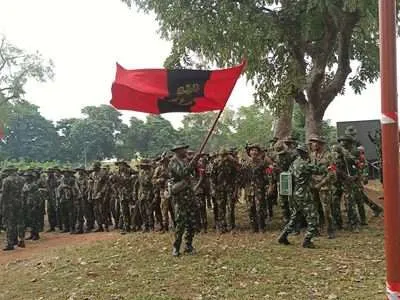
    Over the weekend, troops from “Operation UDO KA II” launched clearance operations in Imo and Anambra, resulting in the arrest of a suspected terrorist and the recovery of materials for making Improvised Explosive Devices (IEDs), motorcycles, stored provisions, and other logistical items within the terrorists’ camps. The operations were carried out in Lilu community and Orsumoghu Forest in Orsu Local Government Area of Imo, as well as in Ihiala Local Government Area of Anambra.

    During these clearance operations, the troops encountered various obstacles and successfully detonated numerous IEDs. They also engaged with terrorists who fled into nearby forests with gunshot wounds due to the troops’ superior firepower. Several terrorist camps and shrines were destroyed during these operations.

    The Acting Deputy Director of Army Public Relations for the 82 Division in Enugu, Lt.-Col. Jonah Unuakhalu, urged law-abiding citizens in the Southeast region to continue providing timely, credible, and reliable information to security agencies, particularly to “Operation UDO KA II.” Such information could lead to the apprehension of individuals who escaped with gunshot wounds.

    Unuakhalu also called on the people of the Southeast region to disregard deceptive tweets from self-proclaimed Biafra leader Simon Ekpa. He assured law-abiding residents that the region will be rid of criminal activities, as “Operation UDO KA II” remains committed to combating crime and criminality in accordance with established rules and regulations.

  • Analysts Express Concerns Over Timing Of Lifting Forex Ban on 43 Items

    Analysts Express Concerns Over Timing Of Lifting Forex Ban on 43 Items

    The recent decision by the Central Bank of Nigeria (CBN) to lift the foreign exchange restriction on 43 items is seen as a move that could potentially boost market confidence.

    However, analysts argue that the timing of this decision is challenging, given the current global economic context, where capital flows are unfavorable for emerging economies.

    According to analysts at Afrinvest, the policy has good intentions as it aims to cautiously restore market confidence, which has been undermined by liquidity issues and previous unconventional policies. Nevertheless, the analysts highlight the unfavorable timing, as developed markets are experiencing moderating inflation, which supports improved real rates of return, while emerging markets face forex volatility, high inflation, and political uncertainty, which compound investment risks.

    Afrinvest recommends that the CBN should implement complementary policies to attract the necessary forex to achieve its objectives. They suggest seeking concessionary loans from bilateral and multilateral institutions to bolster foreign reserves. They also advise exploring oil-for-loan agreements to unlock liquidity, along with stronger efforts to combat oil theft and enhance oil production.

    The analysts cite data from the Nigerian Upstream Petroleum Regulatory Commission, which reveals a 14.0% month-on-month increase in the nation’s oil output to an average of 1.35 million barrels per day (excluding condensates) in September 2023. This marks the highest level since January 2022, and they attribute the improvement to the government’s commitment to curbing oil theft and bolstering fiscal capacity.

    Afrinvest emphasizes that the success of the CBN’s decision to reverse the forex ban on 43 items hinges on its ability to provide sufficient liquidity to meet the demand at the official window. They predict that, with adequate liquidity, the parallel market premium will gradually decline, but insufficient liquidity could lead to increased pressure in both the official and parallel markets.

    The analysts advocate a long-term approach to addressing Nigeria’s forex challenges, including containing oil theft, boosting non-oil exports, and encouraging cross-border investment in technology and service-based sectors.

    The CBN recently reaffirmed its commitment to enhancing foreign exchange liquidity and shared a 6-point plan to address forex challenges, including the lifting of the forex ban on 43 items. They also pledged to make regular market interventions and clear the current forex backlog.

    In 2015, the CBN, under the leadership of Godwin Emefiele, had imposed a forex ban on 43 items in an attempt to manage forex and promote import substitution. However, this policy failed to achieve its objectives due to misalignment with market forces and a lack of coordination between fiscal and monetary authorities, resulting in declining forex reserves and a weakening Naira. The decision to lift the forex ban is seen as a positive step to reduce pressure on the parallel market and curb speculative activities, potentially narrowing the gap between official and parallel market rates.