Author: Chike Ozohili

  • Nigeria-Morocco Gas Pipeline: NNPCL, ONHYM, others sign $25bn deal

    Nigeria-Morocco Gas Pipeline: NNPCL, ONHYM, others sign $25bn deal

    Nigeria-Morocco Gas Pipeline: NNPCL, ONHYM, others sign $25bn deal

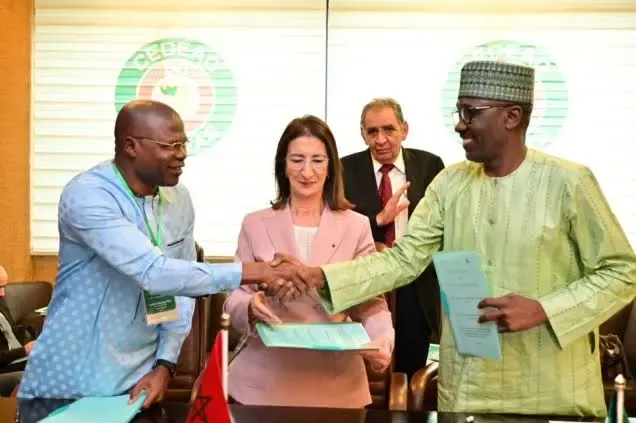
    The Nigeria-Morocco Gas Pipeline Project has advanced with the signing of four Memoranda of Understanding (MoU) to ensure progress and strategic direction of the $25 billion Trans-Atlantic gas pipeline project.

    Four MoUs were signed on Friday in Abuja at the Economic Community of West African States (ECOWAS) Headquarters during the project’s first Steering Committee Meeting.

    The agreements were signed between the Nigerian National Petroleum Company Limited (NNPC Ltd), Office National des Hydrocarbures et des Mines (ONHYM) of Morocco and the Société Nationale des Opérations Pétrolières of Cote d’Ivoire (PETROCI),

    Others include the National Oil Company of Liberia (NOCAL), the Société Nationale des Hydrocarbures of Benin (SNH-Benin), and the Société Nationale des Pétroles of the Republic of Guinea (SONAP).

    Once completed, the project will enhance the monetisation of the natural gas resources of the affected African countries and also offer a new alternative export route to Europe.

    Malam Mele Kyari, Group Chief Executive Officer, NNPC Ltd, in his remarks disclosed that currently, FEED Phase II Study was at over 70 percent in tendering process for the surveys, with clear visibility in project funding.

    Kyari listed the surveys as the Environmental and Social Impact Assessment (ESIA) and the Land Acquisition and Resettlement Policy Framework (LARPF).

    “We are also pleased to welcome our counterparts from NOCAL of Liberia, PETROCI of Cote D’Ivoire, SNH Benin and SONAP of Guinea for committing to collaborate with us on this project through the execution of MoU.

    “This is a clear demonstration of the commitment of the Host Governments, the ECOWAS Commission, and the National Oil Companies to deliver on this strategic project, create wealth and value for our countries and other stakeholders.

    “As you are aware, our collective decisions and actions guided by our shared vision would extend far beyond gas supply to spur prosperity and economic integration between our nations,’’ he said.

    Kyari, while expressing appreciation to President Bola Tinubu for entrusting NNPC Ltd. with the strategic project, acknowledged ECOWAS Commission’s role in co-hosting the meeting in addition to planned execution of the Treaty, Host Government Agreements and other enablers.

    Also speaking, the Director-General of ONHYM, Madam Amina Benkhadra said that the gathering represented a progressive step in ensuring social and economic development through energy security and accessibility geared towards attaining total development of Africa by Africans.

    In his remarks, the ECOWAS Commissioner for Infrastructure, Energy and Digitisation, Mr Sédiko Douka said the pipeline was designed from Nigeria to Morocco, passing through Atlantic Coast States, with inland ramps to supply the Interland Countries, possibly to Europe.

    “The project will strengthen our electricity production/generation capacity, stimulate industrial, agricultural development, and contribute to the energy transition by using a source of energy that is cleaner than other fossil fuels,’’ he said.

    He recalled that the Steering Committee, which was enlarged to include other stakeholders, was part of the dynamics of the MoU signed between the ECOWAS Commission, NNPC and ONHYM on Sept. 15, 2022, in Rabat, Morocco.

    He recalled that ECOWAS was engaged further to the instructions of the Heads of State and Government in the development of the West Africa Gas Pipeline Extension Project (WAGPEP), through a feasibility study approved in 2018.

    He said at the same time, Nigeria and Morocco, through NNPC Ltd and ONHYM, also agreed to initiate the Nigeria-Morocco Gas Pipeline Project (NMGP).

    “The similarities between the two projects soon became apparent, and so, the need for synergy to pool efforts in order to achieve a single gas pipeline project.

    “Today, we can assure you that the ECOWAS member States are fully committed to this structuring Project.

    “As proof, the statutory bodies of ECOWAS have ratified the decision to merge the projects into a single one,’’ he said.

    The ECOWAS-ONHYM-NNPC Steering Committee meeting for development of a single gas pipeline had representatives from Nigeria, Benin, Togo, Ghana, Côte d’Ivoire, Liberia, Sierra Leone, Guinea, Guinea-Bissau, The Gambia, Senegal, Mauritania, and Morocco.

  • Agbebaku emerges Speaker of Edo 8th Assembly

    Agbebaku emerges Speaker of Edo 8th Assembly

    Mr Blessing Agbebaku (PDP-Owan West), on Friday emerged as Speaker of the 8th Edo House of Assembly.

    Agbebaku was the Chief of Staff to the immediate past Speaker, Marcus Onobun

    He was elected by the lawmakers shortly after a letter of proclamation of the assembly by Governor Godwin Obaseki was read on the floor of the House by the Clerk, Mr Yahaya Omogbai, in Benin.

    Mrs Maria Edekor (PDP-Esan North East II) was elected as the Deputy Speaker of the House.

    The 24 members-elect were also inaugurated into the 8th assembly.

    Speaking shortly after taking his oath of office, Agbebaku promised a unified Assembly that would move the state to greater heights through effective legislation.

    He thanked God for his protection and guidance throughout the electoral process and for his emergency as the speaker.

    He expressed gratitude to his colleagues for giving him the privilege and for believing in his capacity and competence to serve as speaker.

    “Choosing me to lead this assembly is a great honour and privilege bestowed upon me with a sense of responsibility and acceptance.

    “I will not take this position for granted. I will carry everyone along irrespective of their political affiliations.

    “I commend the 7th assembly for setting the template in legislative activities which has placed the assembly on the right track.

    “I assure all that we will put Edo people first as we perform our oversight functions and make the state great again,” he said.

    Agbebaku finally thanked Governor Obaseki and his deputy, Philip Shaibu, for leading the party in the right direction.

  • Just in: Tinubu, Sanusi in closed-door meeting

    Just in: Tinubu, Sanusi in closed-door meeting

    Former Central Bank of Nigeria Governor, Sanusi Lamidi Sanusi, is currently meeting with President Bola Tinubu. 

    The meeting, which is ongoing at the Aso Rock Villa with the former Emir of Kano, Sanusi Lamido Sanusi, at the State House, is not unconnected with the current vacant position at the Apex Bank.

    Though the agenda of the meeting is not known, there are speculations that it could be connected to the suspension of Godwin Emefiele as CBN Governor. 

    Sanusi served as CBN boss between June 2009 and June 2024. 

    President Bola Ahmed Tinubu, last Friday, suspended Godwin Emefiele as CBN Governor, ordering him to hand over to deputy governor operators, Folashodun Shonubi till investigation into his activities are concluded. 

    More details later…

  • Anambra targets N160bn revenue from palm oil, coconut

    Anambra targets N160bn revenue from palm oil, coconut

    The Anambra Government says it hopes to rake in more than N160 billion yearly from ongoing palm oil and coconut investment.

    Dr Onyekachi Ibezim, Deputy Governor of the state made this known while inaugurating the 2023 Farming Season at Alex Ekwueme Square Awka.

    Ibezim who represented the governor at the event said the anticipated revenue was from one million palm seedlings and one million coconut being imported from Malaysia.

    “We started importation of one million palm oil seedlings and one million coconut from Malaysia last year, these species have three years maturity period.

    “When this investment fully matures, the off-takers will be processing the fruits of these plants and over N160 billion will be yearly income from this window”, he said.

    Ibezim also said there is a plan for irrigation of 10,000 hectares of land for rice farming at Ifite Ogwari Community, Ayamelum Local Government Area for rice cultivation.

    He said that agriculture has the potential of not only creating wealth but employment opportunities for thousands of people.

    Ibezim said it was for the abundance of opportunities in the sector that the government listed it among the priority area of investment in the 50 years development plan of the state.

    He called on farmers to show commitment to the sector as the government will always support them in their activities.

    Also speaking, Dr Foster Ihejiofor, the Commissioner for Agriculture said the state is currently promoting the “Biological Farming” practice which according to him is nature’s sustainability solution.

    “As we all know farming is not about producing food; it is about preserving our environment and ensuring the sustainability of our food system.

    “Biological farming aka, zero budget, carbon farming or regen-Ag launched in 2022 by Gov. Chukwuma Soludo is a sustainable agricultural system”, he said.

    Ihejiofor urged farmers to embrace the new farming system, saying ”Biological farming is not just environmentally friendly, it is also economically beneficial to farmers as it reduces the cost of inputs while improving soil health, plants health, nutrients among others.

    The event was attended by farmers from the 21 Local Government Areas and tertiary institutions within the state.

  • Bears intervene as equity market dips by N430bn

    Bears intervene as equity market dips by N430bn

    Trading activities on the floor of Nigerian Exchange on Thursday returned to negative trend, declining by N430 billion.


    Market capitalisation of listed equities on Thursday dropped by 1.32 per cent to N32.232 trillion from N32.662 trillion reported on Wednesday.


    Also, the NGX All Share Index also depreciated by 789.89 basis points to 59195.21 points from 59985.10 points traded the previous day.


    A review of the trading for the day showed that MRS Plc, Transco Hotel and Total Plc led gainers table during the day appreciating by 10 per cent each to close at N68.75, N13.31 and N336.70 per shares respectively. Ikeja Hotel followed with a gain of 9.97 per cent to close at N3.31 per share, ETranzact added 9.92 per cent to close at N5.32 per share.


    On the contrary, SUNU Assurance topped losers chart in percentage terms, declining by 10 per cent to close at N0.45 per unit, Cornerstone Insurance trailed with a loss of 9.73 per cent to close at N1.02 per share, Mcnichols fell by 9.33 per cent to close at N0.68 per share, Access Corp fell by 9.24 per cent to close at N14.25 per unit, RTBriscoe fell by 8.83 per cent to close at N0.31 per unit.


    Investors traded 1.170 billion shares valued at N15.359 billion in 12611 deals against 1.296 billion shares worth N21.080 billion in 11947 deals.


    Transactions in the shares of United Bank for Africa led activity during the day, with 192.832 million shares valued at N2.344 billion, AccessCorp followed with account of 121.537 million shares valued at N1.962 billion, Fidelity Bank traded 102.638 million shares valued at N726.740 million, GTCO Plc exchanged 99.847 million shares worth N3.325 billion while Sterling Bank traded 79.277 million shares cost N238.314 million.

    Bears intervene as equity market dips by N430bn

    Trading activities on the floor of Nigerian Exchange on Thursday returned to negative trend, declining by N430 billion.


    Market capitalisation of listed equities on Thursday dropped by 1.32 per cent to N32.232 trillion from N32.662 trillion reported on Wednesday.


    Also, the NGX All Share Index also depreciated by 789.89 basis points to 59195.21 points from 59985.10 points traded the previous day.


    A review of the trading for the day showed that MRS Plc, Transco Hotel and Total Plc led gainers table during the day appreciating by 10 per cent each to close at N68.75, N13.31 and N336.70 per shares respectively. Ikeja Hotel followed with a gain of 9.97 per cent to close at N3.31 per share, ETranzact added 9.92 per cent to close at N5.32 per share.


    On the contrary, SUNU Assurance topped losers chart in percentage terms, declining by 10 per cent to close at N0.45 per unit, Cornerstone Insurance trailed with a loss of 9.73 per cent to close at N1.02 per share, Mcnichols fell by 9.33 per cent to close at N0.68 per share, Access Corp fell by 9.24 per cent to close at N14.25 per unit, RTBriscoe fell by 8.83 per cent to close at N0.31 per unit.


    Investors traded 1.170 billion shares valued at N15.359 billion in 12611 deals against 1.296 billion shares worth N21.080 billion in 11947 deals.


    Transactions in the shares of United Bank for Africa led activity during the day, with 192.832 million shares valued at N2.344 billion, AccessCorp followed with account of 121.537 million shares valued at N1.962 billion, Fidelity Bank traded 102.638 million shares valued at N726.740 million, GTCO Plc exchanged 99.847 million shares worth N3.325 billion while Sterling Bank traded 79.277 million shares cost N238.314 million.

  • Tinubu directs NSIB to probe Kwara boat mishap

    Tinubu directs NSIB to probe Kwara boat mishap

    President Bola Ahmed Tinubu has directed the Nigerian Safety Investigation Bureau (NSIB) ACT 2022 to investigate the boat mishap that occurred at Kpada community in Pategi Local Government Area of Kwara State, on Monday night, June 12, 2023.

    The General/ Manager/CEO of the Bureau, Akin Olateru while briefing newsmen in Abuja on Thursday, explained that reports gathered thus far, say the boat was carrying about 250 passengers from a village called Egboti in Niger State.

    He called on other local, state, and federal agencies and other relevant stakeholders to maintain effective cooperation and collaboration so as to ensure transportation safety.

    He said information received also revealed that 106 fatalities have been recorded while 144 passengers have so far been rescued.

    According to him, the NSIB is an autonomous multimodal investigation agency charged with the mandate to investigate air, rail, marine and other modes of transportation accidents and serious incidents in Nigeria with the aim of identifying the probable causes and proffer safety recommendations that can prevent recurrences.

    “The purpose of accident investigation, however, is not to apportion blame or liability but to prevent future recurrence of similar incidents. 

    “In order to carry out this mandate, the Bureau would be carrying out a lot of fact findings through crew and passenger interviews, working with relevant authorities to be able to determine the probable cause(s) of this accident. 

    “We are committed to a swift response to the accident and serious incident occurrences through our well-equipped Command and Control Centre. 

    “Accident reporting has also been simplified through our Mobile Application, which was introduced to interface with the public and make it easy for them to communicate with NSIB digitally,” he said. 

    He solicited information from the public in the form of pictures, video, or recording evidence to help assist in conducting a comprehensive investigation. 

  • $6trn wasted on subsidies can address climate change – World Bank

    $6trn wasted on subsidies can address climate change – World Bank

    Trillions of dollars are wasted on subsidies for agriculture, fishing, and fossil fuels that could be used to help address climate change instead of harming people and the planet, a World Bank report says.

    The report, Detox Development: Repurposing Environmentally Harmful Subsidies, says global direct government expenditures in the three sectors are $1.25 trillion a year—around the size of a big economy such as Mexico.

    To subsidize fossil fuel consumption, countries spend about six times what they pledged to mobilize annually under the Paris Agreement for renewable energies and low-carbon development.

    “People say that there isn’t money for climate but there is – it’s just in the wrong places. If we could repurpose the trillions of dollars being spent on wasteful subsidies and put these to better, greener uses, we could together address many of the planet’s most pressing challenges,” said Senior Managing Director of the World Bank, Axel vanTrotsenburg.

    The report notes that government subsidies of $577 billion in 2021 to artificially lower the price of polluting fuels, such as oil, gas, and coal, exacerbate climate change, and cause toxic air pollution, inequality, inefficiency, and mounting debt burdens. Redirecting these subsidies could unlock at least half a trillion dollars toward more productive and sustainable uses.

    The problem is bigger than direct government expenditures. The report assesses the harmful impact of implicit subsidies, which amount to $6 trillion each year. These represent the costs on people and the planet from pollution, greenhouse gas emissions, road congestion, and the destruction of nature ultimately resulting from the subsidies.

    In agriculture, direct subsidies of more than $635 billion a year are driving the excessive use of fertilizers that degrade soil and water and harm human health. Subsidies for products such as soybeans, palm oil, and beef cause farmers to push into the forest frontier and are responsible for 14 percent of forest loss every year.

    Fisheries subsidies, which exceed $35 billion each year, are a key driver of dwindling fish stocks, oversized fishing fleets, and falling profitability. With more than 1 billion poor people obtaining most of their animal protein from fish, it is critical that the world’s fish stocks are restored to healthy status.

    The burning of oil, gas, and coal causes 7 million premature deaths a year around the world through the bad air that people must breathe. The burden falls mostly on the poor.

    Chief Economist of the Sustainable Development Practice Group at the World Bank Richard Damania, noted that “With foresight and planning, repurposing subsidies can provide more resources to give people a betterquality of life and to ensure a better future for our planet. Much is already known about bestpractices for subsidy reform, but implementing these practices is no easy feat due to entrenched interests,challenging political dynamics, and other barriers.”

    For successful subsidy reform, governments must compensate the most vulnerable groups through social assistance programs, like cash transfers; build public acceptance through transparent communication; give people and businesses time to adjust; as well as show how freed-up revenue is being reinvested to support longer-term development.

  • CBN collapses all forex markets into I&E window

    CBN collapses all forex markets into I&E window

    The Central Bank of Nigeria has released new operational changes to the foreign exchange market in the country.

    The Apex bank in the new operational changes abolished all segments of the foreign market and collapsed them into the Investors and Exporters (I&E) window.

    It said in the guideline signed by Angela Sere-Ejembi, Director, Financial Markets that applications for medicals, school fees, BA/PTA, and SMEs would continue to be processed through deposit money banks.

    In the new changes, the CBN reintroduced the “Willing Buyer, Willing Seller” model at the I&E Window.

    It stated that operations in this window would be guided by the extant circular on the establishment of the window, dated 21 April 2017 and referenced FMD/DIR/CIR/GEN/08/007.

    It added that all eligible transactions are permitted to access foreign exchange at this window.

    The CBN stated that the operational rate for all government-related transactions shall be the weighted average rate of the preceding day’s executed transactions at the I&E window, calculated to two (2) decimal places.

    It also announced the proscription of trading limits on oversold FX positions with permission to hedge short positions with OTC futures, adding that the limits on overbought positions shall be zero.

    The apex bank also announced the re-introduction of order-based two-way quotes, with bid-ask spread of A1. All transactions, it added must be cleared by a Central Counter Party (CCP).

  • Data Protection Act: Commission, stakeholders applaud Tinubu

    Data Protection Act: Commission, stakeholders applaud Tinubu

    The Nigeria Data Protection Commission (NDPC), formerly Nigeria Data Protection Bureau (NDPB), has commended President Bola Tinubu on the signing of the Nigeria Data Protection Act 2023.

    The Nigeria Data Protection Act, 2023, provides a legal framework for the protection of personal information and the practice of data protection in Nigeria.

    Dr Vincent Olatunji, the National Commissioner, NDPC, made the commendation at the NDPB’s Strategic Roadmap and Action Plan (SRAP) validation workshop on Wednesday in Abuja.

    The Bill was introduced to the Senate and House of Representatives for consideration and passage on Tuesday, April 4, 2023, via a letter from former President Muhammadu Buhari.

    Now an Act, the new law establishes the NDPC and replaced the NDPB established by Buhari in February 2022.

    Olatunji said: “I am happy to announce that data protection ecosystem is really growing.

    “The Nigeria Data Protection Bureau is now a Commission by law. Nigeria now has its Data Protection Act signed by President Bola Ahmed Tinubu on June 12.”

    He appreciated the efforts of the former administration of  Buhari who started the journey under the former Minister of Communications and Digital Economy, Prof. Isa Pantami.

    The national commissioner stressed the need for effective partnership and stakeholder engagement especially in the areas of awareness and sensitisation.

    “We need to work together as government, private sector, academia, civil society groups.

    “We agree that Nigeria is well positioned to move data protection ahead in Africa, the whole of Africa is waiting for us,” he said.

    He disclosed that over 500,000 job opportunities had been identified in the data protection and privacy ecosystem which was in line with one of the campaign points of the current administration to create one million jobs in the digital economy sector in 12 months.

    Olatunji, however, buttressed the need to bridge the huge gap that existed in the data protection ecosystem that had the capacity to create wealth and millions of jobs for Nigerians and promote the digital economy.

    Mr Williams Ojo, the Permanent Secretary of the Ministry of Communications and Digital Economy, reaffirmed the government’s commitment to fostering a culture of trust and accountability in the digital sphere.

    “We can create an ecosystem that protects the rights of individuals while fostering a vibrant and innovative digital economy.

    “Together, let us embark on this validation workshop with a shared vision, a vision of a Nigeria where personal data is treated with the utmost respect, where individuals have control over their own information, and where innovation thrives in an environment of trust,” he said.

    Mr Kashifu Inuwa, the Director-General of National Information Technology Development Agency (NITDA), said data was the currency of digital economy, urging the meeting to look at the key principles for data protection.

    “We need to prioritise freedom and rights of our citizens, promote transparency, accountability and foster an enabling environment for innovation and economic growth.

    “We can only create jobs when we are innovative and look at how we can create prosperity in our country,” he said.

    Dr Abdul-Hakeem Ajijola, the Chairman, Committee on the Action Plan, said the roadmap was intended to help identify some of the things needed to build the ecosystem.

    Ajijola emphasised the need for more awareness and sensitisation to build a robust, inclusive and viable data protection and privacy ecosystem.

  • Subsidy: Marketers lament delay in payments

    Subsidy: Marketers lament delay in payments

    Natural Oil and Gas Suppliers Association of Nigeria (NOGASA) has disclosed that its members now spend as much as N25 million to purchase a 45,000 litres truck of Premium Motor Spirit popularly referred to as petrol.

    Before the subsidy was withdrawn, a fuel tanker was purchased for N7 million. 

    According to NOGASA, the situation has made it impossible for its members to cough out the differentials.

    National President of NOGASA, Mr. Bennett Korie, who revealed this Wednesday in Abuja, insisted that there is need to also consider the problems associated with the removal.

    “We are 100 percent in support of subsidy removal, but you know that everybody is talking about subsidy removal but they don’t talk about the problem behind the subsidy removal. It is good to remove subsidies but there are things that people don’t know, for instance, some of the marketers don’t have the money to pay differentials. 

    “This is because in less than an hour that Mr. President announced the removal of the subsidy, the price changed and that affected a lot of marketers. We are talking about millions of naira. Before the removal, a tanker of fuel was selling for about seven million, but in less than an hour, it went up to 25 million naira, where is the money?” he lamented.

    Korie said that Nigeria’s high interest rate of 30 percent was making it difficult for marketers to make profits. According to him, where would marketers get money from to continue the distribution of petroleum products across the country.

    He urged the federal government to pay marketers their outstanding of the Petroleum Equalization Fund (PEF) to boost their Capita and enable them stay in business.

    “Subsidy was removed without considering some of these problems. At the same time, before now, we have this PEF.  But they are not paying the marketers. There is no money, where do we get the money?

    “Therefore, I want to use this opportunity to appeal to the government to please pay marketers their PEF, so that they will continue in business, if it is not paid, we would not get fuel to sell,” he said.