The Minister of Works, Engr. David Umahi, expressed serious dissatisfaction with the state of the East-West Road in Rivers State, describing it as a failed project.
Umahi, during his inspection of a portion of the road, ordered an immediate halt to construction work and announced that the entire project would undergo a thorough review.
The Minister’s concerns about the poor quality of the project led him to summon the contractor responsible for the road to Abuja for an explanation of the failures observed.
Umahi emphasized that the road had deteriorated to an unacceptable level, rendering it unusable.
He criticized the ongoing construction work, asserting that it was unacceptable for roads to fail so quickly after construction.
He expressed concern that Nigeria was not receiving value for money on infrastructure projects, especially considering the significant investment made in the East-West Road.
Umahi revealed that the project’s cost had escalated from N44 billion to N144 billion without a corresponding improvement in its quality. He insisted that proper construction standards must be adhered to, and called for a meeting with the project manager to address the issues and ensure Nigerians received the quality infrastructure they deserved.
The Minister’s firm stance on the matter highlighted the need for accountability and quality assurance in infrastructure projects, emphasizing that Nigerians should demand better construction standards and value for the funds invested in such projects.
The Chief Justice of Nigeria (CJN), Justice Olukayode Ariwoola, reiterated Nigeria’s position as one of the most litigious countries globally on Wednesday. He noted that the judiciary was facing challenging times due to a continuous surge in pending cases across various courts.
To combat this trend, the CJN urged Nigerians to embrace alternative dispute resolution methods, reducing the burden on courts and preserving valuable resources.
Justice Ariwoola made these remarks at the Supreme Court while swearing in nine newly appointed Justices of the Court of Appeal. He attributed the rise in litigation to an increase in novel crimes within the country.
Political cases, in particular, have placed significant strain on the judicial system, resulting in growing caseloads for courts across the nation. Justice Ariwoola stressed the need for a shift toward alternative dispute resolution, emphasizing that it was essential to unburden the judiciary and conserve resources.
He encouraged the newly appointed Appeal Court Justices to remain committed to upholding the law and avoiding corruption and temptation. The CJN reminded them that their oaths of office signified a solemn commitment to ethical conduct in their roles as senior judicial officers in the appellate court.
Justice Ariwoola concluded by urging the justices to uphold their integrity and reputation, as they would inevitably encounter high-profile cases and tempting offers that could compromise their moral standing. He emphasized the importance of conducting their affairs within the bounds of the law and the oaths they had taken.
The CJN highlighted the heightened public scrutiny they would face and the need to maintain their commitment to justice and ethics. He reminded them that it was easier to follow the crowd but far more meaningful to stand alone with a clear conscience.
The Nigerian Communications Commission (NCC), in keeping with its responsibilities under the enabling law, the Nigerian Communications Act (NCA) 2003, to manage Nigeria’s numbering resources, has announced a new numbering format for fixed lines.
According to a statement signed by Director, Public Affairs NCC Reuben Muoka, Nigeria’s Fixed-Lines Numbering Format has changed from eight digits to 10 digits by adding “02” prefix before the existing fixed number.
It said that from January 1, 2024, the new numbering format beginning with “02” prefix will be operational.
It however, said the change only affects the Fixed Telephone Numbers.
“There is no change to the existing mobile numbering format,” it said.
“The Commission hereby informs the public of the changes and also clarifies that existing numbers will continue to operate concurrently till the cut-over date of December 31, 2023. From January 1, 2024, the new numbering format beginning with “02” prefix will be operational.
“In other words, the old and new number formats are allowed to run concurrently till the cut-over date (December 31, 2023). Thereafter (from January 1, 2024), the new fixed-lines format will assume full recognition across all networks.
“For example, in the new order, to dial the hitherto existing number, 09461700, please dial 02094617000.
“Additional examples are: For Lagos, Abuja, Port Harcourt and Kano’s current number format of 014630643, 094630643, 084460643 and 064460643, will now be 02014630643, 02094630643, 02084460643 and 02064460643 respectively in the new numbering format.
“The announcement is made to give expression to a key responsibility of the NCC and it is consistent with the practices of the International Telecommunication Union (ITU), the United Nations arm supervising Information and Communication Technologies (ICT),” the statement read.
The Orinono Community Centre in Kogi State has lodged a formal complaint with the Inspector General of Police (IGP) against Mr. Ujah Sani Simeon, the Ejeh of Olamaboro, accusing him of fraudulent mining license acquisition without the consent of the host community.
In a petition dated September 20, 2023, titled “Petition Against Mr. Ujah Sani Simeon, The Ejeh Of Olamaboro Local Government, Kogi State, Hon. Agwoka Peter Abah, Mr. Yusuf Akahaka Iduh, Mr. Musa Balla, Matigo Oguche, Achema Joseph Akor Omale, And Luke Usman,” the community demanded a thorough investigation into the matter.
According to the petition, Mr. Ujah Sani Simeon, who is not a member of Orinono Community, allegedly forged signatures of some community members to fraudulently obtain a small-scale mining lease without their consent. The lease was granted in his personal name on May 22, 2023.
The Orinono Community’s lawyer, Ojonimi S. Apeh Esq., stated that attempts to amicably resolve the dispute had failed. The community claims that Simeon has been resorting to threats, including threats of violence and kidnapping, to maintain his authority as the Ejeh of Olamaboro.
The petition highlighted that Olamaboro Local Government Area (LGA) comprises several communities, each with its respective Chiefs (Gagos) and Chiefdoms, pre-dating the creation of the local government and the state itself. Orinono Centre is an ancient community with its own Chief (Gago) and Chiefdom, where coal, a valuable solid mineral, is discovered.
Trouble began when the community discovered on August 4, 2023, that their village stream, the sole source of water, was contaminated due to illegal mining activities by Simeon and his security personnel. The Ministry of Mines was informed, which prompted an investigation and a directive to Simeon to suspend further mining activities, a directive he allegedly ignored. Instead, he continued mining and hired more security personnel, causing security breaches in Orinono Centre.
The community further claimed that the clandestine activities of Simeon and his security personnel have led to crimes within the community, leaving residents in fear of kidnapping, violence, and assault.
The petition also accused specific individuals, including Hon. Agwoka Peter Abah, Mr. Yusuf Akahaka Iduh, Mr. Musa Balla, Matigo Oguche, Achema Joseph Akor Omale, and Luke Usman, of vandalizing properties and destroying farmlands in the community.
The Orinono Community Centre called on the IGP to investigate the alleged criminal activities, ensure justice is served, and safeguard the security and well-being of its members.
The police command in Delta has killed four members of a gang which specialised in kidnapping.
The spokesman for the command, DSP Bright Edafe, disclosed this on Wednesday in Warri.
Edafe said that the hoodlums were killed on Monday by operatives of the command during a patrol on the Jesse/ Igueleba Road.
He said that the armed gang members sighted the patrol vehicle from their hideout, deflated its front tyre and engaged the patrol team on a gun duel.
“Due to reported incidents of kidnapping on Jesse axis of the state, the Commissioner of Police, Mr Wale Abass, directed deployment of operatives of the Special Anti-kidnapping and Cyber Crime Squad and DOPS Bufallo team, among others, to the area.
“Consequently, on Sept. 18, during a joint patrol on Jesse – Igueleba Road, the team encountered a gang of armed bandits who laid ambush to attack and kidnap unsuspecting motorists.
“The hoodlums fired at the front tyre of the lead pickup van; thus, demobilising the vehicle.
“They were swiftly engaged in a gun duel by the police team. The armed bandits eventually succumbed to the superior firepower of the policemen,” he said.
According to the spokesman, the police team pursued the bandits into a deep forest during which four of them were killed.
The police spokesman said that one Ak-47 rifle with 20 rounds of live ammunition, two locally-made cut-to-size guns and cartridges were recovered from them.
The Anambra government has met with leadership of the Independent Petroleum Marketers Association of Nigeria (IPMAN) over debt claims by some marketers who supplied diesel for streetlight generating sets.
Mr Tony Collins Nwabunwanne, the state Commissioner for Local Government, Chieftaincy and Community Affairs, led the government team while Mr Chinedu Anyaso, chairman of IPMAN Enugu Depot Community, led the marketers in company of his executive members and some of the contractors.
Speaking to newsmen, Nwabunwanne said the delay in payment was due to discrepancies and bloated bills which some of the contractors submitted.
The Commissioner, who described meeting with the marketers as productive, said Anambra government was willing and ready to pay the contractors as soon as the inconsistencies in claims are cleared.
He promised to present their plights to the governor in the coming days for his consideration.
“We had a fruitful meeting, the marketers agreed that the blame is not entirely on government but that of the contractors, some of whom have made bloated claims.
“But we have considered all that, we are making the necessary adjustments and very soon, Mr Governor, Prof Chukwuma Soludo, will issue a directive,” he said.
On his part, Anyaso thanked the Commissioner for his prompt response to their plea.
Anyaso said IPMAN was satisfied with the outcome of the meeting and was hopeful that Soludo would act swiftly as promised in the interest of marketers and contractors.
“I want to thank Gov. Soludo for the prompt response we got after complaining to him about the debt to our members and the effect on their businesses.
“The Commissioner explained the issues to us and we understand better, but more importantly, we look forward to the fulfillment of the promises made in the meeting,” he said.
IPMAN had complained about the non payment of about N900 million owed contractors and marketers who supplied diesel to the Anambra government for powering streetlight generators.
The Federal Government is committed and passionate about solving housing deficit in the country.
The Minister of Housing and Urban Development, Mr Ahmed Dangiwa, made the pledge when he received Governor Dikko Radda of Katsina State in Abuja.
“Since independence, Nigeria has struggled to provide decent housing for its citizens.
“In spite of numerous plans, initiatives, projects, and institutions introduced over the past 60 years, progress has been limited.
“With rapid population growth, these unsuccessful or suboptimal efforts have led to the accumulation of a significant housing shortage,’’ the minister said.
Dangiwa said, the housing sector remains far from where it should be in terms of meeting the needs of millions of Nigerians for decent shelter while contributing as a catalyst for economic growth, job creation, and poverty eradication.
“This is the challenge that President Bola Tinubu has put on my shoulders. With the grace of Allah, I am committed to putting in the hard work necessary to break the jinx of failure and achieve historic success.
“As part of our efforts to achieve this, we have outlined a series of housing reform initiatives in line with the Renewed Hope Agenda for Housing and Urban Development of President Tinubu.
“We plan to embark on a Stakeholder Engagement Drive with State Governors nationwide towards achieving it.
Commending the governor for his achievements within a short time, Dangiwa solicited the support of the indigenes of Katsina to ensure the Radda-led administration transforms the state.
‘His tireless efforts in improving security, education, agriculture, infrastructural development, and the welfare of our citizens is a testament to his vision for a prosperous Katsina.
‘As a fellow son of Katsina state, I am immensely proud of the momentum of achievements that he has recorded in such a short time and I pray to the Almighty to continue to grant him the wisdom, understanding, and good health to transform our state.
“As the Minister of Housing and Urban Development, I approach my work with the full understanding of the huge responsibility that accompanies it,’ he said.
The minister encouraged Governor Radda to deepen collaboration with key housing agencies, including the Federal Mortgage Bank of Nigeria, Federal Housing Authority, and the Family Homes Funds, to increase access to affordable housing for Katsina indigenes.
Earlier, Radda said that the provision of affordable housing remains part of its priority programmes to improve the lives of its citizens.
According to the governor, Katsina state is ready to collaborate with the Ministry of Housing and Urban Development to open the cities in the state.
“Urban renewal is one of the major priority of our administration.
“We want to expand our city, we are in the process of developing Katsina master plan which has expired in the last 30 years.
“So, urban renewal is one of the major focus of our administration and affordable housing to serve the people.
“So, we are thinking collaboration with the Housing and Urban Development Ministry to tap from your experiences to help us in achieving our goal of renewing our cities and towns in the state,’’ Radda said.
In a decisive ruling, the Bauchi State Governorship Election Petition Tribunal has upheld the electoral victory of Governor Bala Mohammed, representing the Peoples Democratic Party (PDP), in the gubernatorial election that took place on March 18th.
The tribunal unequivocally dismissed the petition that had been lodged by the All Progressives Congress (APC) and its gubernatorial candidate, the former Chief of Air Staff, Air Marshal Sadique Abubakar.
The three-member panel, presided over by Justice P.T Kwahar, delivered the judgment, affirming that there were no substantial grounds to annul the election, given that it had been conducted in strict adherence to the legal framework.
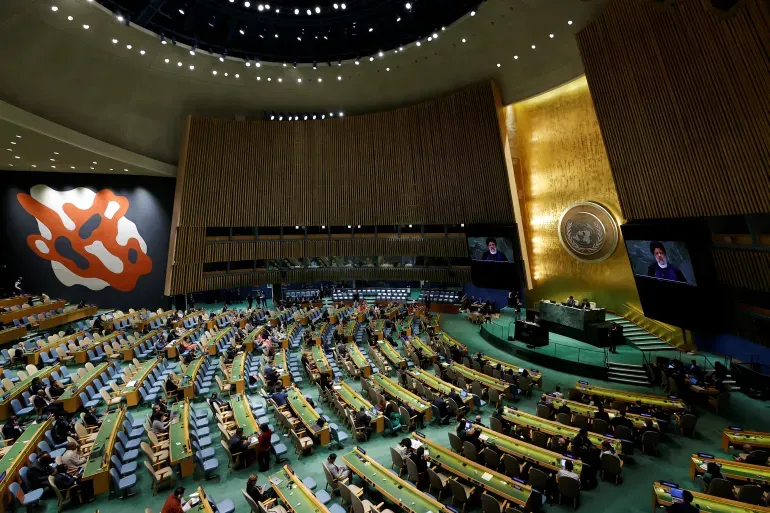
President Bola Ahmed Tinubu delivered his first address at the 78th Session of the United Nations General Assembly, emphasizing the importance of tackling Africa’s unique challenges and fostering global cooperation.
The speech, which was delivered in the early hours of Wednesday (7:55pm New York time), touched upon several critical issues affecting the African continent.
Tinubu began by congratulating the newly elected President of the General Assembly, acknowledging the efforts of his predecessor and applauding the Secretary-General of the United Nations, Antonio Guterres, for his work in seeking solutions to humanity’s common challenges.
In his address, Tinubu stressed the need for Africa to overcome the limitations imposed by foreign exploitation and realize its vast potential. He called for a firm commitment to partnership, urging global institutions, other nations, and the private sector to prioritize African development. He emphasized that this commitment should not only benefit Africa but also align with the interests of those involved.
Highlighting the economic challenges faced by Nigeria and Africa, he underlined the importance of job creation, industrial expansion, and equitable wealth distribution.
President Tinubu cited reforms initiated during his presidency, such as the removal of fuel subsidies and overhauling the exchange rate system, as steps toward fostering economic growth and investor confidence. He invited partnerships with nations and entities willing to engage with Africa on mutually beneficial terms.
Democratic governance was another crucial aspect of President Tinubu’s address.
He affirmed democratic governance as the best way to uphold the sovereign will and well-being of the people, opposing military coups and any civilian political arrangements perpetuating injustice.
Regarding the situation in Niger, President Tinubu mentioned ongoing negotiations with military leaders to reestablish democratic governance and address political and economic challenges in the nation.
President Tinubu also talked about the battle against violent extremism in the region, emphasizing the need to disband extremist groups and improve economic conditions to prevent people from seeking better opportunities elsewhere.
Concerning resource-rich areas, he called for measures to protect them from pilfering and conflict. He drew attention to the exploitation of resources in the Democratic Republic of the Congo and other regions, urging the international community to discourage firms and nationals from such activities.
Finally, Tinubu discussed the impact of climate change on Africa, emphasizing the need for continental efforts to combat it. He highlighted initiatives in Nigeria, such as the Green Wall project and mass distribution of gas-burning stoves, as examples of actions that align with economic development and environmental sustainability. He called for more investment from established economies to support Africa’s preferred climate change initiatives.
To conclude, Tinubu reiterated the importance of ending poverty, respecting the will of the people, and protecting the planet. He called for global solidarity and cooperation, emphasizing that Africa seeks genuine friendship and partnership on its transformative journey.
See the full speech below:
STATEMENT DELIVERED BY HIS EXCELLENCY, BOLA AHMED TINUBU, GCFR PRESIDENT, FEDERAL REPUBLIC OF NIGERIA AT THE GENERAL DEBATE OF THE 78TH SESSION OF UNITED NATIONS GENERAL ASSEMBLY, 18TH SEPTEMBER 2023
Mr. President,
Heads of State and Government, Secretary-General,
Distinguished Delegates, Ladies and Gentlemen,
Mr. President,
On behalf of the people of Nigeria, I congratulate you on your well-deserved election as President of this Session of the United Nations General Assembly.
We commend your predecessor, His Excellency, Mr. Csaba Korosi for his able stewardship of the Assembly.
We also commend His Excellency, Antonio Guterres, Secretary General of the United Nations, for his work seeking to forge solutions to humanity’s common challenges.
This is my first address before the General Assembly. Permit me to say a few words on behalf of Nigeria, on behalf of Africa, regarding this year’s theme.
On behalf of the people of Nigeria, I congratulate you on your well-deserved election as President of this Session of the United Nations General Assembly.
We commend your predecessor, His Excellency, Mr. Csaba Korosi for his able stewardship of the Assembly.
We also commend His Excellency, Antonio Guterres, Secretary General of the United Nations, for his work seeking to forge solutions to humanity’s common challenges.
This is my first address before the General Assembly. Permit me to say a few words on behalf of Nigeria, on behalf of Africa, regarding this year’s theme.
Many proclamations have been made, yet our troubles remain close at hand. Failures in good governance have hindered Africa. But broken promises, unfair treatment and outright exploitation from abroad have also exacted a heavy toll on our ability to progress.
Given this long history, if this year’s theme is to mean anything at all, it must mean something special and particular to Africa.
In the aftermath of the Second World War, nations gathered in an attempt to rebuild their war- torn societies. A new global system was born and this great body, the United Nations, was established as a symbol and protector of the aspirations and finest ideals of humankind.
Nations saw that it was in their own interests to help others exit the rubble and wasteland of war. Reliable and significant assistance allowed countries emaciated by war to grow into strong and productive societies.
The period was a highwater mark for trust in global institutions and the belief that humanity had learned the necessary lessons to move forward in global solidarity and harmony.
Today and for several decades, Africa has been asking for the same level of political commitment and devotion of resource that described the Marshall Plan.
We realize that underlying conditions and causes of the economic challenges facing today’s Africa are significantly different from those of post war Europe.
We are not asking for identical programs and actions. What we seek is an equally firm commitment to partnership. We seek enhanced international cooperation with African nations to achieve the 2030 agenda and Sustainable Development Goals.
There are five important points I want to highlight.
First, if this year’s theme is to have any impact at all, global institutions, other nations and their private sector actors must see African development as a priority, not just for Africa but in their interests as well.
Due to both longstanding internal and external factors, Nigeria’s and Africa’s economic structures have been skewed to impede development, industrial expansion, job creation, and the equitable distribution of wealth.
If Nigeria is to fulfil its duty to its people and the rest of Africa, we must create jobs and the belief in a better future for our people.
We must also lead by example.
To foster economic growth and investor confidence in Nigeria, I removed the costly and corrupt fuel subsidy while also discarding a noxious exchange rate system in my first days in office. Other growth and job oriented reforms are in the wings.
I am mindful of the transient hardship that reform can cause. However, it is necessary to go through this phase in order to establish a foundation for durable growth and investment to build the economy our people deserve.
We welcome partnerships with those who do not mind seeing Nigeria and Africa assume larger roles in the global community.
The question is not whether Nigeria is open for business. The question is how much of the world is truly open to doing business with Nigeria and Africa in an equal, mutually beneficial manner.
Direct investment in critical industries, opening their ports to a wider range and larger quantity of African exports and meaningful debt relief are important aspects of the cooperation we seek.
Second, we must affirm democratic governance as the best guarantor of the sovereign will and well-being of the people. Military coups are wrong, as is any tilted civilian political arrangement that perpetuates injustice.
The wave crossing parts of Africa does not demonstrate favour towards coups. It is a demand for solutions to perennial problems.
Regarding Niger, we are negotiating with the military leaders. As Chairman of ECOWAS, I seek to help re-establish democratic governance in a manner that addresses the political and economic challenges confronting that nation, including the violent extremists who seek to foment instability in our region. I extend a hand of friendship to all who genuinely support this mission.
This brings me to my third crucial point. Our entire region is locked in protracted battle against violent extremists. In the turmoil, a dark channel of inhumane commerce has formed. Along the route, everything is for sale. Men, women and children are seen as chattel.
Yet, thousands risk the Sahara’s hot sand and the Mediterranean’s cold depths in search of a better life. At the same time, mercenaries and extremists with their lethal weapons and vile ideologies invade our region from the north.
This harmful traffic undermines the peace and stability of an entire region. African nations will improve our economies so that our people do not risk their lives to sweep the floors and streets of other nations. We also shall devote ourselves to disbanding extremist groups on our turf.
Yet, to fully corral this threat, the international community must strengthen its commitment to arrest the flow of arms and violent people into West Africa.
The fourth important aspect of global trust and solidarity is to secure the continent’s mineral rich areas from pilfering and conflict. Many such areas have become catacombs of misery and exploitation. The Democratic Republic of the Congo has suffered this for decades, despite the strong UN presence there. The world economy owes the DRC much but gives her very little.
The mayhem visited on resource rich areas does not respect national boundaries. Sudan, Mali, Burkina Faso, CAR, the list grows.
The problems also knocks Nigeria’s door.
Foreign entities abetted by local criminals who aspire to be petty warlords have drafted thousands of people into servitude to illegally mine gold and other resources. Billions of dollars meant to improve the nation now fuel violent enterprises. If left unchecked, they will threaten peace and place national security at grave risk.
Given the extent of this injustice and the high stakes involved, many Africans are asking whether this phenomenon is by accident or by design.
Member nations must reply by working with us to deter their firms and nationals from this 21st century pillage of the continent’s riches.
Fifth, climate change severely impacts Nigeria and Africa. Northern Nigeria is hounded by desert encroachment on once arable land. Our south is pounded by the rising tide of coastal flooding and erosion. In the middle, the rainy season brings floods that kill and displace multitudes.
As I lament deaths at home, I also lament the grave loss of life in Morocco and Libya. The Nigerian people are with you.
African nations will fight climate change but must do so on our own terms. To achieve the needed popular consensus, this campaign must accord with overall economic efforts.
In Nigeria, we shall build political consensus by highlighting remedial actions which also promote economic good. Projects such as a Green Wall to stop desert encroachment, halting the destruction of our forests by mass production and distribution of gas burning stoves, and providing employment in local water management and irrigation projects are examples of efforts that equally advance both economic and climate change objectives.
Continental efforts regarding climate change will register important victories if established economies were more forthcoming with public and private sector investment for Africa’s preferred initiatives.
Again, this would go far in demonstrating that global solidarity is real and working.
CONCLUSION
As I close, let me emphasize that Nigeria’s objectives accord with the guiding principles of this world body: peace, security, human rights and development.
In fundamental ways, nature has been kind to Africa, giving abundant land, resources and creative and industrious people. Yet, man has too often been unkind to his fellow man and this sad tendency has brought sustained hardship to Africa’s doorstep.
To keep faith with the tenets of this world body and the theme of this year’s Assembly, the poverty of nations must end. The pillage of one nation’s resources by the overreach of firms and people of stronger nations must end. The will of the people must be respected. This beauty, generous and forgiving planet must be protected.
As for Africa, we seek to be neither appendage nor patron. We do not wish to replace old shackles with new ones.
Instead, we hope to walk the rich African soil and live under the magnificent African sky free of the wrongs of the past and clear of their associated encumbrances. We desire a prosperous, vibrant democratic living space for our people.
To the rest of the world, I say walk with us as true friends and partners. Africa is not a problem to be avoided nor is it to be pitied. Africa is nothing less than the key to the world’s future.
The Federal Government has urged the United Nations to support its efforts to achieve durable solutions to humanitarian crises.
Dr Betta Edu, Minister of Humanitarian Affairs and Poverty Alleviation, made the call during a high-level meeting with Mr Martin Griffiths, the coordinator under UN Secretary-General for Humanitarian Affairs and Emergency Relief.
This is contained in a statement by Edu’s aide of media, Mr Rasheed Zubair, in Abuja.
The meeting held on the sidelines of the ongoing 78th United Nations General Assembly (UNGA78) in New York.
She also briefed the meeting on President Bola Tinubu’s action plan to eradicate poverty.
The minister sought the support of UN for the presidential Humanitarian and Poverty Alleviation Trust Fund.
Other issues discussed during the high-level meeting centred on systematic and long-term response to Nigeria’s poverty under the SDGs target.
Edu also joined First Lady Oluremi Tinubu, at a side event to re-awaken Nigerians in Diaspora on the need to support the federal government’s renewed hope agenda.
She urged Nigerians in Diaspora to get involved, help to rebuild Nigeria’s economy and Nigerians out of poverty.