Tag: CENTRAL BANK OF NIGERIA

  • Nigeria Records 3.98% GDP Growth in Q3 2025, Misses Target

    Nigeria Records 3.98% GDP Growth in Q3 2025, Misses Target

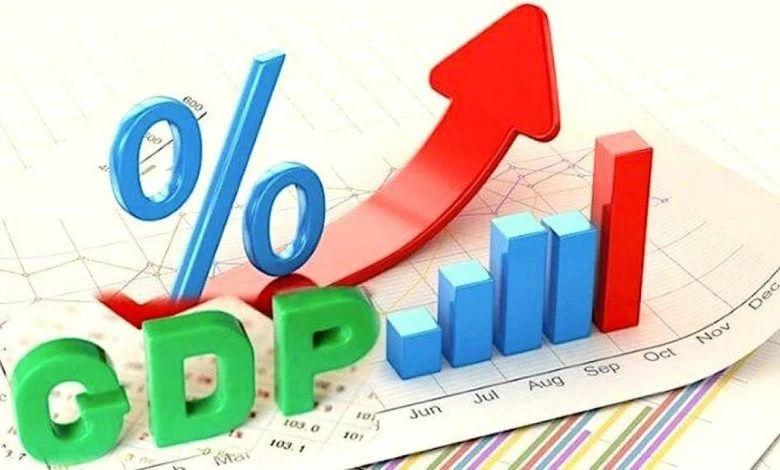
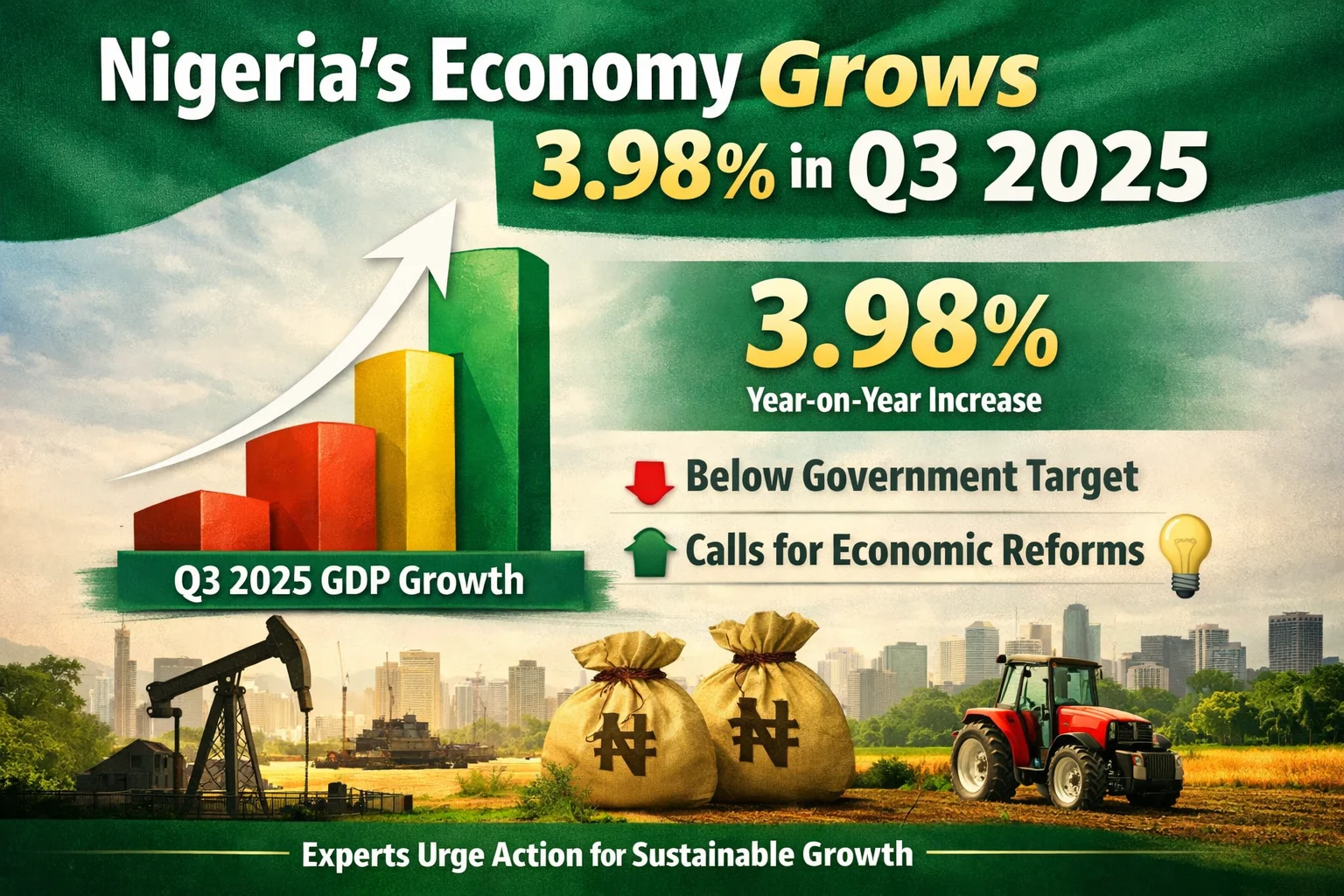
    Abuja / Lagos — Nigeria’s economy recorded a 3.98 per cent growth in the third quarter of 2025, a modest expansion that has intensified calls for decisive reforms to unlock faster, broader-based and more sustainable growth.

    The National Bureau of Statistics (NBS) said the Gross Domestic Product (GDP) grew in real terms on a year-on-year basis, reflecting increased output of goods and services across key sectors of the economy.

    However, the performance remains below the Federal Government’s 4.6 per cent growth target for 2025, and its long-term ambition of achieving about seven per cent annual growth needed to drive sustainable development.

    The Central Bank of Nigeria (CBN) had projected a 4.1 per cent growth rate for 2025, citing easing inflation and improved foreign exchange inflows, while the International Monetary Fund (IMF) recently revised Nigeria’s growth forecast upward to 3.9 per cent.

    Economists Call for Targeted Interventions

    Against this backdrop, economists who spoke with to the media on Friday said targeted policy interventions could help bridge the gap between projections and actual performance.

    Prof. Sherifdeen Tella of the Department of Economics, Babcock University, urged the government to prioritise investment in the industrial sector to stimulate domestic production.

    “The government should empower domestic production firms in critical areas with funds that can be repaid in the future,” Tella said, likening the approach to the U.S. industrial bailout during the 2008 global financial crisis.

    He also stressed the importance of subsidising energy, particularly electricity and petroleum products, to support productivity, and called for sustained peace in the Niger Delta to boost oil production and export earnings.

    Business Environment and Security

    Similarly, Prof. Ndubisi Nwokoma of Caleb University said improving the business environment and ensuring macroeconomic stability were essential to accelerating growth.

    “Insecurity must be reduced to restore investor confidence in the economy,” he said, adding that Nigeria should prioritise the development of its rare earth minerals through partnerships with experienced private firms to boost exports and revenue.

    Agriculture as Growth Driver

    Former President of the Chartered Institute of Bankers of Nigeria (CIBN), Mr Okechukwu Unegbu, said increased investment in modern agriculture could significantly accelerate economic growth.

    He urged the government to allocate at least 10 per cent of the annual budget to agriculture, in line with recommendations by the Food and Agriculture Organisation (FAO), to mechanise the sector and strengthen its value chain.

    Unegbu also called for incentives to encourage private sector participation in agricultural processing and packaging, noting that value addition would enhance the sector’s contribution to the economy.

  • Naira Ends Week Weaker at ₦1,464.49 Amid FX Demand Pressures

    Naira Ends Week Weaker at ₦1,464.49 Amid FX Demand Pressures

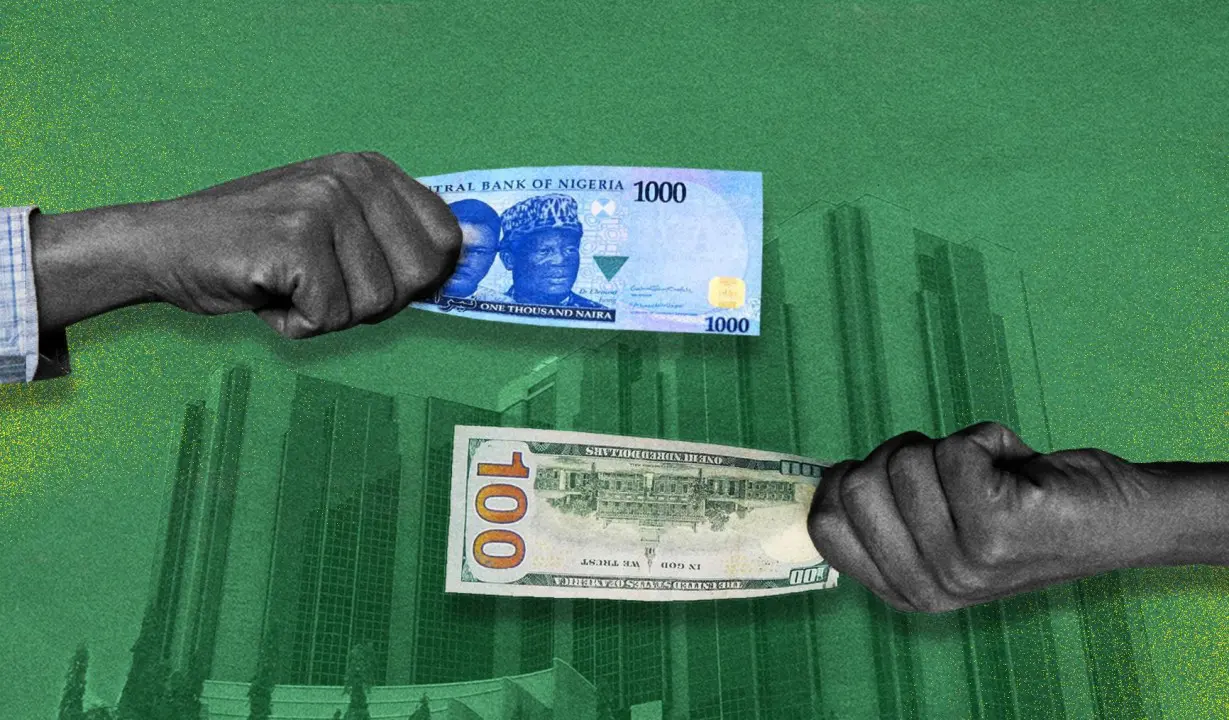
    The naira ended the week on a weaker note against the US dollar at the official foreign exchange market on Friday, settling at ₦1,464.49 as sustained demand pressures continued to weigh on the local currency.

    Data released by the Central Bank of Nigeria showed that the naira depreciated by 0.4 per cent from Thursday’s closing rate of ₦1,457.84.

    The currency had started the week on a positive footing, recording an appreciation of ₦2.59 at the official window on Monday. However, the gains proved short-lived as demand for foreign exchange resurfaced, eroding early optimism.

    By Monday, the naira traded at ₦1,451.81 before weakening further to ₦1,455.08 on Tuesday. The depreciation trend persisted on Wednesday, with the currency exchanging at ₦1,455.49, and continued through the rest of the week, culminating in Friday’s weaker close.

    Despite the early gains, sustained pressure in the foreign exchange market limited the naira’s ability to hold its ground, highlighting ongoing challenges in balancing demand and supply at the official window.

  • CBN, EFCC in legal duel over a N2.7bn property forfeiture case

    CBN, EFCC in legal duel over a N2.7bn property forfeiture case

    The Central Bank of Nigeria (CBN) has pleaded with the Federal High Court, Abuja to throw out a case filed by the EFCC regarding the forfeiture of a property worth N2.7 billion.

    The property, located in the Karmo District of Abuja, was used as collateral for a loan given through the Nigeria Incentive-Based Risk Sharing System for Agricultural Lending (NIRSAL).

    The EFCC had earlier approached the court, seeking permission to temporarily seize the property while investigating Toks Properties Limited.

     The anti-corruption agency also requested approval to appoint someone to manage the property on behalf of the federal government during the investigation.

     In response, Justice Emeka Nwite granted the EFCC’s request in September 2024, barring any sale, lease, or transfer of the property.

    At a court session on Thursday, CBN’s lawyer, Joseph Abah, along with another legal representative from Salis Ventilated Homes Limited, sought permission to join the case as defendants.

     The CBN argued that it plays a key role in regulating banking activities and that the property in question was legally pledged as collateral for a loan under the Anchor Borrowers’ Programme (ABP).

    According to the CBN, in 2020, it provided a loan of over N3.8 billion to Sadolen Interworld Limited for rice farming. The loan, with a 12-month term, was backed by a third-party guarantee from Toks Properties Limited. 

    To secure the transaction, the property was placed under a legal mortgage, with its title documents handed over to NIRSAL.

     The CBN also stated that the surety had agreed in writing not to sell or transfer the property without prior approval.

    Since the loan has not been fully repaid, the CBN insists that the property remains tied to the loan and cannot be forfeited.

     The bank has requested the court to dismiss the EFCC’s case, arguing that seizing the property would violate its legal rights as the mortgage holder.

    During the hearing, Justice Nwite asked the CBN’s lawyer whether the EFCC had been served with the necessary court documents, to which Abah confirmed they had. 

    The EFCC’s legal team acknowledged receiving the documents but requested more time to respond. The agency clarified that it only sought to secure the property while investigations were ongoing.

    After listening to both sides, Justice Nwite scheduled the next hearing for May 21, 2025, to review all pending applications related to the case.

  • CBN sanctions 9 banks for failing to dispense cash via ATMs

    CBN sanctions 9 banks for failing to dispense cash via ATMs

    Often dispensed in dirty and tattered notes, yet the Naira, our local currency was quite scarce during last Christmas holidays as many bank Automated Teller Machines (ATMs) failed to avail Nigerians access to cash. Not a few suspected sabotage by the banks as Point of Sale (POS) operators came to the rescue. The verdict is in.

    The Central Bank of Nigeria (CBN) says it has sanctioned some Deposit Money Banks (DMBs) for failing to make Naira notes available through automated teller machines (ATMs), during the yuletide season.

    According to a statement by Hakama Sidi-Ali, CBN’s Director, Corporate Communications Department, this is a clear message of zero tolerance for cash flow disruptions.

    The affected banks are Fidelity Bank Plc, First Bank Plc, Keystone Bank Plc, Union Bank Plc, Globus Bank Plc, Providus Bank Plc, Zenith Bank Plc, United Bank for Africa Plc, and Sterling Bank Plc.

    Sidi-Ali said that each of the banks was fined N150 million for non-compliance, in line with the CBN’s cash distribution guidelines, following spot checks on their branches.

    She said that the enforcement action followed repeated warnings from the CBN to financial institutions to guarantee seamless cash availability, particularly during periods of high demand.

    “Communication with the banks revealed that the fines would be debited directly from their accounts with the apex bank.

    “Ensuring seamless cash flow is paramount to maintaining public trust and economic stability.

    “The CBN will not hesitate to impose further sanctions on any institution found violating its cash circulation guidelines,” she said.

    She said the CBN’s investigations and monitoring would continue to scrutinise cash hoarding and rationing, both at bank branches and by Point-of-Sale (POS) operators.

    She added that the CBN was working with security agencies to crack down on illegal cash sales and operational violations, including enforcing POS operators’ daily cumulative withdrawal limit of N1.2 million.

    She urged all financial institutions to comply with its guidelines, warning that further violations would attract swift and decisive sanctions.

    The CBN Governor, Yemi Cardoso, had earlier warned banks to strictly adhere to cash distribution policies or face severe penalties.

    Cardoso gave the warning in his address at the Annual Bankers’ Dinner of the Chartered Institute of Bankers of Nigeria (CIBN) in Nov., 2024.

    He underscored the apex bank’s commitment to maintaining a robust cash buffer to meet the need of Nigerians.

    “Our focus remains on fostering trust, ensuring stability, and guaranteeing seamless cash circulation across the financial system,” Cardoso had said.

  • Naira Depreciates Further, Losing N5 on Monday

    Naira Depreciates Further, Losing N5 on Monday

    As Nigeria’s inflationary trend remains upbeat, lending rate prohibitive, and production tanks, the woes of the Naira persisted, exchanging, N1,665/$1 at the parallel market.

    The new rate represents a slight five naira fall from N1,660 that it traded at the weekend.

    This new trend marks another round of depreciation in the unofficial market, reflecting ongoing pressures on the Nigerian currency.

    In contrast, the official foreign exchange market saw a minor improvement for the Naira, appreciating slightly to N1,534.56 per dollar, up from N1,535 per dollar on Friday.

    This represents a modest gain of 44 kobo, according to data released by the Central Bank of Nigeria (CBN).

    The decision of the Federal Government to withdraw subsidy on Petrol and float the naira orchestrated a major headwind that continues to destabilise the Nigerian economic system.

    Unfortunately, while government officials admonish the suffering mass of Nigerians to be patient, to embark on very ostentatious lifestyles that spur the youth to protest.

  • 1000 CBN Staff Resigned Voluntarily – CBN

    1000 CBN Staff Resigned Voluntarily – CBN

    In December 2024, around 1000 staff members of the Central Bank of Nigeria (CBN) voluntarily left their positions, as confirmed by Governor Olayemi Cardoso.

     Contrary to claims that the departures were forced, the CBN emphasized that the exits were initiated by the staff themselves.

    During a recent hearing by the House of Representatives Committee, Bala Bello, the CBN’s Deputy Director of Corporate Services, clarified that the decision to leave was part of a restructuring process aimed at improving operational efficiency.

     The voluntary exits allowed the bank to realign its workforce to better meet its current needs, especially in light of the global shift toward digitization.

    The programme was not a response to internal pressure but rather an opportunity for staff members who had reached a career plateau to pursue other ventures.

     Some individuals leaving the bank have plans to start their own financial institutions. 

    The process was opened to all levels, a first in the bank’s history, and those who chose to stay continue their roles without coercion.

    The CBN also addressed concerns about the N50 billion in severance benefits for the departing employees, stressing that these payments were part of the regular process for voluntary departures.

     The bank has previously carried out similar exercises, though this was the first time the initiative was extended to such a large group.

    The House committee has pledged to conduct a thorough investigation into the matter.

    It would be recalled however, that late in 2024, the Central Bank of Nigeria had offered a N50billion incentive targeted at 1000 staff of all cadres.

    Insider sources revealed however that those targeted were given deadlines to take the offer or get whatever comes their way, meaning they could be sacked.

  • Nigeria inflate rate surges higher, hits 34.60%

    The most realistic sign that the Federal Government’s economic policies are not yielding the desired result emerged again today as figures released by the National Bureau of Statistics (NBS) show a relentless rise in the rate of inflation from 33.88% in October to 34.60% in November.

    The Central Bank of Nigeria’s (CBN) in furtherance of efforts to curtail the rise in inflation took the following measures during 298th Monetary Policy Committee (MPC) meeting on November 25–26, 2024.

    Despite these measures which the current management of the CBN had embarked upon since assuming office, the rate of inflation continues to soar, thereby confirming the contrary opinion of analyst who think the apex bank is not only prescribing the wrong medication but has missed the diagnosis.

    Further, the NBS figure indicates that on a year-on-year basis, the Headline inflation rate was 6.40% points higher than the rate recorded in November 2023 (28.20%). This shows that the Headline inflation rate (year-on-year basis) increased in November 2024 compared to the same month in the preceding year (i.e., November 2023).

    It is noteworthy to observe however, that on a month-on-month basis, the “Headline inflation rate in November 2024 was 2.638%, which was 0.002% points lower than the rate recorded in October 2024 (2.640%). This means that in November 2024, the rate of increase in the average price level is slightly lower than the rate of increase in the average price level in October 2024,” it was stated in the report.

    Food inflation after easing at the peak of the harvest period between July and September has spiked, rising, year on year from 39.16% in November 2023 to 39.93% at the end of November 2024.

    Month on month, the rate rose gently from 2.94% at the end of October to 2.98% in November.
    2.98 39.93

    The NBS stated in the report that, “Every month, 10,534 informants spread across the country provide price data for the computation of the CPI. The market items currently comprise 740 goods and services regularly priced.”

  • CBN to Sack 1,000 Workers, Offers N50bn Incentive Package

    CBN to Sack 1,000 Workers, Offers N50bn Incentive Package

    Even though 17 directors whose appointments were recently terminated are still in court, the Central Bank of Nigeria (CBN) has initiated an Early Exit Package to eliminate 1,000 employees.

    Sources close to the apex bank reveal that targeted staff members were given up to December 31, 2024, to either take the offer or grapple with whatever comes their way.

    The voluntary Early Exit Package (EEP) will cost the bank over N50 billion.  

    A circular released by the CBN announced that the EEP application is open to staff across all levels, except those with less than a year of service.

     The exit date is fixed for December 31, 2024. 

    Employees opting for the package will receive financial compensation based on their remaining years in service, with additional benefits such as financial planning support and extended healthcare.  

    As of now, 860 employees have applied for the program, fueling concerns among staff about the impact of the downsizing.

     The initiative follows the disengagement of 17 directors earlier this year, whose positions remain vacant. 

    As of now, the Yemi Cardoso-led bank has not given any clear reason for this purge other than to say that the program presents an opportunity for employees to explore new career paths.  

    This development occurs at a very crunchy time when many Nigerians are grappling with harsh economic realities precipitated by difficult economic reform policies by the Federal Government.

  • VAT, vassal states and restructuring (2)

    VAT, vassal states and restructuring (2)

    THERE are too many things wrong with the regime of Nigeria’s president, Alhaji Bola Ahmed Tinubu. For 18 months since the advent of the administration, it has been a case of stumbling from one problem to the other. The tragedy is that almost all the challenges that this regime has been grappling with were self-inflicted. It started off with an ill-conceived petrol subsidy removal, and it followed that almost immediately with allowing the national currency, the Naira, to be floated.

    Both policies turned out to be disastrous because the so-called petrol subsidy payment persisted in an opaque manner, and subsidizing the Naira did abate. Recently, the state oil corporation, the Nigerian National Petroleum Company Limited (NNPCL) insisted that it will continue to import petroleum products in spite of the existence of a domestic producer, Dangote Refinery and Petrochemical Company, Lagos, which said that it has the capacity to satisfy domestic consumption for petroleum products. Dangote’s 650,000 barrels of crude oil per day production should on full stream produce 50 million litres of petrol and 15 million litres of diesel per day.

    Experts estimate that petrol consumption in Nigeria should not exceed 35 million litres per day. But corruption puts it much higher, sometimes for as high as 70 million litres per day. This outrageous figure is not strange because Nigeria is widely acknowledged as a crime scene – a country hurting in the hands of its supposed care-givers. Private importers who work at the behest of collaborators inside the government have been known to ‘import’ shiploads of petroleum products without the ships being sited anywhere near the country’s territorial waters, not to talk of discharging any products. But such ‘importers’ file claims with excellent shipping documents, and collect hundreds of millions of dollars from the public treasury. NNPCL does the same.

    Then a cartel hijacks the little litres of petrol that were in truth brought in, ferrying such to neighbouring countries in 33000-litre trucks and in broad daylight where they make a kill. Nigeria has clearly delineated borders with its neighbours. We have all manner of tax-payer paid government officials at those borders. But the trade booms. Currently, an investigative reporter has been reporting on the daily massive smuggling of 50kg bags of rice into the country with the active involvement of immigration top shots. He has been doing so with video evidence. Last week the journalist reported that the leader of the smugglers was accorded a red carpet reception at the Abuja headquarters of the Nigeria Immigration Service. His reports have not been disputed and nothing has happened to the economic saboteurs.

    Back to the issue at hand. Alhaji Tinubu takes responsibility for his misadventures on petrol and Naira. Almost two years since his hare-brained twin policies, market forces are yet to fully determine the prices of petroleum products and the price of the Naira. Whilst the NNPCL moderates the prices of petroleum products especially petrol by importing and fixing different pump head prices for different parts of the country, the Central Bank defends the Naira through regular sales of the United States dollars to the bureaux de change, and through the aggressive mopping up of  Naira in circulation. The policies are obviously not working. The price of petrol at over N1000/litre is not sustainable. It has ruined the economy and will inflict more damage with the regime’s insistence that it will stay the course. Nigerian families are worse off. Bloomberg, an American news organization reported last week that about two -third of Nigerian households can barely manage to feed once a day. And the quality of the meal is suspect. Their report was drawn from the latest statistics from the Nigeria’s National Bureau of Statistics (NBS).

    The irony right now is that there are claims that the country is turning the corner, and that good days are on the horizon. Tinubu says so. The central bank governor says the same. Finance minister who is also the coordinating minister for the economy sees the same signs of economic recovery. Even the national security adviser, yes the NSA, who should have his hands full with widespread insecurity pervading the land, parrots the same message of visible economic turn around. But they are the only people who see economic recovery on the horizon. And they all share one thing in common – they all binge on the public treasury. I wager that none of them had been to a gas station to buy either petrol for the government SUVs (armour- plated and bomb-resistant brands) that they are driven in or to purchase diesel to fire government – owned electricity generators in their residences which also are built and tastefully furnished with taxpayers money.

    It is not strange, therefore, that they are separated from reality and the daily grind of the majority of Nigerians. The case of the NSA is particularly painful and pathetic. Daily, he joins the security agencies including the secret police otherwise called the Directorate of State Services (DSS), the regular Police, the Civil Defence Corps, the Armed Forces, among others, to run political commentaries on the state of the country. In place of combating insecurity, what the NSA does is to warn non-state agents terrorizing Nigeria to know that Tinubu is not known to lose any battle. Is he for real? The man cannot be, and should not be, a national security adviser even in a banana republic. What our rulers are doing is beyond talking up the economy, they are deliberately deceiving Nigerians. Any sign of economic recovery must show in the living standards and living conditions of the people. Today’s reality is that about 20 million children are out of school and about 150 million Nigerians are grappling with dimensional poverty. Of course, our country has been the poverty capital of the world since 2019.

    If nothing good is happening in the country, and nothing good has really happened in Nigeria in the last 18 months, it is down to the fact that the majority of Nigerians do not trust the regime headed by Tinubu. He assumed office about two years ago with a fractured mandate. And since then he has proceeded to surround himself with people like himself (people with real and perceived blemishes), and those who speak and dress like him. He is enmeshed in policy somersaults. At every turn he puts the cart before the horse. His regime is wobbly, fumbling and floundering. And because the regime perceives itself as fragile and unstable and unsure in spite of its attempt at blustering, it now sees treason in every spoken word by non-regime supporters, in every action and inaction, and in every news story and editorial opinions of some publications. The point is that the more this regime sees enemies everywhere, the more it will retreat to itself, and the more eventually it will begin to crack down on imaginary detractors. Already, for the diminishing clan of regime choristers, anybody who opposes where Tinubu is taking the country is treated as not being patriotic. To their warped minds they equate patriotism with love for a serially bungling administration. They are not capable of putting country before party or ethnic affiliations or fleeting benefits from the rulers.

    Expectedly, the gulf between the people and the regime is widening and it is beginning to play out. It’s manifesting in the new tax bills before our supine national assembly. For a start, the tax bills are one year late in coming. It is the style of the regime – to make policy statements without even a draft of the working papers. It did the same thing with the student loans scheme and conditional cash transfer to the poor of the poor in the country, to mention but two. Often its pronouncements bear no relationship with reality. The administration at Inception said it would reduce dependence on loans to run the government. That avowal may have informed what was thought to be the urgency it would attach to the tax bills. It failed. Now that the regime has roused itself from slumber, ‘enemies’ have laid ambush for the bills.

    Except for a segment of the Yoruba nation, every other nation in Nigeria is now increasingly inclined to live like “onye ndiro gbara ugburu gburu n’eche ndu ya nche mgbenile” or eternal vigilance is the price for liberty. With the antecedents of Tinubu other component-nations of the country will only treat his tax bills with levity to their eternal damnation. The first thing that should set the alarm bells ringing is the composition of the team that crafted and superintended the making of the bills. They look like Tinubu. They bear similar names like his. They dress and speak like him. So why should he and his parochial team be trusted to be altruistic in the work they have done? Other nations within Nigeria have a right to suspect these tax bills because, so far, Tinubu has demonstrated that he is an ethnic bigot.

    It came as  no surprise, therefore, that a section of the north of Nigeria was the first to scream that the tax bills were not the ‘Hail Mary’ that the regime claimed that they were. Senator Ali Ndume cried foul and vowed that the bills would be killed in the national assembly. Though a member, Ndume must be mistaken if he believes that the country still has a parliament worthy of that name. This assembly is an extension of the Executive arm. I didn’t say so, the leadership of the assembly said so from the get-go. And they have not disappointed. Indeed the national assembly members commenced consideration of the money bills last year by first singing the personal anthem of Tinubu “On your mandate we shall stand…” Anybody who expected any better from such buffoons who masquerade as lawmakers must be living in a fool’s paradise. Then the national economic council (NEC) composed of the vice president  and governors advised Tinubu to withdraw the bills to allow further stakeholders’ consultations. Tinubu promptly and derisively dismissed them. The controversy and the insistence of the president to forge ahead have alerted the other nations. The south east governors forum, for instance, was reported to have set up an expert team to review the bills for possible boobytraps.

    The one bill in the basket of bills that has attracted much attention was the value added tax (VAT). Some experts and indeed non-experts are concerned that the president and his kinsmen tax team are up to some mischief. They have honed in on two words concerning the VAT bill – Attribution and Derivation – which of them should enjoy preeminence. Among other people, one writer attempted to highlight where the bodies were buried in the VAT bill. We will reproduce part of his exertion. The person who identified himself as Chris Okafor on WhatsApp wrote: “.. the truth is (that) tax experts filled with Tinubu’s apologists (and 90% of Nigerians of Yoruba extraction) worked on the bill and hid so much into the bill which will put Lagos and Ogun (states) into economic advantage slightly short of extortion of other states” of Nigeria. He argued that from the present structure of the VAT bill, 60% of the takings will go to the state of collection. His grouse was that a disproportionate amount of VAT proceeds will go to the states hosting the head offices of companies that produce ‘vatable’ goods and services even when the same goods and services were patronized in other states of the country. He illustrated with some companies saying, for instance, that if VAT of N500 million was collected from a branch of a company in one state, 60% of the collection under the proposed principle of derivation would go to the state hosting the headquarters of that company and not in the state where the product/service was consumed.

    There’s little doubt that an arrangement such as illustrated above will make some areas of the country vassal states. It will sow seeds of discord and discontent. VAT is a sales tax and so components of the federating units of the country should be legally empowered to collect and use consumption tax. Another allegation that should be concerning is the yet to be verified claim that there’s a provision in one of the tax bills that would empower the federal government to take a certain percentage of funds that drop into personal and corporate bank accounts. We align with the national economic council that more time should be allowed for further scrutiny of these tax bills. We do not presently have a national assembly, and the claim by the Executive that the assembly should be allowed to scrutinize the bills on our behalf is gratuitous. Our so-called representatives and senators are preoccupied looking out for themselves.

    It’s accepted that we operate an ugly and difficult to decipher federal system of government, but 25 years and counting, we must summon the will to begin to put processes and structures in place to approximate a federation. The ruling elite has a bounden duty to work harder to smoothen the rough edges which combined forces could lead to the implosion of Nigeria. They should see the Nigerian project as bigger than their personal and/or regional interests. And if this perceived skewed VAT distribution is part of the ongoing restructuring in the image and likeness of Tinubu, it may not bode well for this country that for all intents and purposes is tottering on the edge of the cliff. The allegation that bank deposits may be taxed by the government could just prove to be the trigger for national cataclysm. Who wants this?

    *Concluded.

    UGO ONUOHA Was the Managing Director/Editor-in-Chief, Champion Newspapers Limited
  • Nigeria’s Economy Sees Robust Growth in Q3, 2024

    Nigeria’s Economy Sees Robust Growth in Q3, 2024

    The Nigerian economy has experienced an appreciable 0.27 percent expansion, hitting 3.46% in Q3 instead of 3.19% it averaged in Q2 of 2024.

    Latest data released by the National Bureau of Statistics (NBS) on reveals a consistent upward trend in the economy, surpassing the growth rate of 2.54% seen in Q3 2023. 

    Additionally, the current quarter also outperformed Q2, 2024, which had seen a growth of 3.19%.

    In real terms, the GDP stood at N20.1 trillion, reflecting an increase from N18.2 trillion in Q2 2024 and N19.4 trillion in Q3 2023. 

    The services sector played a crucial role in this performance, driving growth with a 5.19% increase and contributing 53.58% of the total GDP.

    PLEASE READ: FMBN SECURES N100BN OFFTAKER GUARANTEE FOR KARSANA RENEWED HOPE CITY PROJECT, ABUJA

    The data further revealed that the nominal GDP for Q3 2024 reached N71.1 trillion, marking a 17.26% increase from N60.6 trillion in the same quarter of the previous year.

     This surge signifies a robust recovery and positive economic momentum.

    Among the key sectors driving the economy, crop production contributed 26.51%, trade accounted for 14.78%, and telecommunications made up 13.94%. 

    The oil sector also showed improvement, recording a 5.17% growth compared to a negative growth rate of -0.85% in Q3 2023, although it was slightly lower than the 10.15% increase seen in Q2 2024.

    Nigeria’s oil output for Q3 2024 stood at an average of 1.47 million barrels per day (mbpd), marking a slight increase from 1.45 mbpd in the same quarter of the previous year and surpassing the 1.41 mbpd recorded in Q2 2024.

    Despite a strong performance in the oil sector, the non-oil economy remains the dominant driver of Nigeria’s GDP, contributing 94.43% in Q3 2024. 

    The non-oil sector’s contribution has slightly decreased compared to 94.52% in Q3 2023, though it remains higher than the 94.30% seen in Q2 2024. Key areas like agriculture, trade, and services have fueled this growth.