Tag: Nigerian Union of Journalists

  • Media Executives to reposition the sector for democratic governance

    Media Executives to reposition the sector for democratic governance

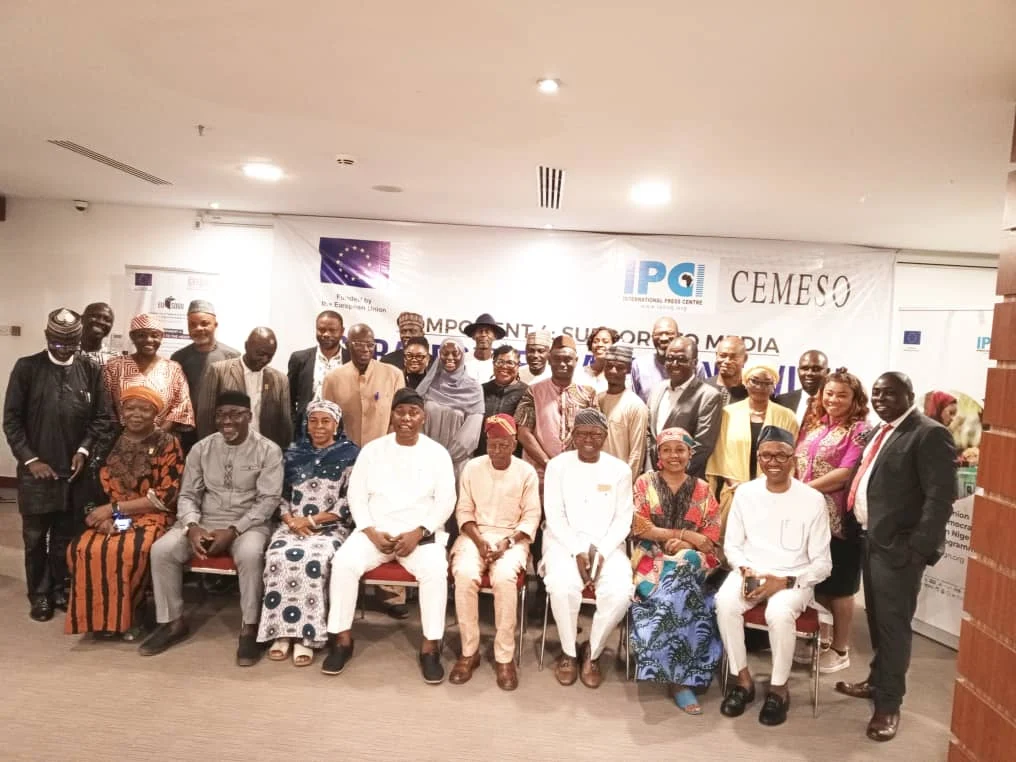
    Spurred by the early recourse to partisan activities, media executives and stakeholders this Monday, resolved to chart a new course to strengthen journalism’s role in democratic governance.

    The senior journalists made the resolution at a high-level strategic engagement on the theme, “Strengthening Media Professionalism and Collaboration for Democratic Governance in Nigeria.”

    The event brought together top media leaders, editors, regulators, and development partners who collectively agreed that a well-resourced, ethical, and inclusive press is essential to the building of a pluralistic, representative democracy in Nigeria.

    Mr. Lanre Arogundade, Executive Director of the International Press Centre (IPC), urged the media to transcend its current challenges and reclaim its foundational role in democracy.

    “The time has come for the media to rise above external pressures and internal complacency, and re-establish its integrity as a democratic pillar,” Arogundade said.

    Dr. Akin Akingbulu of the Centre for Media and Society (CEMESO) delivered a rousing welcome address, emphasizing that democracy cannot thrive without a healthy, professional media sector.

    “A healthy, vibrant media is not a luxury; it is a democratic necessity,” Akingbulu said. “We either maintain the status quo or lead the transformation. The choice is ours — and the time is now.”


    The forum is part of the European Union Support to Democratic Governance in Nigeria (EU-SDGN) Phase 2 project with the main focus being implementation.

    According to him, reforms must move from resolutions to resource backed execution and policy-driven transformation.

    Under EU funding and support, and through implementing partners such as IPC and CEMESO, several measurable gains have been recorded.

    These include, anti-disinformation strategies for reporters, digital storytelling frameworks, more inclusive editorial planning for women and youth coverage and improved adoption of the Media Code of Election Coverage as a newsroom standard.

    However, despite these gains, gaps remain as stakeholders lamented that women-focused programming remains largely domestic in scope, sidelining leadership narratives.

    Youth voices are often relegated to social media fringes.
    Also, Persons with disabilities are still framed through pity rather than empowerment and civic and voter education efforts remain seasonal and insufficient.

    Akingbulu urged media leaders to drive what he described as a “non-negotiable content revolution,” calling for a re-engineering of newsroom programming DNA. “We must transform women’s content into national conversations, amplify youth voices, elevate PWDs as agents of change, and make civic education a daily staple,” he said.

    Other reform areas discussed include legislative reviews of media laws governing public broadcasters such as the NTA and FRCN, and the transformation of these entities from state media to truly public service broadcasters. Discussions also called for an overhaul of the National Broadcasting Commission (NBC) to enhance its autonomy and professionalism.

    Key pillars proposed for transformation include: Inclusion: Structural editorial quotas and inclusive broadcast programming; Fact-Checking: Institutional fact-checking desks to combat disinformation; Ethical Journalism: Continuous improvement of professional standards and digital Transformation: Embracing AI tools, crisis simulation drills, and advanced digital storytelling.

    Participants equally noted that although the 2011 Freedom of Information Act guarantees media rights, both federal and state control of media houses continue to undermine impartial coverage. The EU and its partners believe a stronger legal and operational environment is needed to ensure journalists can report ethically, fairly, and without fear of reprisal.

    “This project is not just about training journalists; it is about embedding higher standards into the very fabric of our media institutions. We’ve equipped our teams—now we must unleash their potential,” Dr. Akingbulu added.

    Key Recommendations from the Engagement: Renewed editorial commitment and increased newsroom investment; Emphasis on both pre- and post-election coverage, not just during voting periods; greater use of researchers for evidence based reporting; strengthened editorial gatekeeping and newsroom mentorship and collaboration between legacy media and digital-native platforms.

    Others include capacity building for young journalists and reward systems for high performers; Integration of solution journalism, data, and investigative storytelling; editorial quotas to include women, youth, and persons with disabilities (PWDs); the adoption of digital tools and AI-powered fact-checking systems and Institutionalization of ethical best practices in editorial policies.

    The event concluded with a unified commitment from media organizations to implement reforms and provide opportunities for journalists trained under the EU-SDGN initiative. Participants called for the translation of training into institutional policy, sustained support, and newsroom accountability.
  • Oborevwori felicitates NUJ at 70, urges better welfare for journalists

    Oborevwori felicitates NUJ at 70, urges better welfare for journalists

    Gov Sheriff Oborevwori of Delta has called for better welfare for practicing journalists in the country to compensate for their incalculable contributions to nation building.

    The governor made the call in a statement issued on Monday in Asaba by his Chief Press Secretary, Festus Ahon to felicitate the Nigerian Union of Journalists (NUJ) on its 70th anniversary.

    He congratulated the President of the NUJ, Mr Alhassan Yahaya and all members of the union for their contributions to ethical journalism and nation building.

    He said that given advancement in the ICT, practicing journalists need to keep learning and relearning to become more ethical and development-focused.

    “I congratulate the President of Nigerian Union of Journalists (NUJ), Comrade Alhassan Yahaya and all Nigerian journalists on the occasion of the 70th anniversary of the union.

    “I must thank Nigerian journalists, who hold the government and its officials accountable, and for their incalculable contributions to the nation’s democracy and progress.

    “As the Fourth Estate of the Realm, media practitioners are critical stakeholders in the society, and have enormous power and influence on the people,” Oborevwori said.

    While noting the watchdog function of the media in the political system, Oborevwori acknowledged the NUJ’s crucial role in defining Nigeria’s narrative and furthering democratic ideals.

    He said;  “I must commend the union’s leadership for defending press freedom and fighting for the welfare of journalists.

    “The NUJ’s 70th anniversary marks a significant milestone in Nigeria’s media landscape, reflecting decades of commitment to journalistic excellence and the promotion of democratic principles.”

  • Court Nullifies Provisions of Broadcasting Code EmpoweringNBC to Impose Fines on Broadcasters

    Court Nullifies Provisions of Broadcasting Code EmpoweringNBC to Impose Fines on Broadcasters

    In a landmark judgement granting relief to broadcast stations, Justice Rita Ofili-Ajumogobia of the Federal High Court, Abuja, declared as null and void, provisions of the Nigeria Broadcasting Code authorizing the National Broadcasting Commission (NBC) to impose fines on broadcast stations for breaching the code.

    The ruling is sequel to the imposition of a N5 million each, on a television station and three pay TV platforms in 2022, for allegedly undermining Nigeria’s national security by broadcasting documentaries about banditry in Nigeria.

    Delivering judgment in a suit instituted by Media Rights Agenda (MRA), the court held that administrative and regulatory bodies could not exercise judicial powers, adding that NBC not being a court of law, acted above its powers by imposing such fines.

    The judge commended MRA for its legal challenge of the NBC’s action and issued an order of perpetual injunction restraining the Commission or anyone acting on its behalf from further imposing any fine on any media platform or broadcast station in Nigeria for any alleged offence committed under the Nigeria Broadcasting Code.

    Justice Ofili-Ajumogobia set aside the fines imposed by the NBC on August 3, 2022 on Multichoice Nigeria Limited, owners of DSTV; TelCom Satellite Limited (TSTV); Trust-TV Network Limited; and NTA Startimes Limited for broadcasting a documentary about the state of banditry and security in Zamfara State, saying the regulator’s action was wrong and unjustifiable in a democratic society.

    Abuja-based human rights lawyer, Mr. Uche Amulu, filed the suit on behalf of MRA asking the court to hold, among other things, the NBC’s action of imposing a fine on each of the media platforms and the station for broadcasting a documentary about the state of banditry and security in Zamfara State is unlawful and unconstitutional and has a chilling effect on the freedom of media to impart information and ideas. MRA contended that it would deter the platforms and station from reporting the true state of affairs regarding the security situation in Nigeria, and therefore constitutes a violation of the rights of MRA, its members, and other citizens of Nigeria to freedom of expression, particularly their rights to receive ideas and information without interference, as guaranteed by the Constitution and the African Charter on Human and People’s Rights.

    MRA also sought a declaration that the procedure adopted by the NBC in imposing the fines is a flagrant violation of the rules of natural justice and the right to fair hearing under Section 36 of the Constitution and Article 7 of the African Charter as the Commission is the drafter of the Code, which provides for the alleged offences for which the media platforms and the station were punished, and which empowers the NBC to receive complaints, investigate and adjudicate on the complaints, impose fines and collect fines.

    MRA contended that the NBC, not being a court of law and not having been constituted in a manner as to secure its independence and impartiality, has no power or competence to impose fines on broadcast stations as punishment or penalties for the commission of an offence as the competence to establish that an offence has been committed and to impose criminal sanctions or penalties belongs to the courts.

    Besides, it claimed, the NBC, not being the Nigerian Police or a law enforcement agency, has no power to conduct a criminal investigation or an investigation that could lead to criminal charges against the affected media platforms and stations or the imposition of criminal penalties and accordingly, that the investigation purportedly conducted by the Commission, leading to the fines imposed on the media platforms and station for alleged offences under the Nigeria Broadcasting Code is ultra vires, null and void.

    MRA also urged the Court to declare that the Nigeria Broadcasting Code issued by the NBC, being a subsidiary legislation that empowers it as a regulatory and administrative body to enforce the provisions of the Code, cannot confer judicial powers or jurisdiction in criminal matters on the Commission to impose criminal sanctions or penalties such as fines, particularly as the Code was made by the NBC itself.

    It urged the Court to declare the fines unconstitutional, ultra vires, null and void, set them aside and issue an order of perpetual injunction restraining the NBC, its servants, agents, privies, representatives or anyone acting for or on its behalf, from further imposing any fine on any of the media platforms or station, or any other broadcast station in Nigeria for any alleged offence committed under the Nigeria Broadcasting Code.

    In her judgment, Justice Ofili-Ajumogobia agreed with all MRA’s arguments and granted all the declarations and injunction sought by the organization. She however refused to grant the organization’s claim for N700,000 as costs it incurred in litigating the action; another claim for N2 million as general damages for NBC’s infringement on its rights as well as a request for N1 million as punitive damages for the Commission’s “outrageous conduct in abusing its powers and arbitrarily imposing fines on broadcasting stations”.