Author: Caroline Ameh

  • Massive Earthquake Hits Japan, Leaving Huge Destruction and Evacuations

    Massive Earthquake Hits Japan, Leaving Huge Destruction and Evacuations

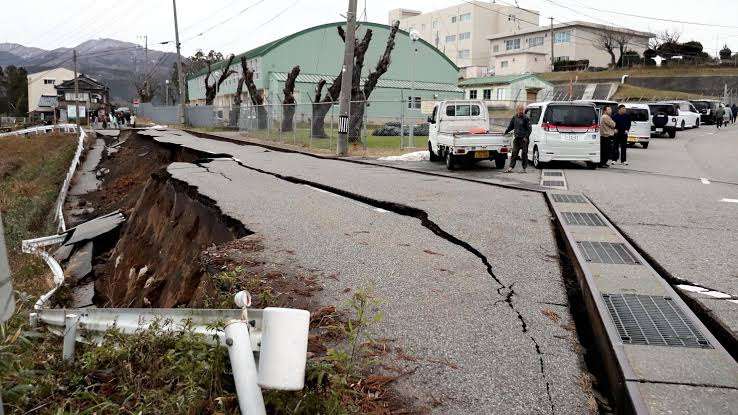
    A magnitude 7.6 earthquake has hit central Japan, triggering widespread destruction, disrupting infrastructure, and necessitating massive evacuations, with one fatality prompting the evacuation of nearly 100,000 residents.

    The quake, which struck on Monday, triggered tsunami warnings along Japan’s west coast and South Korea. Waves approximately 1 meter high were reported, causing concerns for coastal areas.

    The Japan Meteorological Agency (JMA) issued alerts for Ishikawa, Niigata, and Toyama prefectures. Although Ishikawa initially faced a major tsunami warning, it was later downgraded to an advisory.

    The aftermath revealed reports of collapsed buildings, power outages affecting tens of thousands of homes, and mandatory evacuations. Tragically, an elderly man lost his life due to a building collapse in Shika Town, Ishikawa.

    Prime Minister Fumio Kishida urged immediate action by search and rescue teams despite challenges in accessing affected areas. This seismic activity marked the most robust in the region in over four decades, raising concerns for potential subsequent quakes.

    Evacuation orders affected over 97,000 individuals across nine prefectures along Japan’s western coast, highlighting the severity of the situation. Kishida stressed the importance of readiness for potential future disasters.

    The earthquake’s impact rippled beyond its epicenter, causing collapsed buildings, fires, power disruptions, and infrastructure damage, leading to halted train services and closed expressways. Communication networks also faced disruptions due to telecom outages.

    The timing of this seismic event during the New Year holiday disrupted traditional celebrations, prompting cancellations of public appearances by Emperor Naruhito and Empress Masako. Residents, rattled by the quake’s force, sought refuge in evacuation centers, uncertain about returning home.

    The earthquake reignited concerns about Japan’s nuclear industry. Despite fears, authorities reported no irregularities at nuclear power plants in the region.

    As affected areas grappled with the aftermath, concerns loomed over recovery efforts and potential aftershocks. Japan’s resilience and preparedness faced another stern test as they navigated the aftermath of this natural disaster.

  • INEC Implements FG Retirement Policy: Four Directors set to Retire

    INEC Implements FG Retirement Policy: Four Directors set to Retire

    In compliance with the government’s reviewed policy on retirement from the federal public service, the Independent National Electoral Commission (INEC) has approved the retirement of four directors of Election Management Body.

    Based on circular number HSCF/SPSO/268/T3/2/37 issued on July 27, 2023, it becomes mandatory for a director who has put in eight years of service on the rank to retire.

    Sam Olumekun, the National Commissioner and Chairman of the Information and Voter Education Committee, revealed that INEC will comply with the government’s directive requiring Directors with eight or more years of service to retire from the public sector. This decision will result in four directors proceeding on terminal leave.

    Notably, two of these directors hold pivotal roles as heads of departments at the National Headquarters, while the remaining two occupy the positions of Administrative Secretaries within the State offices.

    However, an exemption clause under Circular MH. 7205/T/31 dated September 7, 2023, exempts Clinical Officers within the medical cadre from this retirement policy.

    Olumekun conveyed the Commission’s well-wishes to the affected Directors as they prepare to conclude their tenure and retire from their roles within the Commission.

  • UK Students Launch ‘Career Boycott’ Against Barclays Over Climate Policies

    UK Students Launch ‘Career Boycott’ Against Barclays Over Climate Policies

    Hundreds of students from prominent UK universities have taken a strong stance against Barclays, initiating a “career boycott” in protest of the bank’s climate policies.

    The group, comprising over 220 individuals from universities such as Oxford, Cambridge, and University College London, has firmly conveyed their refusal to work for Barclays, citing the bank’s refusal to give financial support for fossil fuel companies as the crux of their protest warning that the bank risks losing top talent if it continues these practices.

    In a formal letter addressed to Barclays, the students highlighted their concerns, asserting that the bank’s purportedly ambitious decarbonization goals contradict its actions, particularly in financing major oil and gas entities like Shell, TotalEnergies, Exxon, and BP.

    They criticized the discrepancy between Barclays’ professed commitment and the support extended to fossil fuel companies, many of which have scaled back their climate pledges.

    The students’ letter further emphasized the shifting stances of major oil corporations. Notably, BP revised its emission reduction target from 35% to a range of 20% to 30% by 2030, while ExxonMobil quietly withdrew funding for low-carbon fuel creation using algae. Additionally, Shell reneged on promises to increase investments in renewable energy this year.

    Their demand to Barclays is clear: cease all financing and underwriting for oil and gas firms, not solely their projects, and substantially increase funding for wind and solar energy initiatives.

    Michelle Hemmingfield, representing Students Organising for Sustainability UK, underscored the significance of this movement, indicating that Barclays heavily relies on STEM applicants from top universities like Oxbridge for recruitment, posing a potential challenge should the bank persist in financing new oil and gas infrastructure.

    This “career boycott” compounds Barclays’ existing challenges, following prior scrutiny from climate activists at its AGM and pressure regarding sponsorships and affiliations. The bank’s spokesperson defended its actions, stating alignment with a goal to become a net-zero bank by 2050, emphasizing efforts to collaborate with clients in transitioning toward a low-carbon model. Barclays cited a 32% reduction in emissions financed in the energy sector since 2020 and substantial green financing initiatives, aiming to facilitate $1 trillion in sustainable financing between 2023 and 2030.

  • Nigeria’s Diaspora Remittances Predicted to Surpass $20 Billion in 2023, World Bank Reports

    Nigeria’s Diaspora Remittances Predicted to Surpass $20 Billion in 2023, World Bank Reports

    The World Bank’s recent Migration and Development Brief forecasts a significant upsurge in diaspora remittances flowing into Nigeria to surpass a staggering $20 billion by year-end, 2023. This surge reflects a broader trend of a 1.9% increase in total remittances within the Sub-Saharan Africa region.

    The report, unveiled this month, outlines projections indicating that remittances to Sub-Saharan Africa will rise from $53 billion in 2022 to $54 billion in 2023. Furthermore, it anticipates a continued upward trajectory, reaching $55 billion by 2024. The tempered growth in 2023 is attributed to the sluggish pace of expansion in high-income economies, where a significant number of Sub-Saharan African migrants earn their livelihoods.

    Nigeria, serving as the recipient of 38% of remittance flows to the region, experienced a marginal uptick of approximately two percent. Similarly, other key beneficiaries such as Ghana and Kenya registered estimated gains of 5.6% and 3.8%, respectively.

    The report also highlights the influence of fixed exchange rates and capital controls, diverting remittances away from official channels towards unofficial ones.

    Looking ahead to 2024, the projections indicate a 2.5% increase in remittance flows to the region. Notably, remittances from the United States have exhibited stability, while the euro area’s recovery remains hampered, with output lingering 2.2% below pre-pandemic projections.

    The World Bank’s findings underscore the resilience and substantial contribution of Diaspora remittances to the economic landscape of Nigeria and the wider Sub-Saharan African region, albeit in the face of ongoing challenges in global economic recovery.

  • Ondo Gov, Akeredolu is Dead

    Ondo Gov, Akeredolu is Dead

    Arakunrin Rotimi Akeredolu, the Governor of Ondo State, has passed away after a prolonged struggle with leukemia.

    According to a source within his family, Akeredolu breathed his last in Lagos, under the care of State House doctors, unable to travel abroad due to his health condition.

    The 67-year-old governor, who had been undergoing medical attention since his return from Germany in September, recently handed over power to his deputy, Aiyedatiwa, following directives from President Bola Tinubu. Aiyedatiwa had been acting as Governor during Akeredolu’s periods of medical leave.

    Akeredolu’s health struggles were evident earlier in the year when his wife, Betty, announced the suspension of her 70th birthday celebrations due to unforeseen circumstances related to her husband’s health.

    Reports surfaced indicating the Governor’s battle with leukemia, a cancer of the blood affecting the production of essential blood cells, leading to severe health complications.

    Leukemia, which disrupts the body’s ability to fight infections, manifests in various forms, including acute lymphoblastic leukemia, acute myeloid leukemia, and chronic lymphocytic leukemia. Its symptoms, as outlined by medical sources, encompass weakness, bruising, fever, infections, bone pain, and several other discomforts.

    The Governor’s courageous fight against this formidable disease and the subsequent impact on his ability to govern drew public attention and concern. Akeredolu’s passing leaves a void in the state leadership, prompting grief and tributes from citizens across Ondo and beyond.

  • CBN Rescinds Ban on Cryptocurrency Transactions

    CBN Rescinds Ban on Cryptocurrency Transactions

    The Central Bank of Nigeria (CBN) has retracted its prohibition on cryptocurrency transactions in Nigeria.

    This policy reversal was conveyed in a circular no. FPR/DIR/PUB/CIR/002/003, dated December 22, 2023, and signed by Haruna Mustafa, Director, Financial Policy and Regulation Department.

    Earlier, in February 2021, the apex bank had imposed a ban on cryptocurrency transactions in Nigeria, citing concerns over potential money laundering and terrorism financing risks, as well as the absence of regulatory measures and consumer protections.

    However, citing evolving global trends and regulatory developments, the CBN acknowledged the necessity of regulating Virtual Assets Service Providers (VASPs). This recognition aligns with the Financial Action Task Force’s (FATF) updated Recommendation 15 in 2018, which urged the regulation of VASPs to prevent misuse of virtual assets for illegal activities. The Money Laundering (Prevention and Prohibition) Act, 2022 also included VASPs within the definition of financial institutions.

    The new guideline issued by the CBN is aimed at providing clarity to financial institutions under its purview regarding their relationships with VASPs operating in Nigeria. Notably, this guideline supersedes previous directives, particularly circulars FPR/DIR/GEN/CIR/06/010 dated January 12, 2017, and BSD/DIR/PUB/LAB/014/001 dated February 5, 2021.

    Despite the lifting of the ban, the CBN reiterated that banks and financial institutions are still prohibited from directly engaging in trading, holding, or transacting in virtual currencies on their own accounts.

    Under the revised directive, banks and financial institutions are mandated to promptly comply. The CBN also reminded these entities of its previous circular, BSD/DIR/PUB/LAB/014/001 dated February 5, 2021, which urged them to identify and close the accounts associated with cryptocurrency transactions.

  • French Embassy Offers Lucrative Job Opportunities to Nigerians

    French Embassy Offers Lucrative Job Opportunities to Nigerians

    The French Embassy has announced a lucrative job opportunity for Nigerians willing to work as English Language Assistants in France.

    The embassy is looking for English Language assistants to work in France for a 7-month period, providing an excellent chance for individuals to immerse themselves in the French language and culture.

    Information released on the embassy’s official website indicates that eligible candidates must be between the ages of 20 and 30 and possess at least a B1 level of proficiency in the French language.

    The application window for this employment opportunity opened on December 19, 2023, and is set to end on January 19, 2024.

    Successful applicants will not only gain professional experience but will also have the chance to travel, live, and work in France.

    The role requires a commitment of 12 hours of work per week, and the contract duration is seven months.

    Meanwhile, one of the most attractive aspects of the opportunity is the salary offered to the selected candidates.

    English Language assistants will receive a monthly salary of N911,000 or €1,010.67, translating to a total of N6,377,000 over the course of the fellowship.

    Prospective candidates are encouraged to visit the embassy’s application portal to complete the application process.

  • INEC Releases Timetable for Bye-Elections and Court-Ordered Re-Run Elections

    INEC Releases Timetable for Bye-Elections and Court-Ordered Re-Run Elections

    The Independent National Electoral Commission (INEC) has unveiled its comprehensive timetable and schedule of activities for upcoming bye-elections and court-ordered re-run elections across various constituencies in Nigeria.
    This was contained in a release signed by Mr. Sam Olumekun, National Commissioner & Chairman, Information Voter Education Committee in Abuja.

    The vacancies, arising from the resignation or demise of Members of the National and State Houses of Assembly, have been declared by the Presiding Officers, including the Senate President, Speaker of the House of Representatives, and Speakers of State Houses of Assembly.

    These electoral vacancies span two Senatorial Districts, four Federal Constituencies, and three State Constituencies, affecting nine States of the Federation.

    The commission according to the release is set to conduct re-run elections as directed by various Election Petition Appeal Tribunals, encompassing 35 Constituencies resulting from the 2023 General Election. While three cover entire constituencies, others involve select Polling Units.

    The simultaneous conduct of both categories of elections is scheduled to occur on Saturday, 3rd February 2024, in all affected constituencies.

    To ensure transparency and accessibility, the Commission has uploaded the Timetable for the elections and detailed delimitation data, including registration areas, polling unit names, the number of registered voters, and PVCs collected, on its official website and social media platforms.

    INEC emphasizes the importance of political parties and candidates adhering strictly to the specified timelines for the seamless conduct of these elections.

    For further details, the timetable, and other election-related information, visit the INEC website and official social media channels.

  • Senate confirms 11 Supreme Court Justices

    Senate confirms 11 Supreme Court Justices

    The Nigerian Senate, Thursday, confirmed the appointment of 11 Supreme Court justices sent by President Bola Tinubu to fill the vacancies in the apex court.

    The confirmation was made possible after the consideration and adoption of a report by the Senate Committee chairman on Judiciary, Human Rights and Legal Matters, during plenary.

    Recall that President Tinubu had asked the Senate to confirm the nominees, who were recommended by the National Judicial Council to fill the vacant positions following death and retirement of some justices.

    The nominees confirmed are Justice Haruna Tsammani (North East) who chaired the Presidential Election Petition Court, Justice Moore Adumein (South South), Justice Jummai Sankey (North Central), Justice Chidiebere Uwa (South East) and Justice Chioma Nwosu-Iheme (South East)

    Others are Justice Obande Ogbuinya (South-East), Justice Stephen Adah (North Central), Justice Habeeb Abiru (South West), Justice Jamilu Tukur (North West), Justice Abubakar Umar (North West) and Justice Mohammed Idris (North Central).

    The chairman of the committee, Senator Tahir Monguno while presenting his panel report, said the nominees possessed the necessary qualifications and experience to occupy the position and that there was no petition against them. He subsequently recommended their confirmation.

    However, with the confirmation of the 11 justices, the Supreme Court now has the complete statutory requirement of 21 justices on its bench.

  • Federal Government Restores 8,000 Delisted Civil Servants to IPPIS

    Federal Government Restores 8,000 Delisted Civil Servants to IPPIS

    A whopping 8,000 civil servants previously delisted from the Integrated Payroll and Personnel Information System (IPPIS) have been restored to the payment portal.

    While announcing the decision, the federal government explained that their previous exclusion was due to alleged infractions.

    The disclosure of their reinstatement came from Mr. Joshua Apebo, the General Secretary of the Association of Senior Civil Servants of Nigeria (ASCSN), during a function in Lagos on Wednesday.

    Recall that earlier in September, the federal government had removed over 17,000 workers from the IPPIS platform, citing non-compliance with a verification process spanning five years.

    However, following the intervention of ASCSN, the government, facilitated by the Office of the Head of the Civil Service of the Federation, initiated the verification of the 17,000 civil servants in October.

    Mr. Apebo highlighted this new development, stating, “As of yesterday (Dec. 19, 2023), over 8,000 delisted civil servants have had their names reinstated on the IPPIS, and the government has pledged to pay their December salary along with three months’ arrears.”

    Moreover, he mentioned that the Nigeria Labour Congress and Trade Union Congress of Nigeria had submitted a list of committee members to the government for negotiating the minimum wage. The committee, according to Apebo, is set to be inaugurated in January 2024 to commence the negotiation process.

    “The last minimum wage was inaugurated in April 2019, and the regulation stipulates every five years for a review. By April 2024, it will be five years. Therefore, I hope that the negotiation will be concluded before then,” he affirmed.