Author: Chike Ozohili

  • NSCDC Arrests 3 Cable Thieves in Bauchi 

    NSCDC Arrests 3 Cable Thieves in Bauchi 

    The Nigeria Security and Civil Defence Corps, (NSCDC) Command, Bauchi, has arrested three suspected vandals and transformer cable thieves in Jama’are local government area (LGA) of the state.

    This is contained in a statement issued by the Command’s spokesman, DCP Ibrahim Gabdo, and made available to newsmen at the weekend in Bauchi. 

    He said the three suspected transformer cable thieves and vandals were arrested in different locations in Jama’are local government area sometimes in August.

    According to him, the suspects were arrested by the NSCDC Command patrol team following intelligence reports that some criminals were vandalizing transformer cables and carting them away.

    “The arrested suspects are Abdulwahab Yakubu, 18, of Unguwar Abuja, Jama’are LGA, Ya’u Abdullahi, 18, of Unguwar Tsamiya, Jama’are LGA, and Musa Haruna, 19, of Jama’are LGA. 

    He said the Commandant, Mr Oyejide Ilelaboye, paraded the suspected vandals at the NSCDC State Command Bauchi.

    He warned other criminal elements in the state to turn a new life before the law catches up with them.”

    The Spokesman said the three suspects were arraigned before the Federal High Court Bauchi on Friday, for conspiracy and vandalism.

  • UBA Anchors H2 Profitability On Customer-Centric Values

    UBA Anchors H2 Profitability On Customer-Centric Values

    The United Bank for Africa (UBA) Plc, has pledged its commitment to customer-centric values as it aims to build upon its successes to sustain profitability by the end of the current financial year.

    UBA’s Group Managing Director, Oliver Alawuba, who gave the assurance at the half year Investor Conference Call Presentation in Lagos, explained that the bank’s impressive performance was characterised by robust revenue generation, prudent cost management, and strategic capital allocation.

     UBA is a leading pan-African financial institution, offering banking services to more than thirty-seven million customers across 1,000 business offices and customer touch points in 20 African countries.

    Alawuba’s assurance comes on the back of exceptional performance in the first half of the 2023 financial year.

    According to him, these achievements have provided the bank with a solid foundation upon which to further enhance its position as a leading financial institution in Africa and beyond.

    In its first half results ended June 30, 2023, UBA showcased its financial resilience and strength, surpassing expectations with remarkable performance as it reported a profit before tax of N404 billion, representing a rise by 371 per cent, compared to N85.75 billion recorded in the first half of 2022. 

    With that performance, UBA became the most profitable financial institution in Nigeria.

    The result also showed that Operating Income grew by 206.6 per cent to N783.96 billion in June 2023; higher than N255.67 billion reported a year earlier, just as it delivered a 164 per cent growth in its Gross Earnings which rose to N981.78 billion as at June 2023, up from N372.36 billion recorded last year in June 2022.

    Alawuba said, “These figures reflect our ability to finance future growth and help individual customers, families, businesses and non-profit organisations to carry out their projects. At UBA, we remain focused on our Customer First philosophy and growing our share in the various markets we operate. 

    “Thanks to our scale, geographic footprint and business diversification, we have numerous opportunities to grow, which should allow us to remain our customers’ first choice and to make the most of those opportunities, our focus is on implementing plans that enhance the existing network across all the countries and businesses, and improving the profitability of our core businesses through disciplined capital allocation.”

    He further promised that notwithstanding the accomplishments in the first half of the year, the Bank is committed to rendering excellent services to its customers and staying focused on its strategy and corporate objectives.

    Just last week, the Bank announced the rolling out of a special financing initiative aimed at powering the growth of small and medium scale enterprises (SMEs) all over Africa. In partnership with the African Continental Free Trade Area (AfCFTA) secretariat, UBA is to inject up to $6 billion into eligible SMEs across Africa over the next  three years.

    “Under the initiative, SMEs specializing in agro-processing, pharmaceuticals, automotive and transport, and logistics will have access to tailored financing solutions. This move is especially beneficial for businesses that operate within these sectors which heavily rely on imports,” Alawuba said.

    UBA’s Executive Director Finance & Risk Management, Ugo Nwaghodoh, while highlighting the bank’s investment in digital banking, added that the bank continues to gain traction from its huge investments in technology.

    “Our investments in state-of-the-art technology continue to yield expected results, evident in the huge boost of our digital banking income, which grew 53,7 per cent year-on-year to N57.2 billion. These gains have enabled us to optimize net earnings amid the accelerating inflationary pressure, currency devaluation, and increased regulatory induced cost,” he explained. 

    He added that focusing on the bank’s sustained growth across its African Markets, UBA remains focused towards delivering innovative and personalised financial products and services that cater to the unique needs of its diverse customer base.

  • Suspicious Payments: Presidential Tax Committee Received N5bn From FIRS -Chairman

    Suspicious Payments: Presidential Tax Committee Received N5bn From FIRS -Chairman

    The Chairman, Presidential Fiscal Policy and Tax Reforms Committee, Taiwo Oyedele has confirmed that the committee got the sum of N5 billion from the Federal Inland Revenue Service (FIRS).

    In a statement on his official X handle, the Chairman, Presidential Fiscal Policy and Tax Reforms Committee, Taiwo Oyedele said the statement became necessary due to a report by the Cable Newspaper that the immediate past FIRS Chairman, Muhammad Nami, approved the sum of N11 billion after he left office.

    But in a statement Thursday, Nami explained that the Cable report was out to tarnish his hard-earned reputation.

    In the statement, Nami took time to explain the approvals he carried out before he left the revenue agency.

    “The N5 billion paid to the Joint Tax Board was paid to fund the activities of the Presidential Committee on Tax and Fiscal Policy Reforms two months before I left office. It was paid after we received a letter to that effect from the office of Mr. President signed by Zacch Adedeji himself. 

    “The report maliciously attempts to portray a picture that I hurriedly left the country on September 16th after these so-called “suspicious approvals” were made. Again, nothing can be further from the truth. If I traveled out of the country on the 16th of September, how then did I attend the handover ceremony with Mr. Zacch on the afternoon of Monday 18th September 2023? That handover ceremony was covered by the media, and can be cross-checked. 

    “It is disappointing to see the Cable, a revered online newspaper attempt to sensationalise events that took place in the ordinary course of work in office, making them seem as if they were done in bad faith,” Nami said.

    Oyedele said, “We are aware of a recent story regarding some funds transferred by the FIRS to the Joint Tax Board (JTB) for the Presidential Fiscal Policy and Tax Reforms Committee.  

    “The Committee’s budget includes provisions for a national “Data for Tax” project which the JTB has been championing for over 2 years. The project was presented to the National Economic Council in 2022 and was meant to be funded by the federal government and the 36 states. However, it stalled due to lack of funds. Given the importance of the project to the effective reform of our tax system, it was included in the Committee’s budget. 

    “Other expenses included in the Committee’s budget, which has the approval of the National Assembly, include setting up of offices for the Committee in Lagos and Abuja, payment of salaries for the full time staff engaged by the Committee, travels and other logistics for over 70 members representing more than 40 institutions and stakeholder groups mapped to 6 different Subcommittees, more than 30 Secretariat personnel and over 40 students across the country. In addition, the budget covers planned stakeholder engagements with various sectors and interest groups, as well as international engagements and understudy of some leading tax regimes around the world, and so on. The budget covers a period of one year being the lifespan of the Committee.

    “It should be noted that the Committee was not set up simply to produce reports and recommendations, we are also charged with the implementation of recommended and approved proposals which need to be funded. 

    “The Committee’s mandate includes ensuring prudence and accountability in the management of our national resources. It will therefore be a contradiction for the same Committee to be wasteful or reckless in its own affairs. Members of the Committee work on a volunteering basis and are only paid reasonable allowances to cover their out-of-pocket expenses as we cannot afford to pay the commercial value for their time, skills and experience. As the Chairman of the Committee, despite working full time on the assignment, I do not receive a salary.

    “All the expenses of the Committee are properly documented and available for audit. We collect receipts for fuel, stationeries, and virtually every Naira that we spend to the extent possible. Over N4 billion of the said funds transferred by the FIRS to the JTB for the Committee’s work is yet to be spent and very much intact in the JTB account.”

    He assured that the Committee will be responsible, prudent and accountable with every Naira of public funds that it will be entrusted with. 

  • FAAC Distributes N1.1trn In August Allocation To FG, States, LGs  

    FAAC Distributes N1.1trn In August Allocation To FG, States, LGs  

    The Federation Account Allocation Committee (FAAC) has shared a total sum of N1100.101 trillion August 2023 Federation Account Revenue to the Federal Government, States and Local Government Councils.   

    A communique issued by the FAAC at its September, 2023 meeting indicated that the N1100.101 trillion total distributable revenue comprised distributable statutory revenue of N357.398 billion, distributable Value Added Tax (VAT) revenue of N 321.941 billion, Electronic Money Transfer Levy (EMTL) revenue of N14.102 billion, Exchange Difference revenue of N 229.568 billion and Augmentation of NN177.092 billion. 

    According to the communique, total revenue of N1483.902 billion was available in the month of August 2023.  

    “Total deductions for cost of collection was N58.755 billion, total transfers and refunds was N254.046 billion and savings was N71.000 billion.   

    “Gross statutory revenue of N 891.934 billion was received for the month of August 2023. This was lower than the N1150.424 billion received in the month of July 2023 by N258.490 billion.  

    “The gross revenue available from the Value Added Tax (VAT) was N345.727 billion. This was higher than the N298.789 billion available in the month of July 2023 by N46.938 billion,” the Committee said.

    The communique stated that from the distributable revenue, the Federal Government received a total of N431.245 billion, the State Governments received N361.188 billion and the Local Government Councils received N266.538 billion.

    A total sum of N26.473 billion (13% of mineral revenue) and N14.657 billion (13% of savings from NNPCL), were shared to the relevant States as derivation revenue. 

    From the N357.398 billion distributable statutory revenue, the Federal Government received N173.102 billion, the State Governments received N87.800 billion and the Local Government Councils received N67.690 billion.

    The sum of N14.446 billion (13% of mineral revenue) and N14.361 billion (13 % of savings from NNPCL) were shared to the relevant States as derivation revenue. 

    The Federal Government received N48.291 billion, the State Governments received N160.971 billion and the Local Government Councils received N112.679 billion from the N321.941 billion distributable Value Added Tax (VAT) revenue.

    The N14.102 billion Electronic Money Transfer Levy (EMTL) was shared as follows: the Federal Government received N2.115 billion, the State Governments received N7.051 billion and the Local Government Councils received N4.936 billion.

    “The Federal Government received N114.445 billion from the N229.568 billion Exchange Difference revenue. The State Governments received N58.048 billion, and the Local Government Councils received N44.752 billion. The sum of N12.027 billion (13% of mineral revenue) and N0.296 billion (13 % of savings from NNPCL) went to the relevant States as derivation revenue. 

    “From the N177.092 billion Augmentation, the Federal Government received N93.292 billion, the State Governments received N47.319 billion and the Local Government Councils received N36.481 billion. 

    “In the month of August 2023, Value Added Tax (VAT), Import and Excise Duties and Electronic Money Transfer Levy (EMTL) increased considerably while Petroleum Profit Tax (PPT), Companies Income Tax (CIT), Oil and Gas Royalties recorded significant decreases.  

    “The balance in the Excess Crude Account (ECA) was $473,754.57,” FAAC added. 

  • Blue Economy: Prof Pauli Tasks FG On Private Sector Partnership, Job Creation

    Blue Economy: Prof Pauli Tasks FG On Private Sector Partnership, Job Creation

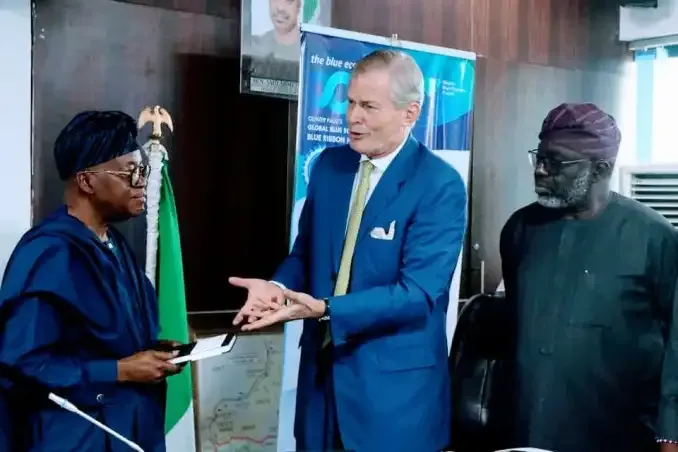
    The creator of Blue Economy, Prof Gunter Pauli, has said that, for the policy to succeed, the Federal Government must aggressively collaborate with the private sector to attract investment into the sector. 

    While hailing President Bola Tinubu for creating the Ministry of Marine and Blue Economy, Pauli said in six months the ministry can facilitate the creation of a hundred thousand jobs by exploiting opportunities provided by the blue economy.

    Prof Pauli, who listed shipping, paper conversion from wastes and maggot farming for poultry and fishing as low hanging fruits, urged the ministry to embrace job and wealth creation. 

    In his remarks, the Minister of Blue Economy, Gboyega Oyetola expressed happiness on the interest shown by Prof Pauli in assisting the country tap its idle capacity from the oceans and the blue economy, while also promising to work with private investors in opening up the sector.

    “I want to say that it’s not by accident that this ministry was created. It was part of the economic diversification policy of our country. We believed so much in oil but we now realize that 70% or so of the resources available actually come from the ocean and we have it in abundance here but neglected it for long.

    “I must commend the president for creating the ministry. I want to assure you that we are up to the task and I believe so much in the PPP arrangement because government has no business in business. Government should just provide the enabling environment for business to thrive,” the minister said.

    He disclosed that efforts have been stepped up to improve transportation infrastructure, including automation of port operations for efficiency and increase in revenue.

    “We now have sufficient control over insecurity and I want to tell you that for the past two years there has been no record of piracy on our shores. That is re-assuring to investors. I also assure you that we are ready to collaborate with investors, we are willing and ready and we will support all the initiatives that will bring all this to reality,” the minister promised,” he said. 

  • Nigeria’s Atomic Energy Commission Signs MoU With Russian Varsity

    Nigeria’s Atomic Energy Commission Signs MoU With Russian Varsity

    The Nigeria Atomic Energy Commission and Russia’s Tomsk Polytechnic University (TPU) have signed a Memorandum of Understanding (MoU).

    The parties, which agreed to cooperate in the field of nuclear education and development of the Nigerian nuclear industry, signed the agreement on Tuesday.

    According to Sputnik, the Russian news agency, the agreement was signed within the framework of the 67th session of the International Atomic Energy Agency (IAEA) General Conference in Vienna.

    Sputnik quoted the press service of the university as saying that Vera Verkhoturova, Advisor to the Rector for External Relations and Abdullahi Mati, Director of the Department of Nuclear Power Plants in the commission, signed on behalf of parties.

    It said TPU and the commission plan to create joint educational programmes, including dual degree programmes with Nigerian universities, academic exchange of students, distance learning, seminars, training courses and research in the field of nuclear physics and technology.

    “TPU has been training in-demand personnel for the nuclear industry for more than 70 years, and its graduates are heads of ministries and departments, heads of companies, engineering and management corps of leading nuclear industry enterprises,” Acting Rector of TPU, Leonid Sukhoy said.

    “Thanks to close cooperation with Rosatom State Corporation, whose main university is the TPU, we are developing international nuclear programs.

    “The university has already become a reference platform for the development of human resource capacity in the field of nuclear technologies in Indonesia, Bolivia, Egypt, and a number of other Rosatom partner countries.

    “And today, Nigeria has officially joined the list of our partner countries.

    “TPU will become a reference platform in Russia for training personnel in nuclear and related specialties in the interests of Nigeria.

    “We are grateful for the trust, I am sure that fruitful and mutually beneficial cooperation awaits us ahead,” he said.

    He added that employees of Nigeria’s energy commission are among the graduates of the TPU international educational nuclear programmes.

    The graduates, he said, are now successfully applying the acquired knowledge and competencies for the development of nuclear technologies in Nigeria.

    “I believe that this is just the beginning of a long-term cooperation,” he said.

    Prof. Yusuf Ahmed, Chairman of the energy commission, who also attended the event, said no fewer than 40 students from Nigeria are already studying for masters and postgraduate programmes in nuclear energy.

    He expressed the hope that the number will grow.

  • I left N129bn In FIRS Coffers – Nami

    I left N129bn In FIRS Coffers – Nami

    The immediate past Chairman of the Federal Inland Revenue Service (FIRS), Muhammad Nami, has insisted that he did not approve the sum of N11 billion after taking his pre-retirement leave as has been alleged by the Cable Newspaper.

    In a statement he personally signed, Nami said that the entire story was sensationally written with mischief that took the ordinary events of his work out of context with the intent to tarnish his hard-earned reputation.  

    The immediate past FIRS boss stressed that after his exit as FIRS Executive Chairman, he did not make any approvals as has been claimed by the newspaper. 

    Nami insisted that he met only N1.4 billion in the purse of the FIRS when he assumed office and left the sum of N129 billion in the purse of the Service when he handed over to the new Chairman, Zacch Adedeji recently.

    “Fundamentally, it is important to note that no payment was made by the Service after the announcement of my pre-retirement leave as claimed by this story. An approval for payment in the Service is one step of a journey to payment. It is the custom that when a new Executive Chairman resumes office, he would review, validate and make final authorisation before any payments can be made. 

    “It is important to note for the record that all decisions reached and extant liabilities/ commitments of the Service during my stay in office are contained in the handover notes I made available to my successor, Mr. Zacch Adedeji. He is fully briefed on everything. For clarity, the items listed in the Cable Newspaper Report were part of the N16 billion outstanding commitments contained in our handover note. 

    “The N5 billion paid to the Joint Tax Board was paid to fund the activities of the Presidential Committee on Tax and Fiscal Policy Reforms two months before I left office. It was paid after we received a letter to that effect from the office of Mr. President signed by Zacch Adedeji himself. 

    “The report maliciously attempts to portray a picture that I hurriedly left the country on September 16th after these so-called “suspicious approvals” were made. Again, nothing can be further from the truth. If I traveled out of the country on the 16th of September, how then did I attend the handover ceremony with Mr. Zacch on the afternoon of Monday 18th September 2023? That handover ceremony was covered by the media, and can be cross-checked. 

    “It is disappointing to see the Cable, a revered online newspaper attempt to sensationalise events that took place in the ordinary course of work in office, making them seem as if they were done in bad faith. 

    “I want to categorically state that every decision I made within the time of my stay in office was within the ambit of the law and within the lawful powers I exercised then as Executive Chairman,” he explained.

  • Bears Continue To Dominate As Equity Market Sheds N112bn

    Bears Continue To Dominate As Equity Market Sheds N112bn

    Bears continued to dominate the domestic equity market as investors’ weather depleted by N112 billion as sell off in the shares of companies in the financial services sector impacted on the market.

    Market capitalisation of listed equities declined by 0.31 per cent to N36.367 trillion from N36.479 trillion reported the previous day.

    The NGX benchmark index declined by 203.54 basis points to 66448.63 points from 66,652.17 points traded the previous day.

    The trading result showed that RTBriscoe led gainers table with 9.76 per cent to N0.45 per unit, CWG followed with a gain of 9.72 per cent to close at N7.90 per share, Betaglass gained 9.55 per cent to close at N56.20 per unit, Veritas Kapital gained 8.33 per cent to close at N0.26 per unit, Cornerstone Insurance added 7.88 per cent to close at N1.76 per share.

    On the contrary, Vitafoam Nigeria Plc topped losers chart in percentage terms, shedding 9.92 per cent to close at N22.25 per unit FTNCocoa trailed with a loss of 9.88 per cent to close at N1.55 per share, Oando Plc down by 9.84 per cent to close at N8.70 per unit, JohnHolt dipped by 9.39 per cent to N1.64 per share,United Capital declined by 7.20 per cent to close at N16.10 per unit.

    Volume of trades for the day declined also by 90.191 million, representing 24.78 per cent as Investors traded 273.798 million shares valued at N3.412 billion in 6826 deals against 363.989 million shares worth N4.529 billion in 7018 deals.
    AccessCorp led market activities with 45.877 million shares valued at N710.626 million, Zenith Bank followed with 21.116 million shares cost N657.222 million, Unity Bank traded 19.835 million shares cost N192.391 million, United Bank for Africa exchanged 17.294 million shares cost N279.315 million, Transnational Corporation of Nigeria exchanged 15.728 million shares worth  N93.924 million.

  • IMF Advocates Fiscal Adjustments As Solution African Countries’ Debts 

    IMF Advocates Fiscal Adjustments As Solution African Countries’ Debts 

    The International Monetary Fund (IMF) has urged African governments to re-anchor fiscal policy through a credible medium-term strategy to avoid a debt crisis.

    According to the Fund in its report ‘How to Avoid a Debt Crisis in Sub-Saharan Africa’, it stated that to avoid a debt crisis, African countries seek to achieve key debt targets.

    The Bretton Woods Institute said the average debt ratio in the region has almost doubled in 10 years adding that the average debt ratio to gross domestic product (GDP) has increased to 60 percent as of 2022, which is a 30 percent rise compared to the figures of 2013.

    According to the Fund, this is what makes debt repayment costlier.

    “In most sub-Saharan African countries, fiscal policy focuses excessively on short-term goals and is not guided by a clear medium-term strategy. This lack of anchoring has resulted in frequent breaches of fiscal rules and ever-increasing public debt levels.

    “A more strategic approach to fiscal policy would be preferable by setting explicit debt targets that integrate key policy trade-offs between debt sustainability and development objectives, rather than focusing narrowly on short-term fiscal deficits.

    “The paper suggests a novel approach to estimating country-specific medium-term debt anchors, which ensures that debt service costs remain manageable.

    “The region’s ratio of interest payments to revenue, a key metric to assess debt servicing capacity and predict the risk of a fiscal crisis, has more than doubled since the early 2010s and is now close to four times the ratio in advanced economies,” the IMF said.

    In the report, the IMF said more than half of the low-income countries on the continent are at high risk or already in debt distress as at the end of last year.

    The multilateral also said mobilising more domestic revenue through the elimination of tax exemptions or digitalising filing and payment systems is key to avoiding a debt crisis as well.

    “Sub-Saharan African countries tend to rely excessively on expenditure cuts to reduce their fiscal deficits.

    “Although this may be warranted in some circumstances, revenue measures, like eliminating tax exemptions or digitalizing filing and payment systems, should play a greater role.”

    The IMF noted that mobilising domestic revenue is less detrimental to growth in countries where initial tax levels are low, whereas the cost associated with reducing expenditures is particularly high given Africa’s large development needs.

  • Manufacturers Unsold Inventories Hits N272bn In 6 months –MAN

    Manufacturers Unsold Inventories Hits N272bn In 6 months –MAN

    The Manufacturers Association of Nigeria (MAN) says weakened purchasing power of Nigerians in the first half of 2023 pushed up the inventory of unsold finished products to N271.96 billion.

    MAN in its half year report on ‘Half Yearly Review of the Economy (January – June 2023) said the figure is N48.88 billion representing a 45.4 per cent growth compared to N187.08 billion recorded during the same period in 2022.

    MAN’s Director General Segun Ajayi-Kadir, noted that the decline in the purchasing power of Nigerians is due to diminishing real household income as a result of inflationary pressures.

    The National Bureau of Statistics in its inflation report for August stated that headline inflation jumped to 25.80 per cent. The figure is 1.72% points higher than the 24.08% reported in July. Analysts say the scarcity of the naira and the petrol subsidy removal further aggravated the situation.

    “Consequently, both businesses and foreign investors are growing increasingly cautious about committing capital, thereby impeding economic growth and the prospects for recovery.

    “The collective impact of these factors is an upsurge in inflationary pressures, which inflates production costs, diminishes consumers’ purchasing power, and exerts a significant influence on manufacturers,” remarked Ajayi-Kadir.