President of the Association of Bureau De Change Operators of Nigeria (ABCON), Aminu Gwadebe has urged the Central Bank of Nigeria (CBN) to immediately leverage the BDCs by allowing them access banks’ autonomous window and agency of international money transfer operators.
This, he said, will allow them to provide liquidity in the retail end of the foreign exchange market and help stop the free fall of the Naira occasioned by forex scarcity in the country.
Gwadebe also urged the CBN to reinstate its 2015 policy guidelines which allow the BDCs to effectively provide liquidity in the retail end of the market through the forex windows.
The 2015 policy guidelines allow the BDC operators to access foreign exchange from the autonomous window of the commercial banks as well as act as agents for diaspora remittances.
Gwadebe in his statement said BDCs are effective tools of the transmission mechanism of the CBN. “I quickly want to advise the apex bank to leverage on the BDCs and allow them access banks’ autonomous window and agency of international money transfer operators.
Gwadebe, who accused some of the International Money Transfer Organizations (IMTOs) of diverting diaspora remittances, said the commercial banks revealed that they don’t even see most of these remittances.
“Imagine you are the IMTO and then you are the one that will pay the beneficiary the naira, invariably, then I as well just give you the naira without paying you the dollar.’’
“Even the banks have been saying that they are not seeing the diaspora remittances that the fintechs have taken over. We had a meeting with the banks where we even tried to bring up the issue of diaspora remittances so that we can harness it and bring liquidity, but they said they don’t see it. That’s the truth of the matter, a lot of unlicensed online firms are in the process.’’
The black market rate fell to as low as N950/$1 last week, opening up about N200 disparity with the I&E window as demand continued to outstrip supply. Meanwhile, the official rate averaged N765/$1.
Author: Chike Ozohili
-

Allow us access banks’ autonomous window, BDCs appeal to CBN
-

Equity market continues negative trend, sheds N59bn
Domestic equity market on Tuesday sustained its negative trend, shedding N59 billion following declines in share price of Unilever Nigeria Plc, Eterna Plc, UACN, Dangote Sugar among othe
Market capitalisation of listed declined by 0.17 per cent to N35.356 trillion from N35.415 trillion reported the previous day.
The NGX All Share Index also depreciated by 107.37 basis points to 64928.98 points from 65036.37 points traded on Monday.
A review of the transactions during the day showed that Tantalizer led gainers table, gaining 10 per cent to close at N0.44 per share, Ikeja Hotel followed with a gain of 9.82 per cent to close at N3.13 per unit, Cornerstone Insurance added 9.30 per cent to close at N1.41 per share, TIP gained 8.82 per cent to close at N1.11 per unit, Linkage Assurance grew by 8.33 per cent to close at N0.91 per unit.
On the contrary, Eterna Plc recorded the highest loss with a drop of 9.86 per cent to close at N16.00, SUNU Assurance trailed with a loss of 9.62 per cent to close at N0.94 per share, Omatek down by 8.11 per cent to close at N0.34 per share, Unilever fell by 7.05 per cent to close at N14.50 per share while AIICO Insurance dipped by 5.63 per cent to close at N0.67 per unit.
Investors traded 280.468 million shares valued at N4.645 billion in 6296 deals against 259.041 million shares worth N4.204 billion exchanged hands the previous day in 5899 deals.
Trading in the shares of Transnational Corporation of Nigeria led market activities with 36.469 million shares valued at N147.502 million in 244 deals , United Bank for Africa followed with account of 23.242 million shares cost N475.416 million in 367 deals, AccessCorp traded 17.667 million shares worth N299.366 million in 375 deals, Sterling Bank exchanged 15.973 million shares cost N57.498 million in 190 deals while Japaul Gold traded 11.398 million shares valued at N11.015 million in 93 deals.
-

AMAC, FCT IRS on collision course over double taxation
The Chairman of Abuja Municipal Area Council (AMAC), Hon. Christopher Zakka Maikalangu, has urged President Bola Ahmed Tinubu, security agencies and relevant authorities to intervene in calling the Federal Capital Territory Internal Revenue Service (FCT IRS) to order with regards to the collection of revenue belonging to the council.
Speaking to newsmen Tuesday at AMAC headquarters, Maikalangu, who was represented by the Supervisory Councilor for Special Duties, Mr Emmanuel Inyang, said that AMAC has not signed any agreement with FCT IRS with regards to revenue collection.
Maikalangu said that, even at a recent townhall meeting organized by FCT IRS for the six area councils in the FCT, with the aim of revenue harmonisation, the Permanent Secretary of the FCT, Dr Olusade Adesola, said he was the driver of revenue harmonisation, but left the meeting halfway and hence unable to answer questions, leading to the inability to reach any consensus.
The AMAC chairman said FCT IRS was harassing AMAC and FCT residents with the aim of their paying the same taxes they had already paid to AMAC, thereby opening ways to double taxation.
He said that the court had already ruled that AMAC should not pass over the role of revenue collection to a third party, hence the need for FCT IRS to explain from where it derived its powers to be collecting revenue on behalf of AMAC.
Maikalangu said that FCT IRS is preparing way for anarchy and a breakdown of law and order by harassing AMAC residents for revenue, including the “Park and Pay” policy that is the duty of AMAC.
The Council Chairman, therefore, urged President Tinubu and concerned authorities to, as a matter of urgency, call the FCT IRS to order before it plunges AMAC and the FCT into anarchy by harassing residents to pay taxes they had already paid to AMAC, even as far back as 2010.
Maikalangu said that the council remains law abiding and hence will not take laws into its hands, but warned that the council will not sit idly and watch FCT IRS engage in illegalities such as collecting revenue meant for AMAC.
Maikalangu advised residents not to pay revenue to agents purporting to be FCT IRS, otherwise they will pay double as only revenue paid into AMAC account will be acceptable.
In the same breath, Maikalangu urged AMAC residents not to pay revenue to FCT IRS, but to challenge any official from the Service to go to court for an order that will explain how it came about collecting revenue for AMAC.
-
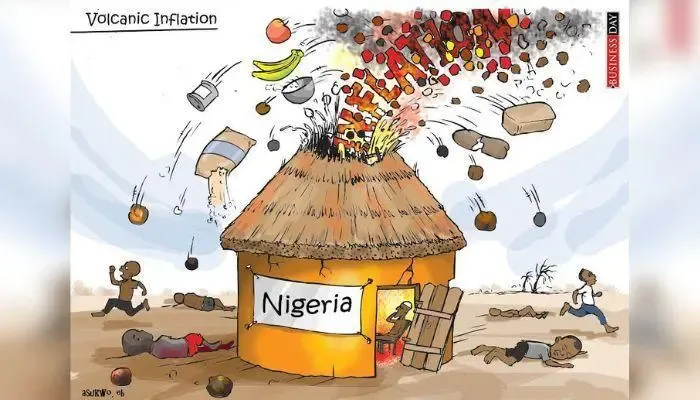
Nigeria’s inflation shoots to 24.08% in July -NBS
Nigeria’s headline inflation rate for the month of July 2023 increased to 24.08% from 22.79% recorded in June 2023.
This was contained in the Consumer Price Index report by the National Bureau of Statistics.
According to the NBS, the figure represents a 1.29% percentage points rise from June headline inflation while on year-on-year basis, the inflation rate was 4.44 percentage points higher compared to the rate recorded in July 2022, which was 19.64%.
The report noted that the increase was attributed to an increase in contributions of some items in the basket of goods and services at the divisional level.
“These increases were witnessed in Food & Non-Alcoholic Beverages (12.47%), Housing, Water, Electricity, Gas & Other Fuel (4.03%), Clothing & Footwear (1.84%), Transport (1.57%), Furnishings & Household Equipment & Maintenance (1.21%), Education (0.95%) and Health (0.72%).
“Others are Miscellaneous Goods & Services (0.40%), Restaurants & Hotels (0.29%), Alcoholic Beverages, Tobacco & Kola (0.26%), Recreation & Culture (0.17%) and Communication (0.16%).
“On a month-on-month basis, the Headline inflation rate in July 2023 rose to 2.89%, this shows an average increase of 0.76 percentage points on the general price level relative to June 2023,” it said.
The report also noted that the percentage change in the average Consumer Price Index for the twelve months ending July 2023 over the average of the CPI for the previous twelve months was 21.92%, showing a 5.17% increase compared to the 16.75% recorded in July 2022.
“The food component sub-index for July 2023 increased by 26.98% on a year-on-year basis; this was 4.97% points higher relative to the rate recorded in June 2022 (22.02%).
“The rise in Food index on a year-on-year basis was caused by increases in prices of Oil and fat, Bread and cereals, Fish, Potatoes, Yam and other tubers, Fruits, Meat, Vegetable, Milk, Cheese, and Eggs,” the report added.
The further observed that, the Food inflation rate on a month-on-month basis, in July 2023 rose to 3.45%, this was 1.06% points higher compared to the rate recorded in June 2023 (2.40%).
“The average annual rate of Food inflation for the twelve months ending July 2023 over the previous twelve-month average was 24.46%, indicating an increase of 5.71% points from (18.75%) recorded in July 2022.
“Core inflation, which is All items less farm produce, that is excluding the prices of volatile agricultural produce, stood at 20.47% in July 2023 on a year-on-year basis; it rose by 4.41% when compared to the 16.06% recorded in July 2022.
“This was driven by an increase in prices of Passenger Transport by Air, Passenger Transport by Road, Vehicle Spare parts, Medical Services, Maintenance and repair of personal transport equipment etc.
On a month-on-month basis, the Core inflation rate stood at 2.11% in July 2023.
“This shows an increase of 0.34% when compared to the 1.77% recorded in June 2023.
The average annual core inflation rate for the twelve-month ending July 2023 over the previous twelve-month average stood at 18.84%; this was 4.31% points higher than the 14.53% recorded in July 2022.
“The inflation rate in July 2023 for Urban consumers was 25.83% on a year-on-year basis. This indicated an increase of 5.74% points higher compared to the 20.09% recorded in July 2022,” it said.
Also, the Urban month-on-month inflation rate rose to 3.05% in July 2023, which was 0.75% points higher compared to June 2023 (2.31%).
The report said the twelve-month average for the Urban inflation rate ending July 2023 over the corresponding twelve-month was 22.87%. This was 5.59% points higher compared to the 17.29% reported in July 2022.
“Similarly, the inflation rate for rural consumers in the month of July 2023 was 22.49% on a year-on-year basis; this was 3.26% points higher compared to the 19.22% recorded in July 2022.
“On a month-on-month basis, the Rural inflation rate in July 2023 was 2.74%, up by 0.78% points compared to June 2023 (1.96%).
“The twelve months average for the Rural inflation rate ending July 2023 over the corresponding twelve-month was 21.04%. This was 4.79% points higher compared to the 16.25% recorded in July 2022.
“The analyses of the states show that the all-item index for July 2023, on a year-on-year basis was highest in Kogi (28.45%), Lagos (27.30%), Ondo (26.83%); while the states with slowest rise in headline inflation on a year-on-year basis were Borno (20.71%), Jigawa (20.85%) and Sokoto (20.92%) during the month.
“On a month-on-month basis, July 2023 headline inflation recorded the highest increase in Kogi (4.99%), Abia (4.12%), and Akwa Ibom (4.07%). On the other hand, Jigawa (0.16%), Taraba (1.09%) and Yobe (1.10%) recorded the slowest rise on month-on-month inflation.
“State-level analyses of the food index in July 2023, on a year-on-year basis, showed the highest increases in Kogi (34.53%), Lagos (32.52%) and Bayelsa (31.31%). While Jigawa (20.90%), Sokoto (21.63%) and Kebbi (22.45%) recorded the slowest rise in Food inflation during the month.
Ends
-

Gunmen kill newly-wedded couple in Plateau
Unknown Gunmen have killed a newly-wedded couple, both of whom are teachers at BECO Comprehensive High School, Kwi in Riyom Local Government Area of Plateau.
The gunmen also injured the Vice-Principal of the School. The incident happened on Monday.
The Police Public Relations Officer in Plateau, DSP Alfred Alabo, confirmed the incident to newsmen on Tuesday.
Alabo, who did not give further details on the incident, said that the command was on top of the situation.
In a statement in Jos, Mr Rwang Tengwong, National Publicity Secretary of Berom Youth Movement, a socio-cultural group, said that the incident occurred at about 3.00 p.m. on Monday.
”We are saddened by the invasion of BECO Comprehensive High School Kwi by gunmen.
“Two teachers, Mr. and Mrs. Rwang Danladi, a newly-wedded couple, were shot dead.
”Mr. Dalyop Emmanuel, the Vice-Principal of the School, was seriously injured by the armed men.
”The teachers were holding a meeting to compile results of students in preparation for the school’s 2023 Speech and Prize-Giving Day slated for this Friday.
”The injured person is currently receiving treatment at the Jos University Teaching Hospital,” he said.
The spokesperson decried the influx of criminals in some communities in the state.
”We call on security operatives to, as a matter of urgency, raid these communities that have become enclaves of criminals, particularly Fass and Mahanga in Riyom.
”This is necessary to get rid of criminal elements that have defied law and order,” he said.
-

Nigeria’s intercity transport rises by 98.88% in June -NBS
The average fare paid by commuters for bus journeys within the city per drop increased by 97.88 percent from N649.59 in May 2023 to N1,285.41 in June 2023, the National Bureau of Statistics (NBS) has said.
In its Transport Fare Watch of June 2023 posted on its website, the NBS stated that on a year-on-year basis, it rose by 120.63% from N582.61 in June 2022.
Analysts have attributed the astronomical increase to fuel pump price hike following the removal of fuel subsidy by President Bola Ahmed Tinubu.
Transport Fare Watch for June 2023 covers the following categories: bus journey within the city per drop constant route; bus journey intercity (state route) charge per person; air fare charge for specified routes single journey; journey by motorcycle (Okada) per drop; and water way passenger transport.
In another category, the average fare paid by commuters for bus journey intercity per drop rose to N5,686.49 in June 2023, indicating an increase of 42.09% on a month-on-month basis compared to N4,002.16 in May 2023.
“On a year-on-year basis, the fare rose by 55.25% from N3,662.87 in June 2022. In air travel, the average fare paid by air passengers for specified routes’ single journey increased by 4.93% from N74,948.78 in May 2023 to N78,640.54 in June 2023. On a year-on-year basis, the fare rose by 40.22% from N56,082.64 in June 2022.
“The average transport fare paid on Okada transportation was N618.52 in June 2023 which was 33.14% higher than the rate recorded in May 2023 (N464.55),” the statistics bureau stated.
On a year-on-year basis, the fare rose by 48.34 percent when compared with June 2022 (N416.97).
For water transport (waterway passenger transportation), the average fare paid in June 2023 increased to N1,366.22 from N1,045.15 in May 2023. On a year-on-year basis, it increased by 44.84% from N943.26 in June 2022
-

Economic Reforms: BudgiT tasks Tinubu on transparency, accountability
BudgiT, a civic tech organization, is advocating for the implementation of a transparency and accountability plan to ensure the fulfillment of President Bola Ahmed Tinubu’s commitments.
This call follows President Tinubu’s national broadcast on July 31, 2023, addressing the prevailing economic challenges in the country.
During his speech, President Tinubu unveiled various measures to address the economic crisis.
Notably, he announced a budget allocation of N75 billion from July 2023 to March 2024 to support 75 promising manufacturing enterprises with N1 billion credit each.
These credits would carry a 9 percent interest rate for long-term loans spanning up to 60 months and 12 months for working capital.
BudgiT, in a statement signed by its Communications Associate, Nancy Odimegwu, emphasized the importance of transparent execution.
The organization highlighted President Tinubu’s commitment to stabilize staple food prices by releasing 200,000 metric tonnes of grains and 225,000 metric tonnes of fertilizer and inputs to farmers.
Moreover, President Tinubu outlined plans to bolster Micro, Small, and Medium Enterprises (MSMEs) through an N125 billion investment.
This initiative includes allocating N50 billion as a Conditional Grant to support 1 million nano businesses and dedicating N75 billion to assist 100,000 MSMEs and start-ups.
Additionally, the introduction of affordable Compressed Natural Gas (CNG)-fueled buses, backed by an N100 billion investment, and collaboration with labour unions to establish a new national minimum wage were outlined in the plan.
While acknowledging the substantial effort to navigate the intricacies of the economic crisis arising from fuel subsidy removal, BudgiT stressed that the successful execution of these commitments hinges on transparent planning and robust accountability mechanisms.
-

Toyota to begin production of longer-lasting EV batteries by 2026
Toyota has announced exciting advancements in batteries for electric vehicles (EVs), which are pointing to longer battery life by as early as 2026.
The breakthrough occurred on two fronts: increased optimization of lithium-ion batteries and advancements in solid-state batteries for EVs.
Findings for lithium-ion batteries will result in increased battery life and shorter charging time, common concerns among prospective EV buyers. Current EVs allow for approximately 330 miles on one charge, while the updated battery could handle up to 621 miles.
Solid-state batteries would take that even further, allowing for approximately 745 miles on one charge. Created for items like pacemakers and smartwatches, they are similar in structure to lithium-ion batteries but historically have not been durable enough to support EVs.
Toyota’s new breakthrough could put EVs with solid-state batteries on the market by 2027, and they have mentioned zeroing in on a more affordable manufacturing process — leaning more on automated processing than human labor on an assembly line.
Currently, it costs about half as much to power an electric car as it does a gasoline-powered vehicle. Public charging costs are expensed by the minute — meaning that with the breakthroughs in battery life, owning an EV will become even more affordable.
On top of that, there are federal and local monetary incentives depending on where you live, and EVs require less maintenance overall.
EVs also leave a much smaller impact on the environment. Just one electric car on the road can save 1.6 tons of pollution annually, while gas-powered vehicles produce, on average, over 10,000 pounds of harmful gases per year.
-

Equity market opens week bearish, declines 0.44%
Transactions on the floor of the Nigerian Exchange (NGX) on Monday opened in the negative territory, shedding N157 billion.
The market capitalisation of listed equities declined by 0.44 per cent to N35.415 trillion from N35.572 trillion reported the previous day.
The NGX All Share Index also depreciated by 289.00 basis points to 65036.37 points from 65325.37 points reported on Friday.
An analysis of the Investment showed that Cornerstones Insurance led gainers table with 9.32 per cent to close at N1.29 per unit, Omatek followed with a gain of 8.82 per cent to close at N0.37 per share, TIP gained 8.51 per cent to close at N1.02, Chams Plc added 7.37 per cent to close at N1.02 per unit, RTBriscoe grew by 6.98 per cent to close at N0.46 per unit.
On the contrary Eterna Plc topped losers chart, dropping 9.90 per cent to close at N17.75 per unit, SUNU Assurance trailed with a loss of 9.57 per cent to close at N1.04 per share, UPL declined 9.24 per cent to close at N2.26 per share, FTNCocoa down by 8.44 per cent to close at N2.06 per share while Okomu Oil dipped by 5.66 per cent to close at N250.00.
The volume of trades declined by 230.649 million representing 47.10 per cent as investors traded 259.041 million shares valued at N4.204 billion in 5899 deals against 489.690 million shares worth N8.362 billion exchanged hands the previous day in 5804 deals.
Transnational Corporation of Nigeria led market activities with 41.760 million shares valued at N167.930 million, AccessCorp followed with an account of 18.155 million shares cost N312.692 million, GTCO Plc traded 15.566 million shares cost N585.099 million, Sterling Bank exchanged 14.186 million shares cost N50.996 million and United Bank for Africa traded 13.009 million shares cost N185.375 million.
-

‘European refiners groan as Nigeria’s subsidy removal bites harder’
Petrol subsidy removal by the Bola Tinubu administration is impacting European refiners negatively as demand for the product has reduced by more than 50 per cent, S&P Global Commodities at Sea has said.Imports of petrol to Nigeria plummeted to 106,000 barrels per day, b/d in July from 205,200 b/d in May, according to data from S&P Global Commodities at Sea, after local petrol prices skyrocketed.
Total refined product demand has fallen 41 per cent in the same period, the data showed.
Scrapping the long-standing subsidy could save Nigeria as much as Naira 11 trillion ($2.6 billion) in 2023, according to estimates from the World Bank in June, providing relief to a growing government deficit.
Sinking Nigerian demand, driven by high fuel prices, has also led to a drop-off in demand for European exports, whose refiners had relied on thirsty West African markets.
“There is zero demand [in West Africa] at the moment,” a source in the region said.
Another European market source said: “Considering the [Nigerian] subsidy removal … demand is indeed depressed.”
The 91 RON FOB AR WAF discount to FOB AR gasoline cargoes was $89/mt on August 10, down sharply from before the subsidy was taken away. On May 22, the spread was at a premium of $50.25/mt, but by the end of the month had fallen to a discount.
The subsidy removal has shaken up longstanding arbitrage for European refiners.
While Nigerian demand in particular has diminished, other destinations have picked up the slack. The US Atlantic Coast made up 28 per cent of total petrol exported from the Amsterdam-Rotterdam-Antwerp region in July amid persistently low stocks, according to Kpler shipping data, increasing its share from the low teens almost in tandem with the shrinking Nigerian demand.
As a result, European refiners have been unfazed by sinking demand in West Africa. “The arb is strong. Octanes are tight, so petrol remains well supported” a trader in Europe said.
European traders already faced being crowded out by Russian refined products that have flooded into Africa — including Nigeria — since the onset of the war in Ukraine saw European countries boycott Russian oil products. Yet even Russian exports to Nigeria have fallen sharply since the fuel subsidy was scrapped.
Nigeria is Africa’s largest oil producer, with an output of 1.32 million b/d last month according to the Platts OPEC Survey from S&P Global, but a lack of refining capacity means the country is forced to import refined products.
One potential solution is the long-awaited Dangote refinery inaugurated by former president Muhammadu Buhari in April. The mega project, built by Aliko Dangote, is designed to make Nigeria self-sufficient in fuels, soften the gasoline market, and even to supply countries across Africa and beyond.
According to estimates from S&P Global, Nigerian gasoline production could overtake imports in 2025 and exceed them until the 2040s, if the refinery can get up and running.