Author: Vivian Michael

  • Ex-terrorist negotiator, Tukur Mamu wants transfer from DSS custody to Kuje prison

    Ex-terrorist negotiator, Tukur Mamu wants transfer from DSS custody to Kuje prison

    Former terrorist negotiator, Mohammed Tukur Mamu, has asked Justice Inyang Ekwo of the Federal High Court Abuja, to transfer him out of the custody of the Department of the State Service (DSS) to Kuje prison.

    The DSS, on March 21, 2023, arraigned him on 10 count charge of terrorism financing, among others.

    He pleaded not guilty to the charges.

    Mamu was arrested at the Aminu Kano International Airport upon his arrival from Egypt on September 6, 2022, over his alleged relationship with the terrorists who attacked the Abuja-Kaduna train on March 28, 2022.

    At the resumption of his trial on Monday, Mamu through his counsel Abdul Mohammed SAN, alleged that the order of the court made on December 19, 2023, that he be allowed access to his personal physician for medical treatment was not complied with by DSS.

    In his motion on notice argued by Mohammed, the former terrorist negotiator claimed that he was allowed access to the physician once during which a report of comprehensive medical examination to be carried out on him was submitted to the DSS.

    Since the submission of the report, Mamu alleged that the physician had not been allowed to access him and that he needed urgent surgical operations in any hospital in the county.

    The defendant further claimed that his health had since deteriorated and that he may lose his life any moment if he was not moved out of DSS custody to Kuje prison.

    He promised regular attendance at the trial in the terrorism charges adding that he can only stand trial when alive.

    There was however a mild drama at the proceeding when a federal government lawyer, David Emmanuel Kaswe who was billed to respond to Mamu’s request suddenly disappeared in the court room without any excuse or notification .

    The situation forced the court to stand down the proceeding for over one hour but yet the prosecution counsel did not show up.

    Justice Ekwo who expressed shock over the attitude of the lawyer to the court said “Iam aware that the prosecution counsel was in this court room this morning.

    “The miracle of his disappearance is however beyond my understanding. This court stands on the side of justice and the antics of the prosecution will be tolerated for today’s proceeding only”.

    Justice Ekwo invoked the rule of the court and ordered that the processes filed by the lawyer against Mamu’s application be deemed adopted.

    The Judge subsequently fixed May 20 for ruling on whether to move the defendant out of DSS custody to Kuje prison or not.

  • NNPCL refuses FOI request on staff, Asabe Waziri over multi-million naira property In Abuja, Lagos  …says personal details of staff not discloseable

    NNPCL refuses FOI request on staff, Asabe Waziri over multi-million naira property In Abuja, Lagos …says personal details of staff not discloseable

    The Nigerian National Petroleum Company Limited (NNPCL) has turned down a Freedom Of Information, FOl, request on regarding employment status and alleged multi-million naira property acquisition by a staff of the company, Ms. Asabe Waziri.

    In its reply, the company said the personal inflation of nuts staff is not discloseable.

    NNPCL, through its counsel, Chief Afe Babalola, SAN, in its reply dated April 22, 2024 to an FOI request by Human Rights Writers Association of Nigeria, HURIWA, said, “Accordingly, we regret our client’s inability to accede to your demand for the requested information. Our client, with this, outrightly rejects your request.”

    In the FOI request, HURIWA had sought to know the following:
    The current employment status of Ms. Waziri with NNPC Limited, including her position, department, and any relevant employment records, her salaries and benefits date of enlistment with any records indicating her length of service.

    Other information sought by HURIWA include, acquisition of property: clarification on how Ms. Waziri, as a public servant, allegedly acquired two units of residential property (specifically, units 3B and 3C, Abbey Signature Apartments, 1 Mekong Close, Maitama Abuja FCT) valued at N260 million and the verification of the allegation that Ms. Waziri made a purchase of a prized housing asset in Lagos and information regarding any additional actions or disciplinary measures taken by NNPCL.

    In its response, the company said, “Having reviewed your request, we invite you to please note that our client has ceased to be subject to the Freedom of Information Act 2011 (FOIA) following the coming into force of the Petroleum Industry Act 2021, by which the erstwhile Nigerian National Petroleum Corporation (the Corporation), which was a public institution, transited to a limited liability company upon the registration of the Nigerian National Petroleum Company Limited (NNPC) under the Companies and Allied Matters Act 2020. Thus, our client is not obligated to respond to demands for information under the FOIA. Be that as it may, our client highlights the following in the interest of due process and transparency: i. The information listed as items 1 to 4 are exempted from the application of the Freedom of Information Act, 2011. Section 14 (1)(b) of the Freedom of Information Act, 2011 reads: “…a public institution must deny an application for information that contains .ersonal in ormation and in ormation exem ted under this subsection includes – @) -ersonnel ‘les and 22 onal in ormation maintained with res .. ct to employees, appointees or elected officials of any public institution or applicants for such positions,”

    “As information regarding the salaries, salary scale, benefits, benefits package, additional compensation from our client, date of enlistment position, department, acquisition of property, and any relevant employment records are employees‘ personal information in personnel files, our client must deny your request.

    “Furthermore, information regarding any additional actions or disciplinary measures taken by our client concerning its staff is not disclosable under the Freedom of Information Act 2011. Please see Section 12 (1) (a) of the Freedom of Information Act 2011, which prohibits the release of information in relation to records compiled by the institution for administrative enforcement proceedings or internal matters. It provides that: “12. (1) A public institution may deny an application for any information which contains(a) Records compiled by any public institution for administrative enforcement proceedings and by any law enforcement or correctional agency for law enforcement purposes or for internal matters of a public institution…”

    “As our client is not a party to the alleged suit(s) and dispute between Ms Waziri, Abbey Signature Limited, or any other person, it will not get involved in any matter(s) arising from or connected to the dispute.”

  • Rivers LGA chairmen to court: Compel IGP, DSS to provide us adequate security

    Rivers LGA chairmen to court: Compel IGP, DSS to provide us adequate security

    Local Government Chairmen in Rivers State, have asked the Federal High Court in Abuja to compel the Inspector General of Police (IGP), and the Director General, State Security Service (SSS) to provide them adequate security for their lives and properties.

    In a fresh suit, they claimed that under sections 215 of the 1999 Constitution and sections 4, 7 and 9 of the Police Act 2020, the IGP, SSS and other security agencies are under statutory obligations and bound to ensure their security and welfare.

    In an originating summons instituted on their behalf by Mahmud Abubakar Magaji SAN, the council Chairmen also sought order of the Court against the Attorney General of the Federation (AGF), not to allow any other laws to be implemented for local governments in Rivers other than the ones enacted by the State House of Assembly.

    They predicated their fears on alleged threat and boast by the Rivers State Government not to implement or enforce the laws made the state House of Assembly for the local governments.

    They formulated seven major issues for the court to determine in resolving their grievances with all the defendants in the suit.

    Among others, they asked the court to determine “whether by the combined provisions of sections 215 and 14 of the Constitution of the Federal Republic of Nigeria 1999 as well as sections 4, 7 and 9 of the Police Act 2020, the IGP, CP Rivers, SSS and Director, SSS and other security agencies are not statutorily bound to provide security and welfare for their lives and properties.

    “Whether by the combined provisions of sections 215 and 14 of the Constitution of the Federal Republic of Nigeria 1999 as well as sections 4, 7 and 9 of the Police Act 2020, the IGP, CP Rivers, SSS and Director, SSS are not bound to recognize and enforce all laws and regulations made by the Rivers State House of Assembly.

    Whether by the combined provisions of sections 215 of the Constitution of the Federal Republic of Nigeria and sections 4, 7 and 9 of the Police Act 2020, the defendants are not bound to recognize and enforce Rivers State Local Government (Amendment) Law No. 4 of the 2024 passed by the Rivers State House of Assembly.

    “Whether by virtue of the combined provisions of sections 7 and the Fourth Schedule of the Constitution of the Federal Republic of Nigeria 1999, the local government coincils in Rivers State are not Constitutionally recognized and autonomous as the 3rd tier of government and thereby entitled to Allocation from Federation Account.

    Upon resolving the issues in their favour, the Chairmen asked the court to make declaration that the IGP, CP Rivers, SSS and Director, SSS and other security agencies are statutorily bound to provide security and welfare for their lives and properties

    They also applied for a declaration that the IGP, CP Rivers, SSS and Director, SSS and other security agencies are bound to recognize and enforce all laws and regulations inclusive of the one made by the State House of Assembly of Rivers State.

    The chairmen also want declaration that no organ of any government has power to withhold the financial allocations due to local governments in Rivers State.

    The originating summons is supported by a 29 paragraph affidavit deposed to by one Dr Chidi LLoyd, a legal practitioner and Chairman of Emohua Local Government on behalf of other 41 Chairmen.

    Some of the Chairmen who filed the suit are Dr Chidi LLoyd, Chairman, Emohua local government, Hon Alwell Ihunda Chairman,Port Harcourt local government, Dr Nwanosike Samuel, Ikwerre local government area, Barrister George Ariolu, Chairman, Obio-Akpor local government, Dr Obbinna Anyawu, Chairman, Etchi local government area and Hon Chidorom Nwaiwu, Chairman, Omuma local government area.

    Others are Dr Hope Ikiriko, Chairman, Ahoada West local government area, Barrister Benjamin Isreal Eke, Chairman, Ahoada East Local Government and Dr Roland Sekibo, Chairman, Akuku-Toru local government area among others.

    The defendants are IGP, CP Rivers, DG SSS, Director SSS Rivers, AGF, Chairman Revenue Mobilization Allocation and Fiscal Commission, Rivers State Government, AG Rivers State and Finance Commissioner in Rivers State as 1st to 9th defendants.

    A Federal High Court in Abuja had on Friday last week stopped the Rivers State Government from withholding the financial allocations of the 42 Local Government Areas in the state pending the determination of a.motion on notice for interlocutory injunction instituted by the Chairmen of the Council against the state and nine others.

    In a ruling, the Court stopped the Inspector General of Police IGP, Police Commissioner in Rivers, Director General, State Security Service, SSS and Director, State Security Service SSS from withdrawing the security personnel of the local government Chairmen pending the final resolution of the their motion on notice.

    Justice James Kolawole Omotoso issued the order for status quo to be maintained by the parties in the a marked FHC/ABJ/CS/537/2024.

    Meanwhile, no date has been set for hearing of the originating summons.
  • Guinness Nigeria reports N62bn loss despite price hikes

    Guinness Nigeria reports N62bn loss despite price hikes

    Despite the hikes in prices of it’s products, Guinness Nigeria has reported a loss of N61.7 billion for the nine-month period ended March 31, 2024, compared to a profit of N5.9 billion in the same period of 2023 despite an increase in price.

    The brewer recorded 28 per cent growth in revenue to N220.3 billion compared to N172.5 billion in the same period last year.

    The Managing Director/CEO of Guinness Nigeria Plc, Adebayo Alli, who expressed this said that, while the current macroeconomic environment will continue to present challenges, “I am confident in the resilience of our business and our ability to navigate the volatility.”

    “Our focus remains steadfast on innovation and stepping up operational excellence to meet our consumers’ evolving tastes and preferences.

    “Furthermore, the company intensified its focus on consumer engagement and trade support, leveraging its digital platforms.

    Notably, categories such as non-alcoholic malt, ready-to-serve beverages, and international premium spirits witnessed substantial revenue growth, underscoring the effectiveness of these strategies,” he said.

    Recall that earlier in May, Guinness Nigeria implemented a price increase on all its products, which was ascribed to the rising cost of production and cost of doing business.

    It said in a notice titled, “Price Increase by Guinness Nigeria Plc – Selected Brands,” which was signed by its Ag. commercial director, Olusanya Adesanya, that the new range of prices would take effect from today.

    “Following the prevailing economic realities which have impacted significantly on the costs of our production materials and cost of doing business, this is to inform you that we plan to take a price increase on selected SKUs in our Beer and MSS category,” Guinness Nigeria said.

    “This new price structure will be effective from Wednesday, March 13, 2024, (Go-Live date), and further details will be communicated subsequently,” it said.

    Guinness further told its customers to, “please note the following conditions regarding the price increase. Maximum purchase volume before price increase at old pricing is capped at one-week depletion subject to stock availability.

    Affected products are Guinness Stout, Guinness FES, Guinness Smooth, Malta Guinness, Dubic Malt, Smirnoff Ice, Orijin, Orijin Bitters, Gordon’s Pink Berry, Gordon’s Sunset Orange, Gordon’s Moringa Citrus, Smirnoff X1 Smooth and Choco, Captain Morgan and Orijin Herbal Gin.

    Guinness price of about N500 now sells for N800 and N900, indicating 80 per cent increase. Big stout retails N1000 from N700, which is a 43 per cent increase.

    Trophy’s price increased by 40 per cent to N700 from N500 while Guilder retails N1000 from N600, indicating 67 per cent increase.

    Guinness Nigeria, a Nigerian-based subsidiary of Diageo Plc of the United Kingdom, was incorporated in 1962 with the building of a brewery in Ikeja. The brewery was the first Guinness operation outside Ireland and Great Britain. Other breweries have been opened over time: Ogba brewery in 1963 and Benin City brewery.

  • Missing’ $2.04bn, N164bn oil revenues: SERAP sues NNPC Ltd

    Missing’ $2.04bn, N164bn oil revenues: SERAP sues NNPC Ltd

    Socio-Economic Rights and Accountability Project (SERAP) has dragged the Nigerian National Petroleum Company (NNPC) Limited to court over the “failure to account for the alleged missing USD$2.04 billion and N164 billion oil revenues.

    This is following the allegations contained in a recently published 2020, audited report by the Auditor General of the Federation(AGF).

    According to the report, the NNPC failed to remit the money into the Federation Account, adding that the money may have been diverted.

    In the suit number FHC/ABJ/CS/549/2024, before the Federal High Court, Abuja, SERAP is seeking: “an order of mandamus to direct and compel the NNPC to account for and explain the whereabouts of the missing USD$2.04 billion and N164 billion oil revenues, as documented in report by the Auditor-General.

    SERAP is seeking: “an order of mandamus to compel the NNPC to hand over suspected perpetrators to the Independent Corrupt Practices and Other Related Offences Commission (ICPC) and the Economic and Financial Crimes Commission (EFCC) for investigation and prosecution.

    It also praying for an order of mandamus to compel the NNPC to ensure the full recovery and remittance of the missing USD$2.04 billion and N164 billion into the Federation Account.

    As well as an order of mandamus to compel the NNPC to ensure the full recovery and remittance of the missing USD$2.04 billion and N164 billion into the Federation Account.

    In the suit, SERAP is arguing that:

    “There is a legitimate public interest in providing the details sought. The NNPC has a legal responsibility to account for and explain the whereabouts of the disappeared money.”

    “The missing oil revenues have further damaged the already precarious economy in the country and contributed to high levels of deficit spending by the government.”

    It posited that, “Without the full recovery and remittance of the missing USD$2.04 billion and N164 billion oil revenues, the dire economic situation may worsen and Nigerians will continue to be denied access to basic public goods and services.”

    “the Auditor-General has for many years documented reports of disappearance of public funds from the NNPC. Nigerians continue to bear the brunt of these missing oil revenues.”

    The suit filed on behalf of SERAP by its lawyers, Kolawole Oluwadare and Kehinde Oyewumi, read in part:

    “The alleged missing oil revenues reflect a failure of NNPCL accountability more generally and are directly linked to the institution’s continuing failure to uphold the principles of transparency and accountability.

    “The NNPCL reportedly failed and/or refused to remit N151,121,999,966. The NNPCL without any justification deducted the money from the oil royalties assessed for 2020 by the Department of Petroleum Resources (DPR) now Nigerian Upstream Petroleum Regulatory Commission (NUPRC).

    “The NNPCL has failed to account for the missing public funds. The Auditor-General wants the money recovered and remitted into the Federation Account.

    “The NNPCL also failed to remit USD$19,774,488.15 collected as government revenue into the Federation Account. The Auditor-General wants the NNPCL to account for the money, recover and remit it into the Federation Account, and to hand over those suspected to be involved to the ICPC and the EFCC.

    “The NNPCL also reportedly failed to account for USD$2,021,411,877.47 and N13,313,565,786.49 of royalties collected from crude oil and gas sales and gas flare.

    “The Auditor-General wants the public funds fully recovered and remitted into the Federation Account and for those suspected to be responsible for the missing public funds to be handed over to the ICPC and the EFCC.

    “Despite the country’s enormous oil wealth, ordinary Nigerians have derived very little benefit from oil money primarily because of widespread grand corruption, and the entrenched culture of impunity of perpetrators.

    “SERAP notes that Section 15(5) of the Nigerian Constitution 1999 (as amended) requires public institutions to abolish all corrupt practices and abuse of power.”
    “Section 16(2) of the Nigerian Constitution further provides that, ‘the material resources of the nation are harnessed and distributed as best as possible to serve the common good.

    “Section 13 of the Nigerian Constitution 1999 [as amended] imposes clear responsibility on the NNPCL to conform to, observe and apply the provisions of Chapter 2 of the constitution.

    “Paragraph 3112(ii) of the he Financial Regulations 2009 provides that, ‘Where a public officer fails to account for government revenue, such officer shall be surcharged for the full amount involved and such officer shall be handled over to either the Economic and Financial Crimes Commission (EFCC) or the Independent Corrupt Practices and Other Related Offences Commission (ICPC).

    “Nigeria has made legally binding commitments under the UN Convention against Corruption to ensure accountability in the management of public resources. Articles 5 and 9 of the UN Convention against Corruption also impose legal obligations on the NNPCL to ensure proper management of public affairs and public funds. These commitments ought to be fully upheld and respected.

    Meanwhile, no date has been fixed for the hearing of the suit.

  • Kogi court summons EFCC chairman over attempt to arrest Yahaya Bello

    Kogi court summons EFCC chairman over attempt to arrest Yahaya Bello

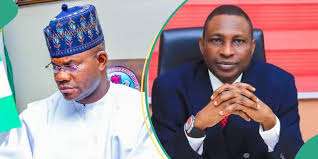
    A Kogi High Court has ordered the chairman of the Economic and Financial Crimes Commission (EFCC), Ola Olukoyede, to appear before it on May 13 over alleged contempt of court.

    According to the court, Olukoyede will need to prove why he should not be committed to prison for allegedly disobeying its order over an attempt to arrest the former Kogi governor, Yahaya Bello.

    The presiding judge, Isa Jamil Abdullahi, gave the order on Friday while ruling in the suit No: HCL/68M/2024 and motion No: HCL/190M/2024, brought before him by Bello.

    Recall that on February 8, Bello instituted a fundamental rights enforcement suit, asking the court to declare that “the incessant harassment, threats of arrest and detention, negative press releases, malicious prosecution” of the EFCC — “without any formal invitation — is politically motivated and interference with his right to liberty, freedom of movement, and fair hearing”.

    The former governor also sought an order “restraining the respondent by themselves, their agents, servants or privies from continuing to harass, threaten to arrest or detain him”.

    On February 9, the Kogi high court granted an interim injunction restraining the EFCC from “continuing to harass, threaten to arrest, detain, prosecute Bello, his former appointees, and his staff or family members, pending the hearing and determination of the substantive originating motion for the enforcement of his fundamental rights”.

    On March 12, the EFCC filed an appeal against the interim injunction because the court could not stop the commission from carrying out its statutory responsibility.

    The Kogi high court delivered judgment on the substantive motion on notice on April 17 wherein the presiding judge granted an order restraining the EFCC “from continuing to harass, threaten to arrest or detain Bello”.

    However, the judge directed the commission to file a charge against Bello before an appropriate court if it had reasons to do so.

    The judgment coincided with the recent “siege” laid on the Abuja residence of Bello by EFCC operatives seeking to arrest him.

    The commission had also obtained a warrant of arrest against the former governor from the federal high court in Abuja.

    The EFCC is seeking to arraign Bello on 19 counts bordering on alleged money laundering, breach of trust and misappropriation of funds to the tune of N80.2 billion.

    At the scheduled arraignment on April 18, Bello was absent.

    At the court session, Abdulwahab Mohammed, counsel to Bello, told Emeka Nwite, the presiding judge, that the court lacked jurisdiction to grant the warrant of arrest in the first instance.

    He referenced the February 9 interim injunction issued by the Kogi high court, adding that the appeal filed by the EFCC was still pending.

    However, the EFCC has filed a notice to withdraw the appeal.

    In the notice filed on April 22, the anti-graft agency said the withdrawal was predicated on the fact that events have overtaken the appeal.

  • National Justice Summit 2024: Stakeholders call for reforms  ..In judicial appointment process ..Funding ..Eradicating delays in the justice system

    National Justice Summit 2024: Stakeholders call for reforms ..In judicial appointment process ..Funding ..Eradicating delays in the justice system

    The communique released at the end of the National Justice Summit, 2024, made far-reaching recommendations that will address the issues of judicial appointment process, funding, and eradicating delays in the administration of justice in Nigeria.

    Stakeholders in the judiciary, experts, legal luminaries, retired judicial officers etc have noted that the National Policy on Justice 2024 to 2028, will now serve as a roadmap, paving the way for a more efficient, equitable and responsive justice system for all Nigerians.

    In the communique on Friday, the Chairman, Joint Planning Committee of the Justice Summit, Dr Babatunde Ajibade SAN, said the summit had three technical sessions.

    He stated that the general consensus reached at the summit was that the role of the National Judicial Council in discharging its responsibility for judicial appointments into the Superior Court of record required significant review.

    The stakeholders expressed concern about the fact that the Chief Justice of Nigeria, who is the chairman of the NJC is also the chairman of the Federal Judicial Service Commission, the body that initially reviews proposals or lists of candidates by appointment into judicial office.

    The summit pointed out the seeming inconsistency between the CJN playing both roles, as it would appear that he is recommending candidates to himself being chairman of both bodies, and being the person who appoints a significant number of the members of both bodies other than those who are statutory members.

    There’s a general consensus by the summit on the need to reconstitute or propose reconstitution of both the NJC and the FJSC.

    On the role of the State Judicial Service Commission in judicial appointmens, the summit concluded that there was a significant need to ensure that composition of the SJSC is more diverse, that it reflects the interests of the users of the justice sector.

    Stakeholders noted the fact that the current NJC guidelines may have subverted the intent of the constitutional provision, empowering the SJSC to make judicial appointments, because the NJC guidelines, rather than authorising the SJSC to prepare a shortlist of potential candidates for judicial appointments, appear to address that responsibility solely in the Chairman (Chief Judges of States).

    The summit therefore called for an amendment of the aspect of the NJC guidelines to make clear that the development or preparation of shortlist of candidates for judicial appointments is something that is to be done by the Commissions as a whole and not just by the Chief Judges.

    On the general approach that ought to be taken to reforming the judicial appointments process, the summit stressed that focus should be on increased transparency in the appointment process, meritocracy and on meaningful performance evaluations of those who seek judicial office.

    Also, it was recommended that Nigeria should consider the model that is currently being used in Kenya.

    There was a consensus on the need to codify the judicial appointments process, such that the discretion that is currently witnessed in the appointments process is reduced to the barest minimum.

    On funding, budgeting, and administration for the judiciary, the summit resolved
    that the current process for funding the courts was totally deficient as it was evident that the provisions of the Constitution as amended by the Fifth Amendment, authorising that funding for the State courts should be a joint effort carried out by the executive and the judiciary was not being implemented in any shape or form in the majority of the states.

    Clear recommendations were made that this was something that needed to be pursued and dealt with decisively, as the summit stated that funding of the judiciary at the federal level is much better than what obtains in the States of the Federation.

    More so, the summit observed the need to professionalise the administration of the courts, as well as to appoint persons with clear administrative experience to be selected through a transparent process to administer the courts, and to separate the administration of the courts from the administration of justice.

    On eradicating delays in the administration of justice agenda for leveraging the rules of procedure and effective case management in Nigeria, the panel considered the importance of limiting the jurisdiction of the Supreme Court, and ensuring that matters that would go to the Supreme Court would only be matters of significant national importance.

    The summit held that before a matter goes to apex court, it would only be by the leave of the Supreme Court, and that the automatic right of appeal to the will be severely curtailed and will be limited only to matters relating to the office and the election into the office of the president of the federation, Vice President and, and Governors of the States.

    The summit also stated the need for there to be clarity as to who has the authority to discipline legal practitioners and also issues as to how to improve the efficiency of the disciplinary process for legal practitioners.

    It was agreed that significant steps needed to be taken in these areas to enhance the quality of justice delivery in Nigeria and increase the confidence of members of the public in our justice sector.

    Conclusively, the summit noted the commitment by the Attorney General of the Federation and by all stakeholders, stressing the need to quickly engage the resolutions into draft legislation that will be presented to the National Assembly for inclusion in the ongoing constitution review process, and also for non-constitutional related legislation to be implemented almost immediately.

  • Glo, MTN, Airtel, Plan to Raise Tariff

    Glo, MTN, Airtel, Plan to Raise Tariff

    Nigerians are in for very tough times as telecommunications companies operating in the country, namely Glo, MTN, Airtel, and 9Mobile have hinted of plans to raise their tariff.

    The four have called on regulatory authorities in the sector to facilitate constructive dialogue with the federal government in that regard.

    They expressed that the current price control mechanism is not in tune with the economic realities in Nigeria and hence the demand for government’s intervention in order to address pricing challenges.

    The four telecommunications companies say they were the only ones that have not reviewed their prices, which threaten the industry’s sustainability and possibly erodes investors’ confidence.

    They made this known in a joint statement by the Association of Licensed Telecommunications Operators of Nigeria (ALTON) and the Association of Telecommunication Companies of Nigeria (ATCON) on Thursday.

    According to the statement signed by ALTON Chairman, Mr Gbenga Adebayo, and ATCON President, Mr Tony Emoekpere, there has not been a general service pricing upward review in the past 11 years.

    They attributed the non-increment to regulatory constraints despite the adverse operating environment and economic hardship.

    They said: “For a fully liberalized and deregulated sector, the current price control mechanism, which is not aligned with economic realities, threatens the industry’s sustainability and can erode investors’ confidence.

    “Despite the adverse economic headwinds, the telecommunications industry remains the only industry yet to review its general service pricing framework upward in the last 11 years, primarily due to regulatory constraints.

    “Government needs to facilitate a constructive dialogue with industry stakeholders to address pricing challenges and establish a framework that balances consumers’ affordability with operators’ financial viability.”

    They also expressed concerns on the worsening security challenges affecting the productivity of the services provided, urging the federal government erect measures to tackle the menace.

    “Telecom infrastructure undisputedly plays a pivotal role in Nigeria’s national security and socioeconomic growth, especially as the country currently contends with multiple security challenges that require urgent and immediate actions in response to these threats.

    “Attacks on cell towers, fibre optic cables, and other critical assets disrupt telecommunications services and result in significant financial losses for operators. We urge the government to prioritize the security of telecommunications infrastructure and collaborate with law enforcement agencies to enhance protection measures and combat vandalism and sabotage effectively.

    “The industry also requires substantial investments in network expansion, maintenance, and technology upgrades,” they said.

  • Health, welfare of judges topmost priority, FG assures …Justice Orji-Abadua, jurist of unimpeachable character – Justice  Dongban-Mensem

    Health, welfare of judges topmost priority, FG assures …Justice Orji-Abadua, jurist of unimpeachable character – Justice Dongban-Mensem

    The Attorney General of the Federation (AGF) and Minister of Justice, Lateef Fagbemi (SAN), has assured of the federal government’s commitment to improving the justice system and enhancing the capacity of the judges.

    The AGF spoke at a valedictory court session held by the Court of Appeal for the late Justice Theresa Orji-Abadua, who died on March 8 as the presiding justice of the Benin division of the court.

    Fagbemi said: “The federal government will continue to support to support the judiciary and ensure that the health and welfare of the judges remain the priority of this administration.”

    Fagbemi, who, like every speaker at the event, eulogised the deceased, said her keen and brilliant insight into legal matters, earned her the respect and admiration of her peers and colleagues.

    He added: “It is indeed, safe to say that throughout her professional journey, Honourable Justice Orji-Abadua not only achieved brilliant success, but also served as a beacon of inspiration for aspiring legal professionals in her exceptional demonstration of the importance of integrity, diligence, and unwavering dedication to the pursuit of justice.

    “Her contributions to the Judiciary, at the different levels of the Nigeria Judicature, indeed stands as a testament to her exceptional legal prowess and unwavering commitment to upholding the Rule of Law.”

    The President of the Court of Appeal, Justice Monica Dongban-Mensem, said Justice Orji-Abadua was a jurist of unimpeachable character who had a very simple and humble nature.

    Justice Dongban-Mensem, who was represented by the Presiding Justice of the Abuja division of the Court of Appeal, noted that the deceased was in the service of the Judiciary for 27 years, 16 of which were spent at the Court of Appeal.

    She added that although Justice Orji-Abadua was no longer around, her “contributions to the development of the law will remain and continue to help our jurisprudence to grow.”

    The chairman of the Body of Benchers (BOB), Adegboyega Awomolo (SAN), and former President of the Nigerian Bar Association (NBA), who spoke for the Body of Senior Advocates, Paul Usoro (SAN) equally spoke glowingly about the deceased.

    Awomolo described the late Justice Orji-Abadua as a fair and thorough jurist who served without blemish.

    The deceased’s widower, Dr. Benjamin Abadua expressed delight about the beautiful things he said about his late wife.

    Abadua said his late wife was a forthright personality who was always conscious of the truth and justice.

  • Ensure reforms guarantee wellbeing of Nigerians, economic growth -Tinubu

    Ensure reforms guarantee wellbeing of Nigerians, economic growth -Tinubu

    President Bola Tinubu has tasked the judiciary to ensure that justice sector reforms will guarantee the well-being of Nigerians and the economic growth of the country.

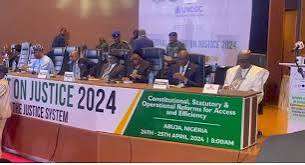
    He said this while declaring open, a 2-day National Summit on Justice 2024, organized by the Federal Ministry of Justice, in collaboration with the Nigerian Bar Association and the National Judicial Council.

    The President was represented by Vice President Kashim Shettima at the summit holding at the National Judicial Institute, Abuja.

    He said justice sector leaders and professionals need to find the right responses to the challenges we face through policy innovation, citizen-centered reform, systems change, and legislative reform, where necessary.

    Further in his speech,
    Tinubu insisted that the country needs judicial reforms that would enhance a functional justice delivery system that will aid a fast growing economy, guarantee basic human and political rights of individuals as well as provide security and justice to all Nigerians.

    He tasked the judiciary to align its activities within the tenets of his administration’s Renewed Hope Agenda, particularly as they relate “to the priorities on inclusivity, fairness, rule of law, and anti-corruption stance, among other things”.

    In accordance with his administration’s pledge to be impartial and adhere to constitutional principles, Tinubu said the National Justice Summit will avail institutions in the justice sector “with an opportunity to push boundaries by identifying needed system changes and critical reforms that would allow Nigerians to reap the benefits of huge investments in the sector.”

    He said much is achievable when institutions of government, including the Executive, Legislature and Judiciary, unite to acknowledge their challenges and brainstorm with a view to proffering solutions to the problems bedeviling Nigeria.

    “I accordingly urge the leadership of all justice sector institutions to seek a new direction and focus on outcomes by creating a justice system that truly responds to the needs of our citizens – one that serves Nigerians now and for generations to come.

    “I demand informed and coordinated responses to the identified challenges plaguing the effectiveness and efficiency of the sector.

    “I demand performance so that Nigerians can feel and acknowledge the impact of your reform efforts.

    “Ultimately, the expectations are that law and justice should aim to ensure public safety, economic development, peaceful co-existence, and the well-being of our people” Tinubu stated.

    The Vice President said President Tinubu’s administration is determined to implement its policies and promises made to Nigerians for a renewed hope, through the instrumentality of the “law and the dictates of justice to create opportunities for our people”.

    While highlighting the preliminary measures he took in order to reposition the Judiciary in an effort to aid a just and rules-based Nigeria, President Tinubu recollected his administration made funding for the Judiciary a top priority, doubling it in the Renewed Hope budget 2024 by more that 100 per cent from last year’s budget.

    More so, Tinubu stated that in his administration efforts to reposition the judiciary, the Supreme Court of Nigeria now has a full complement of 21 Justices as required by law for the first time after many years.

    In addition, the President said he has made approval for a substantial increase in the salaries and emoluments of judges, which is currently undergoing legislative action.

    However, inspite of these progresses being made in the justice sector, Tinubu said there “is an urgent need for a functional justice system capable of supporting a rapidly growing economy, guaranteeing basic human and political rights of individuals, and providing security and justice to all.”

    In his welcome address, the Attorney General of the Federation and Minister of Justice, Prince Lateef Fagbemi SAN, said the national summit seeks to address critical challenges in the justice sector.

    The AGF hinted that the summit will address the significant challenges plaguing Nigeria’s justice sector and pave the way for the much-needed reforms that will make justice more accessible to all Nigerians.

    One of the summit’s goals according to Fagbemi, is to review, validate, and adopt the revised National Policy on Justice 2024-2028 to drive prison reforms, access to justice for the average Nigerian, as well as the review of electoral laws and procedures in handling election related cases, among several other reforms.

    The summit, the Justice Minister said, will deliberate on draft legislations proposed to address specific identified challenges within the justice sector, relating to the judicial appointments process, administration, funding and budgeting for the judiciary, the elimination of delays and inefficiencies in justice delivery and to evolve ways to reduce the amount of time for adjudication of cases, eliminate some of the associated technicalities, and reduce the number of cases getting to the Supreme Court.