Author: Ugo Onuoha

  • 2027 and fear of free, fair and credible election

    2027 and fear of free, fair and credible election

    By

    UGO ONUOHA

    One, two, three…, 17, 18, 19…, 28, 29, 30. Counting may no longer be of any use. The figure changes at the drop of a hat. It has remained a moving and elusive target since 2024, and especially so since last year. They were in a queue. And on cue. They said the regime had done good for the country. But when you look around, you only see a mountain of bad and ugly things. Poverty bestrides the country – relentless poverty. Nevertheless, the Presidency was overwhelmed by the rush by many governors elected on the platforms of opposition political parties to align with the regime at the centre. To synchronise the obviously hostile acquisitions of the mandates of opposition political parties, the Presidency which present occupants are Alhaji Bola Ahmed Tinubu and Alhaji Mohammed Kashim Shettima, and their collaborators were compelled to draw up a schedule, a roster and a calendar for the admission of the mandate thieves into the fold of the ruling and ruining All Progressives Congress [APC] political party.

    The governors who were jostling among themselves as to who would be the first to jump ship were of the former ruling, and we dare say ruining party, the People’s Democratic Party [PDP]. This party held Nigerians in a chokehold for 16 years from 1999-2015. They boastfully told Nigerians that they would rule the country for an unbroken 60 years, ostensibly in the mold of PRI [Institutional Revolutionary Party, 1929-2000] that ruled Mexico for 71 years. Innocent Ogbulafor who was once the national secretary of the party said this much. And publicly. He’s long dead, and this democratic dispensation is barely 27 years old.

    The PDP as a behemoth, ruling party, and a self-styled largest political party in Africa lasted for barely 16 years in office before it was swept out. The party is dead in spite of the delusions of the remnants of its fractured leadership at the centre and in the states and the local governments and the wards. Its national headquarters, the Wadata Plaza has been shuttered for weeks by the obviously partisan Nigerian Police and wrapped with barbed wire. Minister of the federal capital territory [FCT], Nysom Wike, who’s the face of a faction of that party which is working for President Tinubu and the APC has assured that the PDP secretariat would be unchained this week [yesterday really]. Wike is believable because he’s the Law and works hands-in-gloves with judges. He builds our judges’ houses and buys them cars. In fact, the chief justice of Nigeria [CJN] was at the sod turning ceremony for an estate that Wike is building for judges working in the FCT. Wike as Rivers state governor routinely fêted the immediate past chief justice in Port Harcourt. It was during one of those occasions that the erstwhile CJN endorsed the rebellion of five PDP governors led by the same Wike against their party. That pathetic man was still the CJN at that time.

    That Wike is the law is not a conjecture. Somehow, disputes involving him routinely managed to be assigned to particular judges in Abuja. It could be a coincidence. But it should be concerning that some words spoken by Wike in public during political stomping manage to be replicated, sometimes word-for-word, in the judgments of a particularly notorious Abuja judge. What could not be coincidence are the words that proceed from Wike’s mouth. For instance, in the course of a very public spat with the national chairman and national secretary of the APC over who was the leader of the APC in Rivers state, the minister reminded them that they did not know how the court judgment that ensured the continuing seizure of the federal financial allocations to Osun state local government councils was procured. Osun state is governed by the opposition PDP. State governor, Ademola Adeleke, has since left the crises-riven PDP for the Accord Party, preparatory to his contesting for a second term in an election slated for later this year. Unlike other PDP governors, he did not join the APC which is led by his Yoruba kinsman, Tinubu. It should be curious that while the PDP governors from virtually every geopolitical zone of the country had been joining the APC, the two in the president’s south west zone, Seyi Makinde of Oyo state and Adeleke, have refused to do the same. By the way, Makinde was part of the insurrectionist PDP governors who worked for Tinubu to be declared president in 2023. So his new stance is really after the fact.

    The fact that for now Tinubu’s governor – kinsmen have not joined the APC bandwagon has not affected the deluge. It should be instructive that the gale of defections of state assembly lawmakers, local government chairmen and their councillors, and federal legislators had been in spite of a ruling by the Supreme Court in 2015 or thereabouts in a suit involving former governor, Rotimi Amaechi, in which the court ruled that votes cast in elections were for the political party that sponsored the candidates. The court said only the names of political parties were on the ballot, not the candidates. Elsewhere, Supreme Court judgments serve as precedents. But that appears to strictly not apply in our jurisdiction. Otherwise, what would be the explanation for a governor who ascended office on the strength of ballots cast for the PDP, dumping the party and moving to another party, and still remained a governor. And there are no consequences. Part of the strangeness of our judicial system is that the Supreme Court can make a ruling, and then forbid lower courts and lawyers from citing the judgment as a precedent. Ballots cast for political parties could be one such case.

    Now back to the counting of governors and others who have defected to the APC ahead of the general elections next year. As at the last count which may not be accurate since defections have become a daily fare, the ruling APC had 82 of the 109 senators; 242 out of the 360 members of the House of Representatives; 30 of the 36 state governors; it has the judiciary firmly in its grips; APC has the Independent National Electoral Commission [INEC]; the Armed Forces [after all the leader of the ruling party is also the Commander-in-Chief]; the Police, the civil defence militia; national union of road transport workers; and sundry area and city boys. One Abdulkadir Musa dutifully conducted the count which was shared on social media. But he’s likely to have under-counted.

    If the APC has this armada behind it, as it surely does, the expectation would have been that the party will rest assured that the results of the elections in 2027 are already firmly in the bag. No, that surely is not the case. The party is jittery. It’s scared stiff. Why? It is because the APC cannot vouch that the vast majority of Nigerians are with them. The party faces the reality that the next general election will be a referendum by the people on the performance [more like its non-performance] since 2023. Actually since 2015 under the regime of Nigeria’s affliction, the late Muhammadu Buhari. The APC has forfeited the right to again campaign on the basis of promises of delivery. It will have to seek a mandate renewal on the strength of promises that had been delivered. The tragedy is that the right hand side of its governance ledger is hopelessly light and scanty on deliveries, but heavy on sloganeering and propaganda and gaslighting. The hallmark of good and focused governance is how many citizens had been lifted out of poverty during the tenure of any administration. On this count, Tinubu and the APC have performed terribly poorly. Indeed, many of our compatriots have been dropping below the poverty line everyday since 2023. As at the last count about 70% of Nigerians are dirt poor. Late last year, a ranking federal government official said that about the same percentage of our people did not know where their next meal would come from. In any case, Nigeria has held the dubious record of being the global capital for poverty for seven years since 2019.

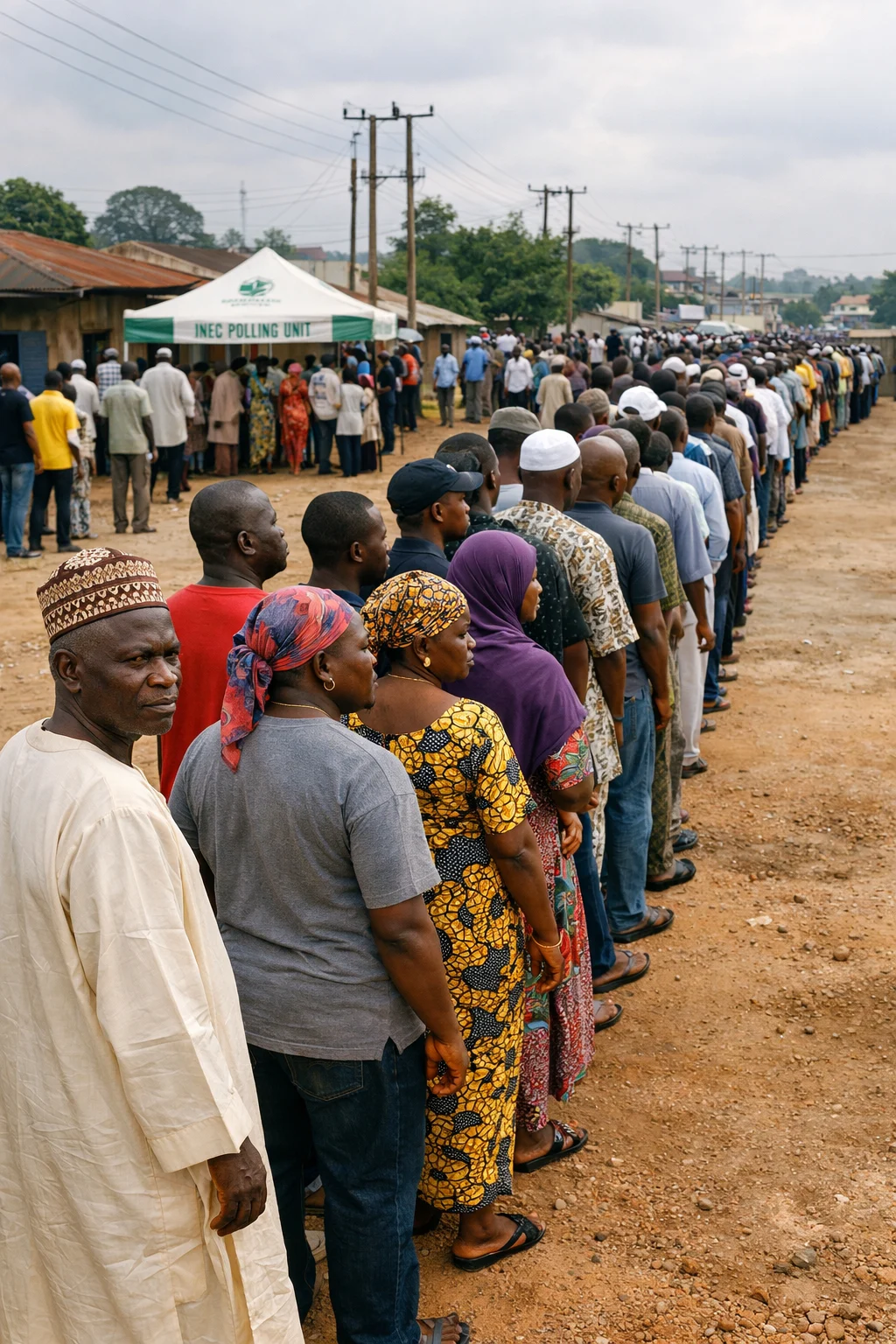
    So, it should not come as a shock if the national assembly [NASS] which is overwhelmingly dominated by the APC and the fair weather defectors are stoutly against anything that could ensure that the 2027 elections are free, fair and credible. It would not bode well for them. To be sure, the remnants of opposition lawmakers are part of the game to sabotage the widespread demand by Nigerians for mandatory and real time transmission of election results as part of the amendments of the Electoral Act. The few opposition lawmakers who have spoken up on the raging controversy have skillfully avoided the word ‘mandatory’ in their references to the affected provision. But that’s the key word in addition to ‘transmission’. The bone of contention in the proposed provision from the Electoral Act [Amendment] Bill is: “The presiding officer shall electronically transmit the results from each polling unit to the INEC Result Viewing Portal [IReV] in real time, and such transmission shall be done after the prescribed Form EC8A has been signed and stamped by the presiding officer and, where available, countersigned by candidates or polling unit agents”. Allowing this amendment should not be difficult except with fraudulent politicians. The excuse of weak internet infrastructure is just that – excuse. The other rationalisation, energy deficit, for being hesitant with this amendment is even more damning. It is self indictment that our rulers have failed and neglected to provide stable public power supply to citizens in 2026, almost 200 years after Lagos, a British colony, started enjoying electricity.

    Well, expecting politicians to be altruistic in their conducts would be expecting too much. Politicians are by nature selfish. They are incapable of building anything that would endure. Their style is ‘chere were’ or expediency. So Nigerians would have to own their country. The test of the resolve of our people does not come any better than the current battle to bring a measure of sanity to the country’s electoral process. Anything that will discourage or eliminate “grab, snatch and run” or “technical glitch” in our electoral process will be another step forward. Nigerians have to seize the moment.

    Meanwhile, many knowledgeable persons have rubbished the poor rationalisations by the leadership of NASS who are working in cahoots with the APC on why mandatory real time transmission of election results in 2027 will not fly. One such person is Dr. Alex Ter Adum of the Narrative Force. He wrote on the social media under the headline ‘Senate’s Tech Illiteracy As Electoral Policy’: “I have listened carefully to the arguments advanced by the Senate President Godswill Akpabio and the Senate spokesperson and other proponents of retaining the discretionary provisions of the 2022 Electoral Act on electronic transmission of results… The claim of inadequate internet connectivity in rural areas is hogwash… To begin with, voter registration in Nigeria was conducted manually. However, voter accreditation on election day is carried out electronically using the BVAS. The same BVAS is also designed to capture Form EC8A at the conclusion of voting and collation, and to transmit the polling unit results to the INEC electronic viewing portal called IReV electronically in real time.

    “If a network exists to enable electronic accreditation with the BVAS, then that same network necessarily exists to enable electronic transmission of results using the same device. This is a basic technological fact, not a matter of conjecture or complexity. It is a standard system functionality, and certainly not rocket science. Moreover, the argument that voting is manual and therefore cannot support real-time transmission is…baseless. What is required to be transmitted is not the act of voting, but the final results tally at the polling unit after voting has concluded, votes have been counted, and the figures duly entered on Form EC8A, which is the primary result sheet. Once the presiding officer announces the results, the completed EC8A is snapped and transmitted immediately. This process is entirely independent of whether voting itself was manuel or electronic.

    “Furthermore, where a temporary network blind spot occurs during transmission, the BVAS automatically stores the data and uploads it once the device enters a network coverage area. This is standard operating protocol for computing devices. So the claim that results transmission will fail due to poor network coverage therefore collapses under even the lightest scrutiny. In addition, internet connectivity across INEC’s approximately 176,000 polling units is today close to 98 percent. The narrative of widespread network absence is thus a choreographed smokescreen, not a genuine concern. To drive the point home. Point-of-Sale [POS] machines, which are equally dependent on internet connectivity, function in virtually every village and hamlet across Nigeria. [So], if POS machines can operate almost everywhere in the country, there is no logical basis for claiming that the BVAS cannot do the same when they rely on the same internet operating protocol… The Senate should therefore desist from its attempt to cripple electronic transmission of election results using the BVAS on the basis of exaggerated, contrived, and largely non-resident network concerns”. 2027 might just be the last stand in the battle for the soul of this country.
  • Ugly optics from Turkiye and return of our visiting president

    Ugly optics from Turkiye and return of our visiting president

    By

    UGO ONUOHA

    Nigeria’s president, Alhaji Bola Ahmed Tinubu, enjoys gallivanting. Put together he has been out of the country for more than half of one year in the two years and some months that he had been in office so far. For this period alone counting from December 28, 2025 to today, February 3, 2026, Tinubu would have spent only 11 days in Nigeria out of 34 days, less than one-third. He has set the tone for this year because the Igbo say that “ana esi n’uto ahuru mara uto nsi”. For decency we will just say that this means that the taste of the pudding is in the eating. But in truth, the transliteration of that Igbo sentence would come out as “you can guess the taste of feces from the smell of the fart that preceded it”. Those who keep tabs on presidential travels in the modern era of our country may yet find out that he holds the record as the most travelled Nigerian head of state in the first two years of their being in office.

    Tinubu has spent about 220 days abroad since he acceded to office on May 29, 2023. He just returned to the country on Saturday, several days after the state visit to Turkiye ended. That was not unusual. That explains why his handlers announce his departure dates but never the return dates. It’s the same when he goes to Brazil as an observer during the BRICS [Brazil, Russia, India, China and South Africa] summit. It’s the same when he visits London. It becomes worse whenever he is in Paris, France, his preferred home which coincidentally is the abode of his long time friend and business associate, Gilbert Chargouri [GCON], the Lebanese Nigerian. Some angry Nigerians have dubbed this secretly awarded medal of Grand Commander of the Order of Nigeria as Gilbert Chargouri Order of Nigeria [GCON].

    Whenever President Tinubu travels out of the country, which turns out to be very very often, the only thing that is known is the date for his departure. His return date is never or at best seldom stated in presidential communications. Sometimes the country he would be going to is never named. For instance, on December 28, 2025, one of the president’s spokespersons, Bayo Onanuga, caused a statement to be issued wherein Nigerians were told in a contemptuous, disdainful and derisive manner that Tinubu had departed for Europe as part of his end of year activities. He said that from Europe, the president would go to Abu Dhabi in the United Arab Emirates [UAE] for a programme. That event was scheduled to last for one week. On that trip, the president stayed away from the country for three weeks. The name[s] of the European country[ies] he went to remained a mystery. Though he was said to have been sighted in Paris during that period.

    When he returned from Abu Dhabi,Tinubu managed to spend one week in Nigeria, the very country he swore an oath to govern, and then he hurried out to Turkiye for a state visit. Though the presidency avoided putting a timeframe to the visit, the understanding was that the Turkiye state visit was not meant to last beyond two days. That’s the way it should be. Nobody should expect the president of Turkiye, Recep Tayyip Erdogan, a busy and obviously serious-minded leader of a country to devote or waste one week babysitting the president of another ostensibly unfocused and unserious country whose ruler may desire to even stay longer in a foreign land. For Tinubu, it’s obvious that better anywhere else but in Nigeria.

    In hindsight it should now be obvious even to the not too discerning that this ruler of Nigeria had a game plan for the duration of his presidency – four years, eight years or any number of years in-between. Travel. Travel. And travel. That should explain why he hastily acquired a well-appointed wide body Airbus aircraft as an addition to the presidential fleet. The prior talks that the aircraft in the presidential fleet were too many to start a commercial aviation service were not for him. Tinubu had made up his mind that he would rule Nigeria from the skies, and from across oceans, and from foreign lands. Of course, as should be expected for a jet procured in a hurry and in an untardy manner, there was no appropriation for it by what has turned out to be a supine national assembly [NASS]. Onanuga later explained, obviously reluctantly amidst national outcry, that the multi billion Naira jet was bought with monies from a slush fund otherwise called Service Wide Vote. It has to be said that this Vote is not unique to this regime. Tinubu did not create it. It has been in existence. Such opaque budgetary provisions are not unusual in jurisdictions such as Nigeria’s where kleptomania rules. To accentuate the proclivity to hedonism, an armour-plated and bomb-resistant Cadillac was added to spruce up the comfort and safety of President tinubu.

    However, Tinubu’s state visit to Turkiye last week demonstrated that there is so much that the perks and appurtenances of a high and demanding office can mask. They cannot mask a man suspected of infirmity to become suddenly strong. Even a performance enhancing steroid wears away over time. Comforts and access to the best of medical facilities and technologies and inventions are useful and life-enhancing. But they cannot cure slowdowns and noticeable sluggishness that come with age. It gets worse when there’s a combination of infirmity and old age. To be sure old age could be grace that comes from on high which many actually covet but do not have. It has to be said, however, that for some people old age could be karma designed to serve them cold dinner in the twilight of their lives when they are helpless and most vulnerable. When suspected infirmity combines with old age, living a jet-set lifestyle becomes ill-advised. It certainly will not be good for a man in his mid-70s or actually in his mid-80s.

    In national terms Nigeria is in a dire straits in almost all facets. If Nigeria were to be a human being it would be a key candidate for admission in the ICU [intensive care unit]. Its politics is bastardised. Its economy is comatose. Paranoid. Paralysed. Its sovereignty is challenged by domestic non-state actors and foreign powers with morbid interests. The claims of the unity of the country and its indissolubility are convenient and self-serving slogans in the mouths of the members of the corrupt and looting ruling elite. In Turkiye last week, it was the instability of Nigeria that was in the global spotlight. Tinubu merely approximated it. The world saw Nigeria on display through their ruler. Nigeria told the world that this was the best it had on offer. The irony is that this country is still a mystery to the international community. It presents a contradictory image of itself – a country of young and tech savvy people and, at the same time, a country of a bungling and utterly corrupt ruling class. It’s a mystery. And an enigma.

    There’s no attempt here to diagnose the health status of President Tinubu. I am not a certificated health professional. And I am not his personal physician. But the telltale signs of a stumbling and tumbling man in Turkiye last week who needed to be assisted by his host to stabilise and focus should be concerning, nay troubling for any Nigerian who means well for this country. The signs were writ large prior to the 2023 election after which he was declared the winner. What this means in effect is that this country which is in ICU has had the dubious burden of nursing its nurse for the better part of 10 years. A president should be a nurse for an ailing country.

    The affliction of Nigeria who masqueraded as its president from 2015-2023, Maj. Gen.[rtd] Muhammadu Buhari, became a patient instead of a nurse for the country. He was in and out of hospitals abroad for the duration of his eight years of reign. At a time he was on a hospital bed in London for 103 consecutive days. His appointees formed cabals which ran the country to benefit themselves. The chickens are now coming home to roost. The only achievement of Buhari was ‘non-governance’ which ensured that the country went back by at least 30 years. It will be frightening if  this country is on the cusp of witnessing a déjà vu. Already, people who should be in the know are indicating that Tinubu is not firmly in control of his regime. They claimed that contending cabals have been pulling at opposite ends which accounts for the many missteps by the regime including smuggling a strange name into the list of ambassadors-designate. Indeed, the strangler had been assigned to a duty post before the scheme was uncovered. The burgeoning perception and image of Nigeria as a rolling crime scene is foreboding.

    UGU ONUOHA, Veteran Journalist, Managing Director/Editor-in-Chief, Champion Newspapers Limited writes from Lagos, Nigeria’s Centre of Excellence

  • Trump’s World Cup stress test and prospects of Europe’s boycott

    Trump’s World Cup stress test and prospects of Europe’s boycott

    By

    UGO ONUOHA

    FEDERATION of International Football Associations [FIFA] awarded hosting rights for this year’s football World Cup tournament to three North American countries about eight years ago, precisely on June 13, 2018. That was in keeping with the longstanding tradition of the world’s football governing body. FIFA allows the host nation sufficient time to provide or improve facilities for the global fiesta. Thousands of people including officials, footballers, fans, tourists and others usually converged on the host nation to attend the events. Some persons who may not be football fans and followers use the opportunity of the World Cup for sightseeing and tourism.

    This year’s World Cup football tournament will be different in many respects. It will be the first time that three neighbouring countries – the United States, Canada and Mexico – will be jointly hosting the tournament. The highest combination, to the best of our recollections, was joint hosting between South Korea and Japan in 2002. All the while it had been solo hosting by willing and endowed countries beginning from Uruguay in 1930 to Qatar four years ago. Again, while there were 32 countries battling for supremacy in Qatar in 2022, 48 countries will be contending for the Cup this year in the United States, Canada and Mexico. This has never happened before.

    And because of the expanded format, Africa was allotted nine automatic slots with the potential to be 10 through a play-off, against the five slots allocated to the continent in the 32-country arrangement. Sadly, and in spite of the 100% increase in the slots available to Africa, Nigeria which is arguably a footballing giant on the continent could not pick a slot. It failed in the automatic qualification for one of the nine spots. It qualified to pick the remaining slot through a play-off in Africa and a final meeting with a qualifier from another confederation. Again, Nigeria failed at the Africa huddle, losing to the Democratic Republic of Congo [DRC]. Nigeria, the self-styled giant of Africa will be MIA [missing in action] in successive world cup tournaments, Qatar 2022 and US/Canada/Mexico 2026. How has the mighty fallen?

    This year’s football tournament has been projected to be the best attended, the most spectacular and the most profitable. But it could turn out not to be. In 2018 when the hosting right was awarded to the US and its neighbours, Donald J. Trump was the president of America. In the years while the US prepared to host a potentially spectacular event, Trump was out of power having lost his reelection bid to Joe Biden in 2020. He still denies that he lost that election and also rejected accusations that he inspired the storming of the Capitol [parliament] by his supporters who violently attempted to stop the certification of the election results. Trump was returned to the American presidency in January this year, in time to be the chief host of the American leg of the tournament. And that’s where the problem starts. Before Trump acceded to the White House in 2016, he gave indications during the campaigns that he would be an unconventional president. And he was. However, there were people embedded in American politics and bureaucracy who worked against him and curbed his excesses. He was constrained and was frustrated.

    But Trump 2.0 has been a different ballgame from the very beginning last January 20. He returned prepared and appointed those who shared his weird governing philosophy to strategic positions. He ignored Congress [parliament] and set up DOGE [the so-called department for government efficiency], armed his now estranged friend and billionaire, Elon Musk, with a chainsaw to decimate the bureaucracy. He did in sacking many government workers but failed in the goal to save money. Indeed, the report was that the exercise ended up increasing the cost of the government. Ostensibly by design, Musk’s name was not forwarded to Congress for consideration as a member of Trump’s Cabinet. Apart from Musk, Trump also had the almost 1000-page Agenda 2025, a governing template pre-prepared for Trump by the arch-conservative Heritage Foundation as a governing philosophy. When the document was exposed prior to the 2024 election, Trump had vehemently denied knowledge of the document and any association with the promoters. Americans knew that he was lying but voted for him anyway.

    The challenge now is that Trump’s unconventional or peculiar way of running the United States is spilling over into the organisation of the World Cup. Before now and with lesser mortals, FIFA would never have tolerated the meddling into the management of football and the organisation of its tournaments by politically exposed persons and government officials. Not anymore or so it seems. Trump fired the first salvo by threatening to strip some American cities of hosting rights, and arbitrarily transferring the same to other cities ostensibly controlled by Republicans. By design or coincidence, some of the host cities and states under threat of stripping them of hosting rights are those administered by Democrats as mayors or governors. Trump is Republican. He claims that cities and states run by Democrats were prone to protests and riots without providing evidence.  For the first time since Uruguay hosted the maiden World Cup in 1930, 96 years ago, political affiliation has become a consideration for cities to host world cup matches in a host country.

    However, FIFA’s vice president, Victor Montagliani, quickly shot back telling Trump that football was bigger than any country. He had said that “with all due respect to … world leaders football is bigger than them and football would survive their regime, and their government, and slogans”. But before this face-off, the American state department had announced visa restrictions on about 75 countries including a big footballing nation, Brazil. All the qualifying countries from Africa, nine of them, are under the hammer of these visa restrictions except South Africa. Even that exception falls under what the US state department describes as qualified visa restriction. In effect, all the qualifying countries from Africa are in dire danger of the disruptions of the movements of their teams, associated staff, football federation officials, and supporters into the US for the football fiesta that starts on June 11 in Mexico, about five months away.

    For Africans in particular, football would lose its essence in the absence of the travelling supporters of the national teams. The non-stop singing and drumming and dancing in stadiums will be felt and will take a toll on the motivations of the players during matches. Arguably, Nigeria has the most vocal supporters club for their national team. But Nigeria did not qualify for this World Cup so the national team’s supporters club would not have valid reasons to seek visas into the US this time. But what about South Africa and their vuvuzela which they introduced when they hosted a highly successful World Cup tournament in 2010. You can argue that a vuvuzela can be picked up in any neighbourhood shop in any American host city, but a vuvuzela in the hands and the mouths of its creator, a South African, sounded differently and certainly more menacingly. South Africans have a way of using the vuvuzela to pass coded messages to their players who are doing battle in the field. National team supporters constitute the 12th player in the field of 11 players.

    FIFA promotes football as a tool and force for unity. This slogan will face an acid test in Trump’s America in the World Cup months of June and July. The vicious and violent anti-immigrants policy of President Trump will ensure that. An immigration policy that has no respect for sanctuary cities in some states in America, the churches and the law courts, will certainly pay scant regard to stadiums and fan zones as no-go areas during the World Cup. Overzealous Immigration and Customs Enforcement [ICE] operatives will find stadiums and fan zones and hotels as fertile grounds to meet their monthly targets for the arrest of immigrants for detention and deportation. What this means is that legal migrants and undocumented ones from countries that qualified for the tournament will avoid match venues for their own safety.

    Football enthusiasts from Iran and Haiti are forbidden from travelling to the US. They are fully banned though their national football teams qualified for the tournament. Of the nine qualifiers from Africa so far, only South Africa can be said to be partially off the hook. The rest – Algeria, Cape Verde, Egypt, Ghana, Ivory Coast, Morocco, Senegal and Tunisia – are under one form of the American visa restrictions or the other. If DR Congo which eliminated Nigeria from the race succeeds in the inter-confederations play-off it will fall under the visa restrictions category. FIFA is trapped in America. Its aspiration of inclusivity through football is directly in conflict with Trump’s divisive immigration policy. The rigging by Gianni Infantino, FIFA’s president, of the so-called FIFA Peace Prize specially for Trump to appease him when the Nobel Peace Prize committee overlooked him in the 2025 award, has not helped the situation. The presentation ceremony for the award and the fawning of Infantino over Trump at the event was a spectacle with unrivalled ugly dimension.

    Now Infantino will have to contend with a troubled tournament even before the games start. He may have to preside over a tournament that could fell far short of expectations and projections. He will have to superintendent a World Cup that excludes three quarters of the world, among them football loving countries. And football as we know it is neither the number one sport in America nor even number two. For Infantino this will be a dilemma with implications for the future. He has allowed Trump to use his corrosive brand of politics to trump football. Future host nations of the World Cup would also be inclined to introduce politics to the game. For instance, Saudi Arabia is slated to host the World Cup in 2034. It will be the sole host of the 48-country format unlike this year’s that will be jointly hosted by the US, Canada and Mexico. What will Infantino and FIFA do on the eve of the tournament if the Saudis introduce a visa policy that excludes gay people? What Trump is doing to the world of football could be the beginning of the diminution of football as a global brand and a force for unity not tainted by overt partisan politics of member countries of FIFA and host nations of the tournament.

    There are other implications of the exclusion of three quarters of the world from the 2026 tournament by the US which is one of the host nations. Airline bookings to the match centres are likely to crater; hotel reservations by football fans from countries affected by visa bans and restrictions would be cancelled; restaurants in the host cities may have to review their plans and projections; the same would apply to tour operators; and, companies that sponsor interpreters but which operate in the countries under visa bans or restrictions may have to review their operations. Apart from these, global brands who are the major sponsors of the World Cup would now be wondering whether their investments would be worthwhile given the virtual exclusion of broadcast audiences from emerging markets. These markets are the new frontiers they are working to reach with their messages, products and services. They could be wondering whether football lovers in such countries would still be enthusiastic in following the tournament on television, radio or through other means. It will be a tough call. But it will not be a call for Infantino alone.

    Postscript

    The prospects of a tragic 2026 World Cup became starker at the weekend with the vice president of the DFA, the German football federation, Oke Gottlich, hinting at Germany boycotting the tournament because of Trump’s immigration and imperialist policies. Trump has been talking about seizing Greenland, an autonomous island under the sovereignty of Denmark. Analysts say that if Germany shuns the World Cup, Denmark is likely to follow suit immediately. Indeed, the potential boycott of the tournament will have a domino effect with European nations walking away. No disrespect intended, but nobody goes to the World Cup to watch Haiti play against DR Congo. No global brand will expend millions of Dollars on any World Cup tournament sponsorship in which European football power houses are excluded. That will not happen. No broadcasting network will pay for rights for such a tournament. If Europe boycotts the World Cup, it means that half of the 48 countries will be out of the tournament. And if countries under the current US visa restrictions join Europe, it will be game over, no pun intended. And all these will be down to one man – Donald Trump.

    Ugo Onuoha is a Veteran Journalist and former Managing Director/Editor-in-Chief, Champion Newspapers Limited

  • Brigadier Ademulegun and 60 years of nightmare

    Brigadier Ademulegun and 60 years of nightmare

    By

    UGO ONUOHA

    RITUALS have a way of degrading and over shadowing the substance and raisin d’etre of almost every memorial. That much can be said for January 15 every year in Nigeria. That day was symbolically and whimsically chosen to mark the end of the fratricidal Nigeria – Biafra civil war, 1967- 1970. That bloody war, in which combatants especially on the federal side appeared to have paid scant regard to the internationally prescribed rules of engagement in such strife, cost between one million to three million lives, especially on the side of the self-determination protagonists. The body count and the labelling of the two sides would depend on whose account of the history of the war you are reading.

    The Nigerian civil war did not just happen. There was a build up, and some of the seeds that culminated in the war were sown long before the country gained political independence on October 1,1960. The constitutional conferences that preceded the country’s independence were marked by toxic debates, disagreements that bordered on irreconcilable differences, and widespread suspicions amongst the leaders of the various regions – east, west, and north. It was so bad that the regional leaders could not find accommodation in determining when self government would start in the regions. That explains why self government commenced earlier in the east and the west, and much later and ostensibly reluctantly in the northern region.

    The subsequent attainment of independence in 1960 did not stem the deep-seated, pervasive, and mortal mutual suspicions. At the root of the trust deficit were the differences in religion, the level of exposure to Western education, and the fear of domination of the north by the south, a part of the country that was perceived to be more educated and sophisticated. The south also dominated the public/civil service and the officer corps of the armed forces and other security agencies at the time. That was the reality. The fear of one another was manifest during the horse trading for political alliances in the aftermath of the pre-independence election which failed to hand any of the major political parties – National Council of Nigeria and Cameroon [NCNC], Northern People’s Congress [NPC], and the Action Group [AG] – a clear electoral majority and the mandate to govern.

    The country’s politicians and rulers fumbled and wobbled into the general elections of 1964 which turned out to be violent and bloody especially in the defunct Western region. At that point it became clear to the discerning that the fledgeling and floundering Nigerian republic and its nascent democracy were heading for the rocks. That chapter was fast tracked to its inevitable end through widespread violence, manipulations, curious political trials, imprisonment, and perceived pervasive corruption in governments particularly at the federal level.

    So in January 1966, the army struck and sacked the democratically elected civilian government headed by Sir Abubakar Tafawa Balewa who was the prime minister, and Dr. Nnamdi Azikiwe, who was the president, head of state and commander-in-chief of the armed forces. That bloody military coup which had Major Chukwuma Kaduna Nzeogwu as its putative head stirred the hornets’ nest. When the coup was foiled by the then Col. Chukwuemeka Odumegwu-Ojukwu and a few other military officers, Major-General Johnson Thomas Umunnakwe [JTU] Aguiyi-Ironsi assumed the office of the head of state and supreme commander of the armed forces. The January 1966 coup which victims were perceived to be preponderantly from the north incubated a revenge coup of July 1966 which was yet another bloodbath this time of the eastern military and political leaders. Civilians of eastern extraction living in other parts of the country, particularly in the north were not spared. Some historians described what happened in July 1966 and thereafter as a pogrom and genocide on the Igbo.

    But our major concern in this season of the ritual of this year’s Armed Forces Celebration and Remembrance Day [AFCRD] was about a particular sad and lingering event during the January 1966 coup. It was the gruesome murder of Brigadier Samuel Ademulegun and his wife, Latifat, who was eight months pregnant, in their Kaduna home. He was the commander of the 1st Brigade of the army and the third highest ranking officer of the Nigerian Armed Forces. When you sign up for the army, you sign either to live or to die. That should not be in contention. You enlist to defend the territorial integrity of your country and to lay down your life for that purpose should the need arise. It will also be your bounden duty to protect and preserve legally constituted governmental authorities. And that was what Brigadier Ademulegun was doing in the  the early hours of January 15, 1966, when a coup plotter, Major Timothy Onwuatuegwu, led his team of mutineers into the bedroom of his commander to shoot him and his pregnant wife. The brigadier was said to have refused to surrender the keys to the armoury to the mutineers.

    So, General Ademulegun [that’s what he should be in today’s nomenclature], an authentic Nigerian patriot, his doting wife who was reportedly shot and killed because she used her body and the baby in her womb in her attempt to shield her husband from harm, died in active service. In service to Nigeria. In the years since Gen. Ademulegun, his wife [a London – trained nurse], and her unborn baby were murdered and their children who witnessed the killing were traumatized, our country has had a national anthem which included this line: “…the labours of our heroes past shall never be in vain…” At a point in our country’s epochal and chequered journey that anthem was discarded for being too colonial. But the extant regime in a sleight of hand, and in connivance with a spineless national assembly restored the old anthem in the dead of the night, in a manner of speaking. That line in that anthem is a blatant lie as it pertains to Gen. Ademulegun and his grieving children who have been crying for 60 years, this year.

    In the room or close by on that fateful day when the Ademulegun couple were killed were three of their six children – Solape, six years, Goke, four, and Kole, 13 in a nearby room. In spite of what happened to their father, Francis Bamidele Ademulegun still joined the military and became a Group Captain (red neck) in the Nigerian Air Force. He died without knowing where his father was interred. The same fate befell Adekunle and Bankole. But their siblings, Gbenga, Solape [now Ademulegun – Agbi], and Goke remain unrelenting in asking questions about what happened to the remains of their officer and gentleman father [N/3] and their Sisi Nurse mother? The Nigerian army owes them an answer. President Bola Ahmed Tinubu owes them an answer or an explanation. He is the Commander-in-Chief of the Armed Forces. Sixty years should be enough time to put a closure to this matter. A national monument in honour of the gallant officer and some kind of compensation for his survivors would not be out of place. The Nigerian Army can, and should treat the remains and memories of one of its pioneering officers better than what has happened in the last 60 years. It’s inconceivable that the Nigerian Army does not know the whereabouts of the remains of Gen. Ademulegun, his wife, and their unborn baby. If that were to be the case, then the Nigerian Army should be an institution of particular concern.

    The Ademulegun children did not just wake up 60 years after to ask questions about what happened to their parents. They have been crying for 60 years. They have campaigned. They have written letters to relevant persons and institutions. They have lobbied. They have petitioned. They have begged. But they have met brick walls. On Thursday, January 15, the family again packaged an event in Lagos to celebrate and pay tribute to the memory of the Ondo state-born army general and his wife who hailed from Lagos. “For 60 years [and counting], we have sought answers to many questions from those in authority. The most saddening being the fact that we do not know where they, our parents, were buried”, Solape Ademulegun – Agbi lamented last week.

    “The years have since gone by. We want to celebrate their gallant and heroic lives. Even when there is still no closure and our hearts still bleed everyday. But right now we believe that President Bola Tinubu can ease our pains. We are appealing to the president to direct the military authorities to show us from their records where exactly… our parents [were] buried. This will go a long way to help us to put this tortuous pain, tears, and grief behind us”. This plea should have been attended to yesterday. But if it is answered today, it could be said to be late but not too late for the grieving surviving children. May the grandchildren of Gen. Ademulegun and Sisi Nurse, authentic Nigerian patriots, not be saddled with searching for where their grandparents were interred. Amen.

  • The buffoonery of so-called ‘Don-roe Doctrine’

    The buffoonery of so-called ‘Don-roe Doctrine’

    By

    UGO ONUOHA

    Donald Trump’s reckless distortion of the Monroe Doctrine to justify the invasion of Venezuela exposes not grand strategy, but hypocrisy, imperial nostalgia, and the accelerating decline of American moral authority.

    A dangerous mix of crude oil lust, militarism, and authoritarian impulse now masquerades as U.S. foreign policy.

    JAMES Monroe was the fifth president of the United States of America. He served for eight years between 1817 – 1825. To an extent, even up till now, and in spite of the deep divisions within American society, his presidency is often regarded as the “Era of Good Feelings”. This was down to what was called the relative peace and unity during that time. Monroe did not earn his place in history and in the pantheon of great American presidents by his delivery of grand or, as we are wont to say here in Nigeria, legacy projects. No. But he secured his place in the hearts and minds of successive generations of Americans through his bold and grand vision for his country and the Western Hemisphere [the Americas in particular].

    That grand vision of more than 200 years ago [1823] was encapsulated in what became known as the Monroe Doctrine which became the cornerstone of US foreign policy for decades, and even up till the present day. In essence, the Monroe Doctrine was an American policy which warned European powers against further colonization or intervention in the Americas in the immediate aftermath of decolonisation. It aimed to establish the Americas as a US sphere of influence. As a corollary, the US committed to non-interference in European affairs. The aim was to keep the New World separate from Old World politics and to prevent monarchies in Europe from reclaiming colonies after countries in Latin America gained their independence. Subsequently, the Doctrine was used to justify the assertion of American dominance in the region and interventions in Latin America and indeed elsewhere.

    The key principles of the Monroe Doctrine included that the American continents were closed to any future European colonization; any European attempt to control, meddle or interfere with countries in the Western Hemisphere would be seen as a hostile act against the US; and, the US would steer clear of European political affairs and wars.

    The Monroe Doctrine, as should be expected, has been used and abused in the hegemonic disposition of the US in the over 200 years of its formulation. It has been used to pressure presidents of countries in Latin America and in other places who were perceived as not promoting and protecting US interests; it has been deployed for regime change in the region; it has been canvassed to justify the assassinations of leaders of other countries, and the installation of friendly regimes; it has formed the basis for occupying some Latin American countries; the Doctrine has formed the basis for the invasion and the abduction of regional leaders who were subsequently put on trial in American courts of law.

    It was the Monroe Doctrine which, as he’s wont to do, President Donald Trump, is attempting to bastardise by branding it as ‘Don-roe [after his own first name, Donald] Doctrine’, that he used for the invasion and kidnapping of the President of Venezuela, Nicolas Maduro. And then bundling him and his wife to the US to face charges on Trump’s so-called ‘narco-terrorism’ crime. To justify his modern day gangsterism, Trump claimed that Venezuela under Maduro, had been “increasingly hosting foreign adversaries in our region and acquiring menacing offensive weapons that could threaten US interests”. He said Maduro’s actions were in “gross violation of the core principles of American foreign policy dating back more than two centuries”. We will recall that the alleged possession of weapons of mass destruction [WMD] was the reason that the US adduced for the invasion and destruction of Iraq. It was a ruse.

    All were pretexts. Being profound and high-minded were not the forte of Donald Trump. He is banal. He is shallow. He lacks basic human decency. He is not capable of deep thought. He could be regarded as clever. He could pass as being smart. But that will only be in the class of crooks. In any case, he is a convicted felon. Trump is probably the only known practiced liar who is incapable of sustaining a lie. And that could be because 10 out of every nine words out of his mouth are likely to be lies. The reasons he adduced for abducting Maduro have all crumbled. He crumbled them himself along with his regime’s band of bare-faced liars. And racists.

    Let’s make an attempt to deconstruct Trump and his rationales for going into Venezuela and abducting its president. But before that it must be acknowledged that Maduro did not cover himself in glory in the years he was in power. There are receipts that he brazenly stole Venezuela’s presidential election of last year. But if stolen election is sufficient grounds for a foreign power to oust the president of another country, some people who are sitting pretty in the presidencies of some African and third world countries would have long been sacked and jailed. Some of such presidents are consumed by working out how their henchmen will rig elections, cause violence in their opponents strongholds, compromise election managers, use security agencies to intimidate opposition figures, deploy anti-graft agents to harass and besmirch rivals, and ‘snatch, grab and run’ away with results on election day, and finally cause a ‘technical glitch’ on the portal for the transmission of election results, than in governing and doing good for a majority of their people.

    Trump accused Maduro of being at the head of a drug cartel called Cartel de los Soles [or Cartel of the Suns], and so undeserving of continuing to be the president of neighbouring Venezuela. That could not be sustained because on December 1, 2025, the same Trump had pardoned a former president of another neighbouring country Honduras, Juan Orlando Hernandez, who was arrested under President Joe Biden by US law enforcement agents, arraigned in a US court, convicted, and sentenced to prison for importing 400 tons of cocaine into America. Hernandez, who served as president from 2014 to 2022, was convicted for turning Honduras into a “narco-state” and accepting bribes from drug traffickers. He was to be in prison for 45 years. The hypocrisy should be staggering. Indeed, at the arraignment of Maduro and his wife in New York last week, the frequently bandied name of the drug cartel that Maduro allegedly headed for the drug business was not mentioned in the charge sheet. Pretext number one crushed. The president of El Salvador, Nayib Bukele, is notorious for his alleged links to the MS-13 criminal group but he visits the White House at the instance of Trump and is treated to a red carpet reception. He was in the Oval Office last year. There have been credible allegations that Bukele’s regime made deals with the gang, offering them power and financial incentives in exchange for reducing violence and supporting his ruling party, Nuevas Ideas, during elections. He is Trump’s friend.

    Then Trump said that Maduro was a dictator which is true. But that also cannot be a justification for kidnapping another country’s president. Trump himself is a wannabe dictator. He had said so severally himself. His circle of friends comprises strongmen whom he admires and dotes on, including the president of Russia, Vladimir Putin, the leader of North Korea, Kim Jong Un, the president of Turkiye, Recep Tayyip Erdogan, and the president of China who is also the General Secretary of the Chinese Communist Party and the Chairman of the Central Military Commission, Xi Jinping. So if Trump admires dictators, he should be in love with Maduro. Another reason out the window. Trump said one of the things he liked about Xi was that he seized power for life. Maduro rigged elections to cling on to power also for life. He is not different from Xi who fiddled with the constitution of China to remain in office for life. But for Trump, it’s different strokes for different folks.

    The other reason for Trump kidnapping Maduro was that he was not a legitimately elected president of his country. He rigged an election. If that be the case, the expectation should be that with Maduro’s ouster the opposition candidate who was said to have won that election would have been installed. But no. Maduro’s vice president who was his running mate in the discredited election was instead sworn in as the president of Venezuela. Trump is working with her and has already extracted a gift of 50 million barrels of crude oil. Trump has said America would sell the crude at the ruling market rate, and that he would personally control the use of the proceeds of the sale.

    Meanwhile, it has been proven that Venezuela sits atop over 300 billion barrels of crude oil, reported to be the largest crude oil reserve in the world. Trump said that Maduro had to be removed because the oil belonged to America. He said US oil giants including ExxonMobil, Chevron, Conoco Philips and others were in the know about the plot. And that they would move in to take over the oil fields. The oil companies have since disclaimed the story. When finally Trump held a meeting with the oil executives last week, they gave him a condition for the transaction – that the American government, read taxpayers, should fork out a minimum of $100 billion to subsidize their potential return and investment and revamping of Venezuela’s degraded upstream and downstream oil sectors. ExxonMobil chief said that his company had a bitter experience in Venezuela about 40 years ago, and so would hedge its bet on the country this time around. In other words, the oil executives were saying that for them to return to Venezuela, the poor people of the US should fund the venture of the rich oil companies. Of course, as usual Trump had lied that he consulted with the American oil majors before and after his invasion of Venezuela.

    Furthermore, Trump said that Venezuela was not a democracy. But there has been no talk of restoring democracy since the removal of Maduro. President Trump merely said he would run the country for an indeterminate period. He has not mentioned conducting any elections. Instead the rumps of the Maduro regime continue to hold on to power. He has dismissed the winner of the latest Nobel Peace Prize, a Venezuelan opposition figure, saying that she did not possess leadership capacity. But Trump added that she could be considered for some sort of role in governing that country if she gave him the Nobel Peace Prize when she visits Washington soon. Trump coveted and vigorously campaigned for the Prize before it was awarded to Maria Corina Machado, a politician and activist who was recognised for her efforts to achieve peaceful transition from dictatorship to democracy in Venezuela. The world football governing body, [FIFA] has since manufactured its own peace laureate and awarded it to Trump in an elaborate ceremony ostensibly to pacify him. America, Canada, and Mexico are jointly hosting this year’s football world cup.

    So why did Trump invade Venezuela and kidnap Maduro. There are three possibilities. Trump has been enamoured by the phrase: take their oil. He had been quoted as saying that a grave mistake that America made when it invaded Iraq in 2003 was in not seizing that country’s oil fields and assets. And he is now insistent on seizing Venezuela’s oil. This is in spite of the fact that America is an oil producer with sizable crude deposits. Secondly, Trump is mortally afraid that Venezuela was becoming a staging post for the encirclement of the US by hostel and rival powers such as Russia and China. And in addition, Venezuela’s adoption of transactions for its crude oil sales in currencies other than the Dollar posed an immediate danger to the American currency. It did not matter to Trump that on this issue the horse has since bolted from the stable. Russia and BRICS nations have already made tremendous advances in de-Dollarisation of global trade. BRICS and partner countries now make up more than half of the world’s gross domestic product [GDP]. And they are perfecting payments for trades amongst themselves without using the USD. The American century is almost over. Trump is only helping to accelerate the decline.

    However, the most important reason for Trump’s adventures could be his love for the use of the American military might in an unrestrained and unconstrained manner. Last week he bombed ISIS in Syria. Previously, he had bombed Iran, Nigeria and other places for incoherent reasons especially in the case of Nigeria. His flexing of military might has not been limited to foreign lands. He also has attempted to use the American military inside the US in spite of the act being forbidden by the US constitution. He federalised the American National Guard for domestic law enforcement in some cities controlled by the opposition Democrat Party. It was even suggested that he planned to use the military to intimidate voters during the midterm elections in November which he feared his Republican Party would lose. And in the 2028 election. But the US supreme court has stopped him by declaring that he is constitutionally forbidden from federalising the National Guard. Democracies die when megalomaniacs and buffoons accede to power. That’s the fate that awaits the US with Trump in the presidency. The sun is setting on America as a city on the hill and a force for global good.

  • Contemptous rulers and docile people

    Contemptous rulers and docile people

    By

    UGO ONUOHA

    LATE last year, precisely on December 28, a presidential spokesman, Bayo Onanuga, wrote across his social media platforms that Nigeria’s president, Alhaji Bola Ahmed Tinubu, had departed to Europe as part of his end-of-year pleasure and winding down activities. The statement was not explicit that he would be on vacation. He hates the word ‘vacation’ because it might require him to transfer power to vice president Kashim Shettima, who is an orphan in the administration. The statement was as vague as they come, including the announcement that Tinubu would travel from ‘Europe’ to Abu Dhabi in the United Arab Emirates [UAE] in January to attend the annual Abu Dhabi Sustainability Week [ADSW 2026] Summit.

    Onanuga’s statement was careful to emphasize that Tinubu’s planned attendance of ADSW 2026 was to honour an invitation that was apparently graciously extended to him by the president of UAE, His Highness Sheikh Mohamed bin Zayed Al Nahyan.

    But there are issues surrounding the processes leading to the nebulous year-end activities and the detour from ‘Europe’ to UAE for a one-week stay. But the issues are not new, and they are not out of tune with the proclivities of Tinubu from his years as governor of Lagos State between 1999-2007.

    The statement announcing Tinubu’s itinerary, which will be a blatant abuse of the use of that word ‘itinerary’, was deliberately vague, dismissive, and designed to demonstrate how much the presidency, the president himself, and his enablers hold Nigerians in utter contempt.

    As president, Alhaji Bola Ahmed Tinubu, is this country’s number one public figure. The statement said that he was departing for ‘Europe’ on December 28. The last time we checked, Europe was not a country, even if anyone is minded to stretch the concept of the European Union [EU].

    If Tinubu planned in the course of his usual junckets abroad to visit more than one country on the continent of Europe, decency and accountability required that Nigerians whom he is supposed to be serving should be apprised of his movements. But no, not for Tinubu, and certainly not for his collaborators. He treats a majority of Nigerians as though they do not exist and do not matter.

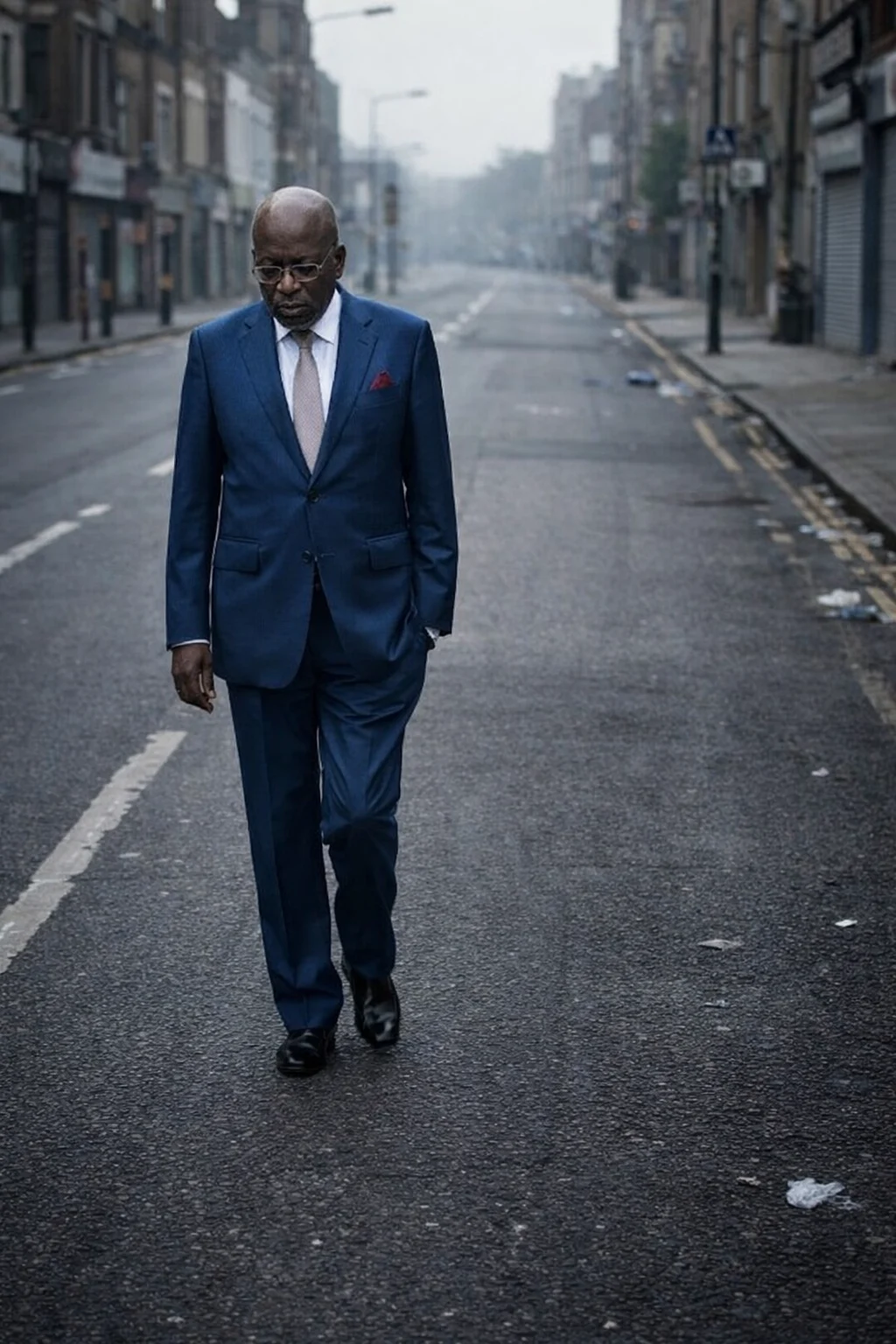
    An elderly man in a blue suit walks alone down an empty, rundown city street, head slightly bowed, with shuttered buildings and scattered debris stretching into the distance under a gray, overcast sky.
    Alone in the silence of an empty street, power fades and only the weight of the journey remains.

    To this presidency, Nigerians are veritable ‘mumus’ who do not know the difference between a continent and the countries therein. And even if they know the difference, they have been so pauperised and castrated by the rulers’ policies and programmes to ask questions and to demand answers.

    Tinubu’s indifference to, and contempt for, Nigerians has been evident for close to one generation. He was not different while he was the governor of Lagos State. He could pretend for all he cares, but he’s not a democrat. Contrary opinion counts for nothing in his politics. The receipts are in the public domain.

    His braggadacio, not withstanding, Tinubu exhibits the traits of an insecure person. Here’s a man who craves adulation and public office but despises accountability to the people. Not many Nigerians imagined that after the years of the locusts that marked the presidency of the former head of state, the late Muhammadu Buhari, that Nigerians would yet be saddled with another man who regards the presidency as a trophy, and not a call to service that imposes a duty of care on the occupant. One of the Obamas [either Barack or Mitchell] once said that the presidency of the United States does not change its occupant. It reveals the person. That profound assertion was prior to the emergence of Donald Trump as America’s president. Trump 2.0 is unravelling.

    The presidency of Nigeria revealed the person of Buhari – as incompetent, low on energy, clueless, sectarian, myopic, divisive, and a man with little or no redeeming feature. Buhari came, he saw, and he was overwhelmed and conquered. Some of us were surprised only by the magnitude of his spectacular failure.

    Tinubu was an open book ever before he ascended to the presidency. There was not much waiting to be revealed about him. He said that becoming Nigeria’s president was his lifelong ambition. Ahead of the 2023 presidential election, he commanded his henchmen and supporters to “grab, snatch, and run” with ballot boxes and ostensibly the result sheets. His supporters dutifully went beyond the brief. They disrupted balloting in places suspected to be the stronghold of opposition political parties. On election day, they attacked and bloodied voters whom they feared would vote for candidates other than Tinubu. State security agencies played their own part in an alleged industrial scale electoral heist.

    Earlier, during the stomping, Tinubu had declared that it was his turn to be coronated as president in his fraud- tainted and entitlement-laddened claim of “emi lo kan”.

    Like Buhari, but from a different prism, the Nigerian presidency is also unmasking Tinubu – that he’s at best a pseudo-democrat if not a dictator, he’s  unprepared for the job in spite of claims to the contrary, he may not really be in the best of health, he prefers to operate as a sole administrator or an emperor, he’s epicurean, he listens only to himself, he detests accountability, he delights in adulation and praise-singing, faces of citizens contorted by pains do not move him to sympathy and empathy, that he can only work with people from a section of his Yoruba nation, among other parochial considerations.

    The other concerning aspects of his current end of year trip to ‘Europe’ has to do the Abu Dhabi leg this January. For the Abu Dhabi Sustainability Week Summit, the presidency would rather treat it like the mystery of Tinubu’s travel to ‘Europe’ where nothing definite was disclosed. Not the country or countries he was travelling to; not the specific purposes of the visit beyond the claim of end-of-year activities; not how long he would be in ‘Europe’, or any other things for that matter.

    Except for the cruise and the opportunity to ‘flex’ as we are wont to say on Nigerian streets, no serious president of any serious country, especially a country like ours which is in the lower rungs of the global development index should ever elect to waste one whole week in a foreign land for this kind of summit. In any case, we are not persuaded that the president is currently equipped with the necessary alertness, mental capacity, and requisite attention span to absorb the technical details and jargon of such a summit. We have seen the president at events at home and abroad, and his struggles to remain alert and follow conversations have been, to put it mildly, very embarrassing.

    Furthermore, it was difficult to imagine that Nigeria’s president departed for ‘Europe’ hours after the US president, Donald Trump, ordered the American military to bomb alleged terrorists enclave in parts of Sokoto state in the north west region of our country. Tinubu behaves in a troubling manner. His behaviour can be likened to the case of “onye ulo ya na-agba oku ona achu oke,” or a home owner who is busy chasing rats while his home was being consumed by an inferno.

    In a little over two years of this regime, one issue has dogged its leadership – persistent allegations of forgery. Somehow, a sentence on forgery and sundry shenanigans is deemed incomplete until the name of the president of Africa’s most populous country or the ruling APC is featured in it.

    If any name is controversial, some people would be minded to use the name of the president to illustrate the unsavoury subject. If a certificate is suspected to be from the ‘Oluwole’ area of Lagos, instinctively, some Nigerians would allow their minds to wander to the same suspect. Why not, given that Tinubu and his team created their own bishops ahead of the 2023 election. By the way, ‘Oluwole’ is a byword for anything and everything fraudulent in our country.

    When unknown persons suspected to be from the bureaucracy, the presidency and the national assembly [NASS] forged the 2024 budget with the insertion of strange items worth billions of Naira, it was difficult to exculpate the lead figure and the usual suspect. The same thing is currently playing out with the alleged forgery of the new and controversial tax laws, which came into effect on January 1.

    The abduction of Maduro

    It was bound to happen – the abduction of the president of Venezuela, Nicholas Maduro, by the president of the United States, Donald Trump. It did happen last weekend. The pretext was drug trafficking by Maduro, but the quest was to seize the over 300 billion barrels of crude oil in the belly of Venezuela.

    Trump framed the exercise as a ‘capture’, but it was not. It was a case of the abduction or kidnapping of another country’s head of state. Trump violated the US constitution and ignored international laws. He has said that he would run Venezuela for some time. This is curious coming from a man who bankrupted casinos as a private businessman. What Trump has succeeded in doing is turning the world’s order upside down. And made it less safe. The sovereignty of nations is now a myth and the United Nations a caricature. Might is now right. It will be a matter of time before China seized Taiwan, and Putin escalated his hunger for an imperial Russia to straddle Europe.

    UGO ONUOHA, A Veteran Journalist, was the Managing Director/Editor-in-Chief, Champion Newspapers Limited

  • Forgeries, taxations and the reign of Rehoboam

    Forgeries, taxations and the reign of Rehoboam

    By UGO ONUOHA

    “A profligate regime should not expect Nigerians to willingly submit to a new tax regime that looks like an exercise in extortion. The administration gets its priorities wrong. At a time that virtually all federal highways have collapsed and become deathtraps, this government prioritises the construction of a N15 trillion coastal highway from Lagos to Calabar.”

    A little over three months into the presidency of Alhaji Bola Ahmed Tinubu, on September 5, 2023, I wrote an opinion piece titled “100 days of Rehoboam” in this space and elsewhere. Rehoboam was a king of the divided kingdom of ancient Israel. He was the son of King Solomon and the grandson of King David, both of whom were also past rulers of a united Israel. Rehoboam caused Israel to be divided through policies that inflicted pains on his people. He was reckless. He was proud. He was unfeeling. He took counsel from his scatter head fellow young men. He told the Israelites that the privations they suffered under his father should be regarded as a child’s play. And that while his predecessors chastised them with a whip, he would chastise them with a scorpion. And he verily proceeded to do so. Rehoboam and Tinubu share similarities and dissimilarities. Rehoboam was a monarch. Tinubu is not a king in spite of his pretending to be one. Rehoboam was born into royalty. Tinubu was not. Indeed Tinubu’s birth and early years are still subjects of conjectures and controversies. Rehoboam was a young man when he ascended the throne of his fathers, and so could be excused on account of youthful exuberance. Tinubu was an old man when he was installed as president of Nigeria though his true age is only known to himself and himself alone. There’s no verifiable evidence of when he was born and where. Unlike Rehoboam, Tinubu takes no counsel from anyone. He said this much himself when, without consultations and without a Cabinet, he unilaterally removed the so-called petrol subsidy.

    On September 5, 2023, I wrote this about Tinubu and Rehoboam. “[Tinubu at 100 days in office] has been like that proverbial bird that perched on a tree branch – the tree branch has remained unsettled and the bird can’t stop dancing to unheard sounds. Since his inauguration [as president] on May 29 [2023], exacerbated hopelessness has been the lot of Nigerians and Tinubu himself can only pretend to have had peace of mind. If he has had the presence and prescience of mind, he would not have been enmeshed in serial fumbling from one policy somersault to another from the removal of the so-called petrol subsidy, [devaluation of the Naira], student loan and [the] proposed payment of N8,000 per month for six months to a specified number of poor Nigerian families, and planning to lead the Economic Community of West African States [ECOWAS] to war on Niger Republic [when the military in that country seized political power]”… In Igbo Tinubu is a classical case of ‘akwu rere ere n’ikwo puru epu’ which transliteration in English language will roughly read: rotten palm fruits being pounded inside a decayed mortar. The finished product is better left to the imagination…”

    When Rehoboam became the king, the older advisers in the palace pleaded with him “to heed the cry of the people and lighten the heavy load of labour and taxes that Solomon had laid on them, but the younger elements who had grown up with the new king counselled otherwise. He took the counsel of his mates. The consequences of the actions of the new and rash King Rehoboam are well documented in the chronicles of the kings of Israel in the Holy Bible book of 1Kings. In Tinubu’s rash and irrational decisions [on] the first day and [subsequent] weeks of his reign, he appears to have borrowed a leaf from the wicked and unthinking  King Rehoboam”. One of the undoings of Rehoboam was that he insensitively raised taxes on his people and so lost more than half of his kingdom. The northern part of Israel split away, taking its own path separate from the southern kingdom of Judah. But Nigeria is not a monarchy and bears no resemblance to the old kingdom of Israel. Does that mean that Nigeria splitting is unthinkable?

    With the new tax laws set to come into effect in a matter of days, Tinubu who rules like a monarch may yet be treading the path of King Rehoboam. Rehoboam raised taxes on his people at a time they were already complaining of privations and pains, Tinubu is poised to also raise taxes on Nigerians at a time the people are groaning under the weight of a multiplicity of harsh economic policies of the regime. And he appears not to be bothered. He is irritated by wise counsel that he steps on the brakes and allows Nigerians to breathe. Instead, he empowers the relevant agency of government to execute a secret contract with a so-called tax consultant in France which may lead to handing over Nigeria’s tax data to a foreign company. Tax data is a national security issue that should not be traded as a favour to a friend. Tinubu and the president of France, Emmanuel Macron, are known to be buddies. The frequent ‘working visits’ of our president since he assumed office a little over two years ago had been to Paris, France, unlike his predecessor, Muhammadu Buhari, who made London his tourism and medical destination, and the former archbishop of Canterbury his bosom friend. And a go-to man.

    A profligate regime should not expect Nigerians to willingly submit to a new tax regime that looks like an exercise in extortion. The administration gets its priorities wrong. At a time that virtually all federal highways have collapsed and become deathtraps, this government prioritises the construction of a N15 trillion coastal highway from Lagos to Calabar. To add insult to injury, the contract for the road was not subjected to an open and transparent bidding, no public tendering, no definite and finite route, and no environmental impact assessment report. To cap it up, the highway contract was awarded to a known long time friend and business associate of Tinubu. The president’s son, Seyi, is alleged to be a significant shareholder in some of the companies in the Chargouri Group which owns Hitech construction company which was awarded the opaque Lagos – Calabar highway contract. This is a classic and glaring case of abuse of office. The argument by the regime that much of the money for the execution of the road contract would be borrowed does not make the smell of the contract less pungent and offensive. Even the money to be borrowed will still have to be paid by Nigerians. By you. Or by me. Or by our children and grandchildren.

    As the government preps to extract more taxes from us, it is telling us that we should be the people to fund their ostentatious, obscene and provocative lifestyles including, committing billions of Naira to build or to refurbish mansions for the president and vice president, buy hundreds of foreign manufactured sport utility vehicles [SUVs] for ministers, a coterie of advisers, lawmakers, local government chairmen, and even for the wife of the president whose well appointed office of the first lady is not known to any law in the land. Members of the boards of MDAs [ministries, departments, and agencies] are usually not left out of the largesse. Ours is probably the only country in the world where government computers, vehicles, websites, and the like, are replaced every year. The debauchery includes procuring a fleet of armour – plaited presidential limousines every four years with the advent of a new president and a presidential jet in tow. Of course, the issue of looting the public treasury has been normalised. It’s so brazen that public servants routinely send their children to schools abroad where the fees are charged in millions of the United States dollars. If you want to be reminded of how decadent the system is, do not look further than the annual budget provisions for the feeding of our president and his family. It runs into multiple billions of Naira. We give the president a rent-free accommodation, we afford him and his family pro bono top rate round-the-clock security, gift him a fleet of high-end luxury vehicles, fuelled and maintained at our expense, top it up with a presidential jet, and then turn around to pay him millions of Naira every month as salary. Not even the United States of America, the biggest economy in the world, does that.

    In spite of the foregoing proclivity of this regime to extort citizens, it still cannot be satisfied and appeased. It is a leopard that cannot change its spot. The information last week was that the administration had allegedly fiddled and rigged the tax reform laws passed by the national assembly [NASS]. Last week Rep. Abdulsamad Dasuki  [PDP, Sokoto] raised the alarm, alleging discrepancies between the tax laws passed by NASS and the versions subsequently gazetted and made available to the public. He said the rigging of the laws should be concerning because some provisions were deleted and strange and terrifying provisions illegally inserted. Hon. Dasuki had said during plenary on the floor of the House that his legislative privilege had been breached by the fact that the content of the tax laws as gazetted by the executive arm of government did not reflect what lawmakers debated, voted on, and passed on the floor of the House. “I was here, I gave my vote and it was counted, and I am seeing something completely different”. He said that he obtained copies of the gazetted laws from the ministry of information and found them to be inconsistent with what was approved by both the House and the Senate. Dasuki said that there had been ”a serious breach”, and warned that allowing laws different from those duly passed by the national assembly to be presented to Nigerians would undermine the integrity of the legislature and violate the Constitution.

    “Mr. Speaker, I will be pleading that all the documents should be brought before the Committee of the Whole [House]. Thank you. The whole members should see what is in the gazetted copy and see what they passed on the floor so that we can make the relevant amendment. Mr. Speaker, this is a breach of the Constitution”. Consequent upon the alarm, the House raised a committee of seven persons to probe the allegations. However, Nigerians are not fooled. The current administration across board, from the executive to the legislature and the Judiciary, is populated by people who are adept at rigging and forgery. The NASS and the executive, working separately or in collusion, routinely rigged our national budgets. The 2025 fiscal document is the latest of fiddling with budgets. It was reported and never denied that about 6,000 illegal projects were inserted into the budget with accompanying billions of Naira allocations. We complained and grumbled and then moved on as usual. In effect, the NASS is the least morally competent to cry foul on the issue of rigging and forgery of documents. The same can be said of the judiciary where court judgements, especially of political hues, are routinely awarded to the highest bidder or to the most powerful and connected. So our system thrives on rigging or “mago mago” or “wuru wuru” to use the local lingo.

    But whether rigged or not the implementation of the new tax laws should be suspended, if it cannot be scrapped. It’s inhuman and inhumane to tax poverty. The majority of Nigerians are dirt poor. The other day, a top federal government official said that about 80 million citizens do not know where their next meal would come from. And a little over two years ago, the national bureau of statistics [NBS] determined after its study that over 130 million Nigerians were dimensionally poor. Certainly, the figure should be higher today given what Nigerians have been subjected to since May 29, 2023. And by the way, there has been no concrete evidence that any country has engendered or engineered economic recovery by taxing the poor. Instead putting more money in the pockets of citizens could help to reflate the economy as long as it is done in a manner that will not trigger inflation.

    UGO ONUOHA, a Veteran Journalist, was the Managing Director/Editor-in-Chief, Champion Newspapers Limited

  • Corruption: Going to equity with unclean hands

    Corruption: Going to equity with unclean hands


    Selective prosecutions, moral contradictions, and the crisis of legitimacy in Nigeria’s anti-corruption war

    ABUBAKAR Malami was the minister of justice and attorney-general of the federation. He served under former president, the late Maj-Gen. Muhammadu Buhari, between 2015 and 2023. Buhari’s tenure must rank among the worst years of the country. They were not only wasted, but he took Nigeria back by at least 30 years.

    For all of last week, at least up to Sunday, December 14, Malami was in jail in the custody of the Economic and Financial Crimes Commission (EFCC) in Abuja. Like Buhari, Malami cannot be credited with exceptional skills, intellect or administrative sagacity.

    He is not associated with any landmark reforms of the country’s judicial processes and system in the eight years of his stay. He is not known to be a brilliant lawyer though he is a senior advocate of Nigeria (SAN).

    He came. He saw. But he was not known to have done anything that could be said to be beneficial to the majority of litigants or the administration of justice.

    Malami has remained in relative obscurity in the over two years he had been out of office and power, except for once when he claimed that the convoy of his cars was attacked by bandits under the direction of his political enemies.

    He is of the ruling All Progressives Congress (APC), but it appears he is not of the branch headed by Nigeria’s president, Alhaji Bola Ahmed Tinubu.

    Indeed, he had been linked to the Congress for Progressive Change (CPC) faction of the late Buhari whose leading lights were said not to be favourably disposed to the reelection of Tinubu for a second term in 2027.

    In addition, Malami is reported to be angling to contest for governor of Kebbi state on the ticket of an opposition party, African Democratic Congress (ADC).

    Malami is yet to be arraigned in court. But if public media reports are to be believed, he may likely face grave charges which operatives of the anti-graft agency were reported to be framing.

    There are reports that the former minister could face charges on alleged terrorism financing; questions over the handling of the former Head of State, late Gen. Sani Abacha’s part-loot of $322 million retrieved from Switzerland and the island of Jersey; money laundering involving his alleged link to 46 bank accounts; abuse of office including findings on decisions over asset recovery, seized asset disposal, and contract approvals during his tenure.

    There are also other suspicious transactions in connection with N10 billion investment in his home state, Kebbi, as well as involvement in a $419 million judgment debt.

    Malami has denied the allegations. His lawyers have argued that his continued detention was unlawful and unconstitutional. They claimed that the former minister had been cooperating with the government investigators.

    That same last week, towards the end of it, another of Buhari’s ministers who was in charge of labour and employment, Dr. Chris Ngige, was arrested and taken into custody by the EFCC.

    It was reported that he was still in his night gown (pyjamas) when he was whisked away in the early hours of the morning on that fateful Thursday.

    Ngige was a former governor of Anambra state on the ticket of the People’s Democratic Party (PDP). His victory was annulled after about three years in office.

    He defected to the then opposition party and was made a minister when the APC stormed to power in 2015.

    The ex-minister also spent last weekend in prison to await his application to be granted bail on Monday (yesterday). By the time you are reading this, he may have been sprung from jail and preparing for his day in court.

    Ngige is charged with abuse of office; awarding seven contracts worth N366 million to Cezimo Nigeria Limited, a company alleged to be linked to his associate Ezebunwa Charles.

    He is also charged with contract fraud for awarding eight contracts worth N583 million to Zitacom Nigeria Limited, also linked to Ezebunwa.

    There are allegations of bribery; receiving N38.6 million from Cezimo Nigeria Limited, N55 million from Zitacom, and N26 million from Jeff & Xris Limited through his campaign organisation and scholarship scheme.

    He is accused of granting unfair advantage; awarding contracts to Olde English Consolidated Limited for N664 million, and Shale Atlantic Intercontinental Services Limited for N161 million, linked to another of his associates, Uzoma Igbonwa.

    There are other contracts; awarding N362 million worth of contracts to Jeff & Xris, owned by Chukwunwike Nwosu.

    Ngige pleaded not guilty to all the charges which the EFCC described as offences which violated sections 17(a) and 19 of the Corrupt Practices and Other Related Offences Act, 2000.

    So Ngige was cooling his heels at the weekend in Kuje prison.

    Ngige is also of the APC but he is not known to be full-throated in supporting the extant president of the country produced by his party.

    He is not also known to be publicly antagonistic of his kinsman, Peter Obi, who was the Labour Party candidate in the bitterly contested and controversial 2023 presidential election.

    Obi has been the nightmare of the APC for more than two years, probably because he defeated Tinubu in Lagos state in the last presidential election.

    Tinubu was a two-term governor of Lagos and he was until 2023 touted as unbeatable in the state he holds by its jugular.

    Olu Agunloye was a minister of power and steel under the PDP administration of President Olusegun Obasanjo. Though his trial did not originate with the current regime, he is facing prosecution by the EFCC over alleged $6 billion fraud related to the Mambilla Hydroelectric Power Project.

    He is facing an amended seven-count charge on corruption, abuse of office, forgery, and disobedience of a presidential directive. He has pleaded not guilty to the charges.

    Justice Jude Onwuegbuzie is in charge of the federal high court in Abuja where his trial is being heard.

    An investigator and other witnesses have testified that Agunloye allegedly forged the contract papers for the award in favour of Sunrise Power and Transmission Company Limited.

    The contract was said not to have budgetary provision, no approval, and no cash backing. The former minister was alleged to have collected kickbacks totaling about N5 million.

    Agunloye is free on a N50 million bail with two sureties in like sum.

    There are a few other high-profile cases involving some APC party men who appear not to be enamoured to the presidency of their current party leader.

    The same disposition to prosecution by the regime cannot be said to be the lot of other party faithful who had been alleged to have committed crimes.

    One such person is Betta Chimaobim Edu. She was the pioneer minister of humanitarian affairs in the first Cabinet of this administration.

    On January 8, 2024, Tinubu directed the suspension of Edu from office. Almost two years later, the former minister is still on suspension though her position has reluctantly been given to another.

    Edu was accused of financial misconduct involving huge sums of money meant for vulnerable groups.

    The main allegations included the transfer of N585 million to a private bank account which allegedly belonged to one Bridget Oniyelu.

    The money was supposedly for vulnerable groups in Akwa Ibom, Cross River, Lagos, and Ogun states.

    There was also an alleged fraud of N44 billion at the National Social Investment Programme Agency (NSIPA) which was under her ministry.

    In addition, there were questions raised about a controversial N438 million consultancy contract awarded by her ministry to New Planet Project Limited, a company allegedly linked to her colleague minister of interior, Olubunmi Tunji-Ojo.

    Edu denied any wrongdoing but remained sacked. Tunji-Ojo also denied any wrongdoing and remains in office.

    If the anti-graft posturing of this regime is to be taken seriously, it must indict and prosecute Edu, or formally clear and rehabilitate her. The same treatment should be meted to Tunji-Ojo.

    There was also the issue of the director of NSIPA, Dr. Halima Shehu, whose travails coincided with that of her supervising former minister, Edu.

    She was suspended as the national coordinator of NSIPA over alleged financial impropriety involving billions of naira.

    She was subsequently arrested by the EFCC and placed in the agency’s custody while it allegedly investigated the movement of N17 billion from NSIPA accounts to suspicious beneficiaries.

    As usual, Shehu was promptly released from custody. As far as information in the public domain is concerned, the N17 billion payments to alleged phantom beneficiaries are still being investigated by the EFCC two years on.

    In 2015, the EFCC investigated the current president of the Senate, Godswill Akpabio, over alleged fraud and looting of Akwa Ibom state funds when he was governor.

    A petition by a lawyer, Leo Ekpenyong, accused Akpabio of using aides to steal N18 billion from the state’s treasury.

    Akpabio was grilled by the anti-corruption agency before he was installed as the president of the Senate and chairman of the National Assembly.

    But he was neither indicted nor cleared.

    Even in his present post there have been allegations of improper conduct. We know that even in his present position he has no immunity against indictment and prosecution if found culpable.

    There are serving ministers who have allegations of fraud and money laundering against them prior to their appointments by this regime.

    The defence minister who just resigned his appointment and the defence minister of state who is still in office have been accused of having links with bandits and terrorists.

    The budget minister was accused of being a bagman for Abacha.

    No Nigerian in their right senses would oppose the fight against corruption. The excesses of office holders across the board and nationwide are so brazen and egregious.

    Their proclivity and capacity to loot the commonwealth are unfathomable. Their tendencies to steal border on the abnormal.

    For instance, why would an office holder in his 50s steal N1 billion, a sum he cannot exhaust in one lifetime no matter how profligate he might be.

    By the way, life expectancy in Nigeria is barely 55 years.

    But we read reports of not just looting billions of naira but billions of dollars.

    So Nigerians and their government should be angry and fight such corrupt lunatics with every fibre in their body that they can muster.

    However, that administration that should mobilise Nigerians to battle the looters of the commonwealth is not the Tinubu regime. It has no moral standing. Its credentials are sullied.

    For this regime, mmiri siri n’isi gbaruo (the stream was polluted from the fountainhead).

    As the Good Book asked, if the foundation is destroyed, how much can the righteous few do?

    This government is led by a man whose name is mired in mystery. And this is being generous.

    The parents that Tinubu claimed are said not to be his. The schools he allegedly attended including primary, secondary, and university are still subjects of controversy.

    He was the man who graduated from a secondary school in Lagos four years before that school was founded.

    In 2023, he fought spiritedly in law courts in the United States and Nigeria to ensure that the certificate (diploma) which he claimed was awarded to him by the Chicago State University was not made public.

    He had been accused of forging the diploma which he had been using as a qualifying document in his contests for political offices since 1999.

    A lawyer, Festus Keyamo, once battled Tinubu on the authenticity of his credentials for office as governor.

    The same Keyamo is now a minister in the administration of Tinubu whom he accused of malfeasance.

    In light of the antecedents of Tinubu, it has not come as a surprise that he runs an opaque regime.

    His government has been accused of spending over N17 trillion on contracts for crude oil pipeline security in just one year.

    There is no evidence yet that the money was appropriated by the National Assembly.

    He has neither debunked the grave allegation nor provided evidence to the contrary.

    The regime is adroit in deflection and propaganda, but its most potent tool when cornered is to ignore.

    That is the tool it has chosen on the bogus, if not rogue, N17 trillion pipeline protection contracts.

    Now the opaque regime has cranked the engine of wholesale auctioning of the country and its citizens.

    The Federal Inland Revenue Service (FIRS) has reportedly signed a memorandum of understanding with France’s DGFiP to “modernise tax administration”, ensure “data-driven enforcement”, and “information exchange”.

    When you strip the jargon, this simply means Nigeria has surrendered the engine room of its tax system to France at a time Nigeria boasts of some of the best brains in fintech.

    Nigeria’s taxpayers’ data is being exposed to a French firm ahead of the commencement of the tax reform laws next month.

    In every other country, tax data is a national security issue. Not in Tinubu’s Nigeria.

    Under Buhari, the country of first call was Britain. With Tinubu, France is home.

    It has even been alleged that Tinubu’s recent military intervention in Benin Republic to foil a coup was at the instigation of Emmanuel Macron.

    This government that is pretending to be fighting corruption is the same that awarded a N15 trillion contract for the construction of a coastal highway from Lagos to Calabar without appropriation, without public tendering, without competitive bidding, and without environmental impact assessment.

    And to the business partner of the president.

    His son is also alleged to be a shareholder in a company associated with the contractor.

    Meanwhile, the regime keeps prevaricating on how much the road would cost per kilometre.

    Even the N15 trillion project cost is bogus.

    If the government is unsure of the cost per kilometre, then it cannot claim to know how much the 700km road would cost at the end of the day.

    The route for the road is not certain.

    Reports suggest the president extended the highway coverage to Ebonyi and Edo states, which were not in the original plan.

    Ebonyi is the home state of the minister of works supervising the contract. Edo is governed by the president’s Man Friday.

    These are the bona fides of the man who is prosecuting former government officials.

    Again, as the Holy Bible says, it would be helpful if the president first removed the speck in his own eyes before…

    Ugo Onuoha, Veteran Journalist, was the Managing Director, Editor-in-Chief, Champion Newspapers Limited. He writes in from Lagos.

  • How to Make Nigeria Work, If Still Possible

    How to Make Nigeria Work, If Still Possible

    By Ugo Onuoha

    It will be difficult, probably impossible, to make Nigeria work the way it is presently structured and governed. In theory, we are running a federal system. In practice, it is a unitary structure where operatives in Abuja determine who gets what, how, when, and where.

    The Osun Example and a Flawed Federal System

    Until recently, Osun State, governed by the opposition Peoples Democratic Party (PDP), became the latest victim of this distorted arrangement. The Supreme Court had ruled in July 2024 that local government funds must be paid directly to councils, not through state governments. It also declared that only democratically elected councils are entitled to federal allocations.

    Yet, that judgment has largely been ignored. Some states have passed laws effectively nullifying it, and in many others, it remains business as usual.

    Ironically, the same federal government that sought the ruling, under President Bola Tinubu, has itself been accused of flouting it. For months, Abuja withheld Osun’s local government allocations, claiming that PDP-controlled councils were illegitimate. The state was forced to rely on Governor Ademola Adeleke and his nephew, musician Davido, who reportedly contributed funds to pay council workers’ salaries.

    When Osun challenged the federal government at the Supreme Court, the court struck out the case for lack of standing but condemned Abuja’s action as “illegal and egregious.” Both sides claimed victory, but Nigerians were left with the same lesson: partisan politics trumps governance.

    Politicians vs. Statesmen

    The Osun case typifies a larger truth, partisan politicians cannot build nations. They are fixated on winning the next election, not on laying enduring foundations. Any country dominated by politicians rather than statesmen will struggle on the lower rungs of global development. That, sadly, has been Nigeria’s reality since the military sacked the First Republic in 1966.

    Nation-Building: A Process, Not an Event

    Nigeria will not work until we are intentional about making a nation out of the country. Building a sustainable nation requires a shared vision that fosters unity, common values, and inclusive governance. It also demands:

    • Transparent and accountable institutions
    • Security and the rule of law
    • Diversified economic development beyond oil
    • Investment in education, healthcare, and innovation
    • Social cohesion and citizen participation

    Without these, our quest for progress will remain an illusion.

    The Foundation Is Broken

    The biblical question in Psalm 11:3 asks: “If the foundations be destroyed, what can the righteous do?” Nigeria’s foundation, fractured by the 1966 coup and deepened by years of military rule, remains defective. The 1999 Constitution, hurriedly drafted by the Abdulsalami Abubakar junta, was designed to serve narrow interests—not the people. For nearly three decades, we’ve been trying to erect a nation on a bogus foundation.

    To move forward, Nigeria must start afresh, with a people-driven constitution that reflects true federalism and equity.

    A Case for Restructuring

    Many credible voices, including The Patriots led by Chief Emeka Anyaoku, have long called for a new national arrangement. Their proposals include:

    • A new, people-driven Constitution drafted by a non-partisan Constituent Assembly and approved through a referendum
    • True federalism with six or eight federating zones, each with its own constitution
    • Fiscal federalism and devolution of powers
    • A smaller federal cabinet and unicameral legislature
    • Electoral and judicial reforms, including technological voting and specialized courts

    These ideas, if sincerely implemented, can provide a roadmap to rebuild Nigeria.

    Structural Inequities and Centralized Power

    The existing federal structure, largely created by military fiat, is riddled with inequities. For instance, the old Kano State was split into Kano and Jigawa, now boasting over 70 local councils combined—while Lagos, with a similar population, has only 20. This imbalance affects representation and resource distribution.

    Power is dangerously centralized in the presidency, making elections a do-or-die affair and fueling corruption. The figures involved in federal scandals have ballooned from billions to trillions of naira, yet Nigerians no longer express shock. The presidency has become a “golden calf”, an object of worship.

    Unchecked power breeds inefficiency, arrogance, and impunity. The signs are visible everywhere.

    The Way Forward

    To make Nigeria work, we must:

    1. Rebuild the foundation through a new constitution anchored on fairness and true federalism.
    2. Shift from partisan politics to statesmanship, focusing on national unity rather than party victory.
    3. Strengthen institutions and make them independent of political interference.
    4. Diversify the economy and ensure infrastructure, power, and education receive sustained attention.
    5. Restore security and trust between citizens and the state.

    Until these steps are taken, Nigeria will continue to move in circles—rich in potential, poor in leadership, and crippled by structure.

    In conclusion, Nigeria’s tragedy is not that it lacks talent or resources, but that it is burdened by a defective system and a political class unwilling to change it. The challenge before us is to summon the courage to rebuild from the ground up. Otherwise we will keep trying to place something on nothing and expecting it to stand.

    Ugo Onuoha is a journalist, public affairs commentator, and former Managing Director/Editor-in-Chief, Champion Newspapers Limited. He writes from Lagos.

  • Why Nigeria is not working

    Why Nigeria is not working

    By

    UGO ONUOHA

    THE safe thing to do is to say that Nigeria is not working at its optimal best. But that will amount to playing the ostrich. Because the reality is that our country is not working, not at all, not even for the ruling political and economic elites who currently think that they are having a swell time. If only they knew how much more they would be better if the right things were to be done to make this country work for the majority of its citizens. Sadly, the understanding of our elites (and this is a wrong label for them) is limited, warped, myopic, and parochial.

    It has to be acknowledged that the roles of elites, whether political, economic, or intellectual, in nation-building anywhere can be a mixed bag of the good, the bad, and the ugly. The sad reality in our case is that the impacts of Nigeria’s elites on the country over time have gravitated between the bad and the ugly. Any semblance of the elites doing good to the society started and ended in the first republic, 1960-1966. In varying degrees the political elites in that republic represented by the numero uno, Dr. Nnamdi Azikiwe, Chief Obafemi Awolowo, and Sir Abubakar Tafawa Balewa, among others, were the elites who significantly positively impacted the country. Their impact was not just in wresting independence from Britain, but in growing the regions through healthy rivalry and dedication to serving the public good. In this category of service we had Dr. Michael Okpara (Premier of the Eastern region), Chief Dennis Osadebay (Premier of the Mid-Western region), Chief Awolowo (Premier, Western region), and Sir Ahmadu Bello (Premier, Northern region). They have not come any better since then.

    The first republic had its own drawbacks and a plethora of crises one of which led to the military coup and counter coup of 1966, and then to a bloody civil war. But in many respects that period could be described as Nigeria’s golden era. The respective political elites took governance seriously and drove the development of their regions. For instance, the Western region under Awolowo was renowned for the introduction of universal free education at the primary and secondary school levels, a policy which still resonates up till today and which transformed the lives of many, especially the indigent. It was also during that period that the Eastern region with Okpara at the helm was acknowledged as the fastest growing economy of any subregion anywhere in the world. Each region had something that was going for it. Many of the enduring institutions in the country currently can be traced back to that era including universities and teaching hospitals, stadiums, industrial layouts, housing estates, and many more. Of course, human capital formation through access to quality and affordable education at home and abroad remained unrivalled.

    We need to accept that the coups of 1966, and the long stretch of military dictatorships over about 33 years with civilian rule interregnums, took a heavy toll on the building of civil political culture. The lack of trust by the politicians in the military rulers compounded the problem. For instance, in the late 1990s when the last military dictator, Gen. Abdusalami Abubakar, promised to hand over power to civilians, not many people in the political class believed him. The nightmare of the shifting or fluid hand over dates of the military president, Ibrahim Badamasi Babangida, and the attempted transmutation of Gen. Sani Abacha from a military dictator to a civilian president made the political class doubt the sincerity of the juntas. In the wake of the unbelief of traditional politicians in the military’s transition programme ahead of the 1999 elections, some charlatans moved in and seized Nigeria’s political space. Motorpark touts, advance fee fraudsters [419ners], loafers, jetsams and floatsams, persons of dubious and questionable characters, and sundry elements moved in and filled the void. Has it not been proven that nature abhors vacuum.

    These characters got themselves elected into offices wherever the superintending military rulers of the transition, such as the presidency, had no preferred candidates. Early in this republic, a retired ranking police officer who was also a lawmaker said that many of his erstwhile colleagues in the national assembly [NASS] were fraudsters. He claimed that he had participated in probing and arraigning some of them in court. It was also during that period that some Nigerians fled from the United States and other places to Nigeria as fugitives. They contested and won elections mostly into governorship and legislative offices. Once inside government, they started looting the commonwealth, amassing wealth, and consolidating power. Overtime, more of the criminal types joined the early birds in their vice grip on politics, power, and government. Twenty – six years after the start of this dispensation, there are still criminals, especially advance fee fraudsters and fugitives from the law from the US embedded in Nigeria’s Three Arm Zone which houses the National Assembly, Presidency, and the Judiciary. The same applies in some governors mansions in many of our geopolitical zones and state legislatures. This is one other reason why Nigeria is not working.

    Yusuf Musa is the CEO of the Kaduna – based Centre for Contemporary Studies [CCS]. He wrote recently that “nations do not collapse merely because a global power intervenes” as American president, Donald Trump, has been threatening to do to Nigeria. He said that they collapse “because their internal foundations had weakened so badly that intervention (becomes) possible, profitable (and) convenient”. Musa submitted that vulnerable nations were usually first “hollowed out by their own internal contradictions and domestic mismanagement”. If Nigeria is at the precipice, and all indications are that it is, then the problem has to be down to lingering internal contradictions and gross mismanagement of its diversity by the successive ruling political elites. For instance, more than half a century after, the wounds of the Nigeria – Biafra civil war are still festering. Reconciliation has been difficult to attain simply because there has been no commitment to it by the victors. The same applies to rehabilitation of the defeated Biafrans. Of course, lip service had been paid to the reconstruction of the areas devastated by bombs and other munitions during the war.

    Every major component of the country bears one unresolved grudge or the other against the other components. The northern region still will not let go of the killing of their political and military leaders in 1966; untill recently the western region grumbled about being left out of political power in the centre for years; the Midwestern region is suspicious of everybody; and, the many minority nations of the country are perpetually under the fear of being dominated by their bigger neighbours. So Nigeria is essentially made up of centrifugal forces pulling in different directions. Nobody trusts anybody. A nation cannot be forged from a collection of peoples who do not trust one another, a people with almost irreconcilable world views, a people with diverse and contradictory cultural and religious backgrounds, and a people with self-serving and predatory political and governing elites. Primitive accumulation appears to be the only common thread binding the elites.

    How do we expect this country to grow when there’s no Nigerian in the true sense of the word. We are first of all Igbo, Yoruba, Hausa, Efik, Ijaw, tiv, Idoma, Ika etc. before becoming Nigerians. Our rulers do not help the matter. If an Hausa man is born and raised in the heart of Igbo land, say Owerri in Imo state, goes to school there, work in a paid employment or founds a business, marries an Igbo woman, raise a family, pay his taxes there, he remains an Hausa person. He will never be from Imo state. Indeed, the government constantly reminds us of who we are and where we come from. To illustrate, if you have a need to fill a form for any public or private institutions, one of the requirements is likely to be a question on your state of origin. The same applies when filling out a questionnaire for national census or headcount. You may have been born and resident in Maiduguri, Borno state all your life, but you are compelled to write and identify with a state you may not have been to simply because your parents were originally from that state. If as a Yoruba man you’re married to an Igbo woman, and your wife desires to contest for elective position, she will by law including the 1999 Constitution (as amended) be required to go back to her so-called state of origin and seek out the appropriate constituency to consummate her political aspiration. A similar thing also obtains in appointive offices. How do we forge a nation from this incongruities?

    But the more damning evidence that Nigeria is not working is the prevalent attitude of Nigerians to Nigeria. This attitude is worse among the younger generation. To an extent it also applies to the middle aged and the older folks. Nigeria as a country counts for little or nothing in the hearts and minds of many so-called Nigerians. There’s no sense of belonging. There’s no sense of ownership. There’s no stakeholder mentality. To many, Nigeria is a strange place, and there’s a growing feeling of being trapped in a space that’s increasingly becoming unfamiliar and troubling. And our rulers, by commission or omission, do not help the citizen to make a sense of the situation. The prevalent feeling is that this country might just be on a journey to nowhere. In Igbo it appears to be “ebe oku nyuru awusa owa”, or wherever the candle light flickers out, we drop the stick and move on.