The African Democratic Congress (ADC) has directed members of the national coalition yet to resign from their former political parties for their formal recognition as members of the party.
The ADC National Publicity Secretary, Malam Bolaji Abdullahi disclosed the directive after the party’s caucus meeting held in Abuja.
“Though final order has been given to all members to resign membership of other political parties, the caucus was silent on the timeline,” he said.
Abdullahi also disclosed that all the party’s presidential aspirants for 2027 had agreed to support whoever wins the primaries election.
He added that the party denied any interest in registration or otherwise the All Democratic Alliance (ADA) seeking to be registered as a political party.
He noted that the National Working Committee of ADC would announce date for primaries to elect its candidates for Osun and Èkìtì States off-cycle governorship elections.
Abdullahi said that the meeting was attended by ADC National Chairman, David Mark, former Vice President, Atiku Abubakar, National Secretary, Rauf Aregbeshola, former Kaduna State Gov. Malam Nasir el-Rufai.
Others at the meeting include former Sokoto State Gov. Sen. Aminu Tambuwal, former Rivers Gov. Chibuike Amaechi among others.
He said that National Leader of Labour Party, Mr Peter Obi sent apologises, but gave his commitment to decisions took at the meeting.
The Independent National Electoral Commission (INEC) has approved the promotion of 471 junior staff across various grade levels.
The decision was taken at the Commission’s weekly meeting, Thursday in Abuja, and chaired by INEC Chairman, Prof. Mahmood Yakubu.
Out of 515 staff shortlisted, 214 were promoted to Grade Level 07, 134 to Grade Level 06, 106 to Grade Level 05, and 17 to Grade Level 04.
The promotion, which covers officers on Grade Levels 03 to 06, represents the first phase of the exercise, while the promotion of senior staff is now underway.
In a statement, INEC National Commissioner and Chairman of the Information and Voter Education Committee, Sam Olumekun, said the exercise reflects the Commission’s commitment to merit-based career progression.
“Staff promotion is a routine exercise. The Commission remains committed to regular merit-based promotion and the welfare of staff.
We urge all staff to rededicate themselves to service, particularly with regard to elections and electoral activities,” Olumekun stated.
Meanwhile, the Commission also reviewed preparations for the forthcoming Anambra governorship election, the FCT Area Council election, as well as party primaries ahead of the Ekiti and Osun governorship polls.
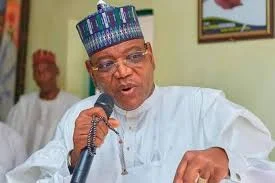
The former Jigawa State Governor, Sule Lamido has declared that his longstanding friendship with President Bola Tinubu will not prevent him from working against the ruling All Progressives Congress (APC) in the 2027 general elections.
Lamido, in an interview with the BBC, emphasized that politics and friendship must remain separate, insisting his loyalty lies with Nigeria’s progress and the survival of the opposition.
“Tinubu and I know each other very well, but we haven’t met in a while.
He told me, ‘Sule, I love you because you are trustworthy.’ We laughed and left. But that doesn’t change politics. My duty is to unite Nigerians in opposition to his government,” Lamido said.
The comment came after Lamido and Tinubu were seen laughing and exchanging pleasantries at the wedding of former Zamfara Governor Abdulaziz Yari’s son in Kaduna, fueling speculation about their political alignment.
Lamido dismissed the speculation, stressing that his commitment is to mobilize opposition forces against what he described as the APC-led government’s failures on insecurity, economic hardship, and national unity.
He further reiterated his loyalty to the PDP despite recent high-profile defections, including that of former Vice President Atiku Abubakar to the African Democratic Congress (ADC). “Atiku and I formed the PDP.
We are still talking to many Nigerians who were once with us but are now scattered. What we are doing is for the people, not ourselves,” Lamido said.
The former governor added that the PDP is working to resolve its internal crises and strengthen unity ahead of 2027.
“We are constantly engaging, reaching compromises where needed, and ensuring dialogue continues. Nigeria must move forward, and we will hold Tinubu accountable,” he noted.
Meanwhile, the Lagos State APC dismissed opposition claims, including suggestions that President Tinubu would serve only one term.
APC spokesman Seye Oladejo described such comments as “wishful thinking from political lightweights,” insisting Tinubu is laying the foundation for long-term transformation.
With Lamido maintaining his opposition stance and the PDP struggling to reorganize, the 2027 elections are already shaping up to be a fierce political contest.
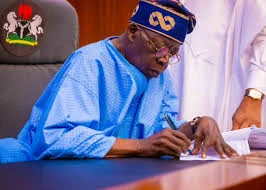
President Bola Ahmed Tinubu has called for sweeping reforms to restore the credibility of the United Nations and global financial systems, urging world leaders to adapt institutions to present-day realities.
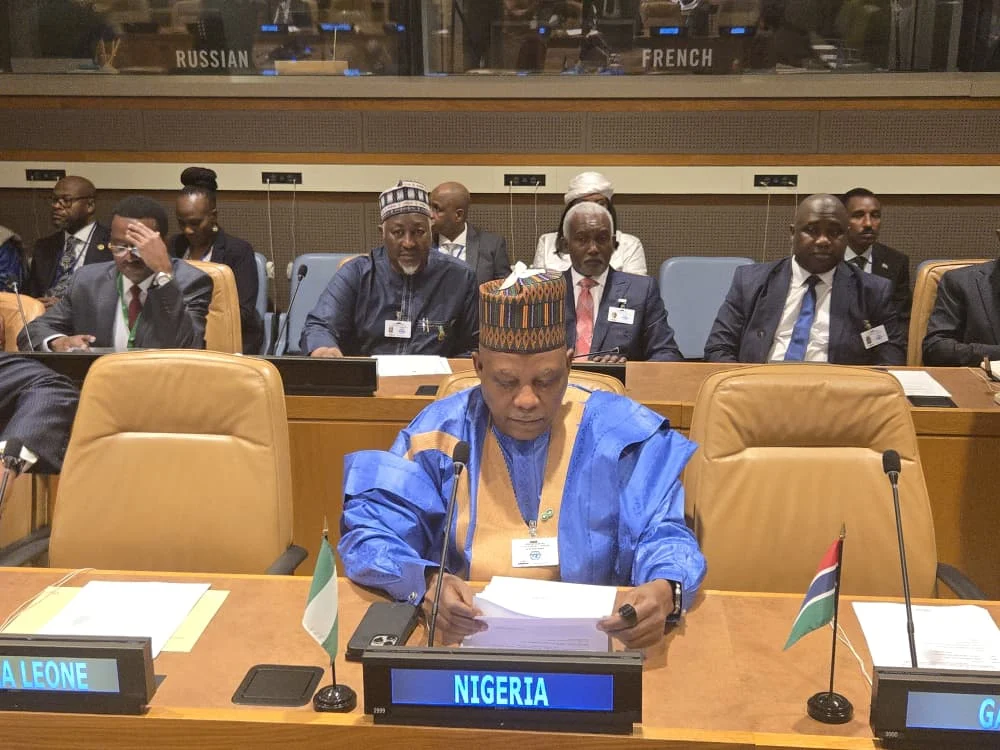
Speaking through Vice-President Kashim Shettima at the 80th United Nations General Assembly (UNGA80) in New York, Tinubu said the world could not afford “the luxury of inaction” in the face of conflicts, climate change, debt crises, and widening inequality.
“The United Nations will recover its relevance only when it reflects the world as it is, not as it was,” Tinubu declared, arguing that Nigeria deserves a permanent seat on the UN Security Council. He noted that while Nigeria was a colony of 20 million when the UN was founded in 1945, it is now a sovereign state of more than 236 million, projected to be the world’s third most populous country.
He outlined four priorities for change which includes:
a) Security Council Reform: that is it’s expansion to reflect current global realities, including Nigeria’s representation.
b) Debt Relief and Fair Financing: as a new binding mechanism for sovereign debt management, “an International Court of Justice for money.”
c) Resource Equity: by ensuring mineral-rich countries to benefit directly from their resources through local processing and jobs, and;
d) Closing the digital divide as a global initiative to expand technology access, declaring that “A.I. must stand for ‘Africa Included.’”
Reaffirming Nigeria’s commitment to peace, Tinubu highlighted the country’s participation in 51 of 60 UN peacekeeping operations since 1960. He also backed a two-state solution in Palestine, saying the right to life “should not be trapped in the corridors of endless debate.”
On regional security, he warned against terrorism and extremism, describing them as threats that prey on division and undermine human dignity.
Tinubu further described climate change as a pressing security concern tied to migration, instability, and inequality, urging the UN to channel climate funds into education, resilient housing, and community development.
Referencing Nigeria’s ongoing economic reforms, including subsidy removals and currency adjustments, Tinubu acknowledged the hardship but said they were necessary steps to unlock growth and attract investment.
He pointed to the inaugural West Africa Economic Summit held in Abuja as proof of Africa’s potential when innovation and investment intersect.
Warning against growing disillusionment with multilateralism, Tinubu said: “We must make real change, change that works, and change that is seen to work. If we fail, the direction of travel is already predictable.”
He closed with a reminder of shared responsibility: “For none of us is safe until all of us are safe.”
Says the proposed amendment will present grave legal implications, counter productive
Mr Ben Ekori, an industry expert cautions the sponsors of the proposed amendment of the Petroleum Industry Act (PIA), saying the proposal would reintroduce uncertainty, counter production and present grave legal implications for Nigeria.
Media reports indicate that Nigerians are raising concerns over the alleged ongoing moves to amend the PIA, passed in 2021 after decades of debate.
Ekori, a public affairs analyst, while reacting to the development said such a move would erode Investors’ confidence and occasion grave unintended consequences to the country and its citizens.
“That the news of the proposed PIA amendment has been in the public space for a week without denial could only mean that there could be some substance in it.
“While we await the confirmation of the news and its ultimate metamorphosis into a policy, it is pertinent to x-ray some provisions the proposed amendment appears to have been designed to bring about and their implications for Nigeria and its citizens.
“The proposed amendment which is alleged to be sponsored by the Ministry of Finance is designed with the objective of addressing the escalating fiscal leakages and revenue loss confronting the Federation.
“The reports also indicate that areas targeted for amendment include section eight which establishes the Nigerian Upstream Petroleum Regulatory Commission (NUPRC) as the body charged with the regulation of upstream operations.
“The amendment, according to the reports, will see the NUPRC replacing the NNPC Ltd. as the representative of the government in all model contracts attached to licenses and leases provided for in section 85,” he said.
He said that section 53 of the PIA was also slated for amendment to make the Ministry of Finance Incorporated (MOFI) the sole owner of the NNPC Ltd.’s shares as against the extant situation where the company’s shares are split 50:50 between MOFI and the Ministry of Petroleum Incorporated.
The expert, however, warned that the proposed amendment to make the NUPRC the concessionaire in place of the NNPC Ltd. would reintroduce uncertainty into the system, with NUPRC serving as a regulator and an operator at the same time.
“This would definitely lead to erosion of Investors’ confidence as it would be an over-stretch of the imagination to expect PSC partners to believe that they could get justice if a dispute broke out between them and the concessionaire (NUPRC) which is also the regulator.
“The sponsors of the amendment need to carefully consider the impact that this proposed provision will have on investors’ confidence and grave legal implications it will present.
“It will be counter-productive to introduce an amendment into a law that could totally negate what the law is fundamentally designed to achieve.
“With NNPC Ltd. serving as the concessionaire, the Federation is insulated from legal hazards, and there will be limits to liabilities from legal infractions.”
He further said the other proposed amendment that could have grave implications for the nation in general, and the national oil company in particular, was the provision that sought to transfer all the shares of the NNPC Ltd. to the MOFI.
According to him, the PIA provides for the NNPC Ltd. to commence a process of listing on the capital market as part of deepening its commercial focus.
He said transferring all the shares to one government entity at a time when activities should be in high gear for the company’s Initial Public Offering could create the impression that the government does not want to let the company go.
“The move has the potential of reversing the modest gain of having the company operate as a true limited liability company without direct government control or interference,” he added.
He said in trying to analyse the implications of the above proposed amendments to the PIA, it would be nice to understand what the situation was, prior to the passage of the PIA.
Ekori recalled that the President Olusegun Obasanjo’s administration set up the Oil and Gas Sector Reform Committee (OGSRC) in 2000 to look at why the industry was consistently not meeting revenue targets and recommend solutions.
He said amongst numerous observations of the committee were that some of the laws that governed the industry were not only obsolete but created uncertainty which made prospective investors wary of committing capital to further asset development projects.
The expert further said the work of the OGSRC laid the foundation for the Petroleum Industry Bill which took almost 20 years to pass, due to politics.
“For the whole of the period that the PIB lagged, Nigeria regressed as a prime investment destination, as most of the IOCs refrained from investments that could boost production because there was no clarity around the fiscal terms which investment decisions could be taken.
“Another critical area that bred uncertainty, apart from the fiscal terms, was the lack of clear delineation of roles amongst agencies in the sector.
“Of particular notoriety was the dual role of the then Nigerian National Petroleum Corporation as an operator and regulator, a situation that made the old NNPC to be like a judge in its own court when in dispute with Joint Venture and PSC partners.
“The enactment of the PIA in 2021 successfully put paid to issues of uncertainty in the system and has gradually begun to restore investors’ confidence.
“Investors may not have started falling over themselves over opportunities in the Nigerian Oil and gas sector yet, but the reports show that things are not the same as they were in the pre-PIA era,” he said.
The lifting of emergency rule in Rivers by President Bola Tinubu has triggered mixed reactions from stakeholders in the state.
Tinubu on Wednesday announced the end of emergency rule in Rivers, and reinstated Gov. Siminalayi Fubara, his Deputy, Prof. Ngozi Odu and members of the state assembly after six months of suspension.
A Niger Delta activist, Ms Ann-Kio Briggs, described the announcement as expected but raised concerns over the uncertainties surrounding Fubara’s return to full constitutional duties.
She said that Rivers people were expecting Fubara to return as governor and perform his constitutional duties without being gagged.
“Until the governor is allowed to freely carry out constitutional responsibilities, we cannot say exactly what the lifting of suspension portends,” Briggs said.
The activist said that the six months period of emergency rule was characterised by project abandonment, poor performance and undemocratic practices.
Briggs further stated that the suspension of democratic rule in Rivers inflicted incalculable losses on the people.
She said that Rivers people would demand accountability for the period the state was governed under emergency rule.
Darlington Nwauju, a factional Publicity Secretary of the All Progressives Congress in Rivers, commended Tinubu for lifting the emergency rule, and reinstating Fubara.
Nwauju however, said that the state witnessed unprecedented poor governance and mismanagement of resources during the six months period.
“Rivers was poorly managed during the past six months. The sanitary condition alone reflected absence of governance. Workers experienced delayed salary payments,” he said.
He said that the emergency rule period had left Fubara with the huge tasks of restoring confidence, improving infrastructure, and re-establishing investor confidence.
“The state did not attract any foreign direct investment during the emergency rule period, but we must move on now that democracy is back in action,” he said.
Prof. Benjamin Okaba, the President, Ijaw National Congress, said that although the emergency rule had been lifted, the state was taken several years backwards.
He claimed that no fewer than 10,000 jobs were lost during the six months of emergency rule in the oil-rich state
According to him, suspending the governor, his deputy and the legislature handed absolute power to a sole administrator and undermined democratic principles.
Analysts say that although the lifting of emergency rule has ended uncertainties, questions remain concerning the political climate that awaits Fubara as he returns to office.
They suggest that sincere reconciliation between the governor and other political stakeholders will determine the pace of recovery.
Suspended Rivers state Governor Siminalaye Fubara resumes duty today as President Bola Ahmed Tinubu has announced an end to the controversial six-month state of emergency in Rivers State.
The president’s pronouncement paves the way for full democratic governance as the state assembly shall also reconvene today.
In a nationwide address on Tuesday, Tinubu recalled that the emergency rule, declared on March 18, 2025, was necessitated by a constitutional deadlock that affected governance in Rivers State.
According to him, the crisis had pitted Governor Siminalayi Fubara against 27 members of the State House of Assembly loyal to Speaker Martins Amaewhule, leaving only four lawmakers on the governor’s side.
“The paralysis of governance, vandalisation of critical oil assets, and the inability of the governor to present an appropriation bill brought the state to a standstill,” Tinubu said. “Even the Supreme Court affirmed that there was no government in Rivers State.”
The President explained that after interventions failed to reconcile the two camps, he invoked Section 305 of the 1999 Constitution to suspend the governor, his deputy, and members of the state assembly for six months, a move later approved by the National Assembly.
Acknowledging opposition from some groups who challenged the proclamation in court, Tinubu maintained that the action was necessary to prevent anarchy and restore order.
“The power to declare a state of emergency is a constitutional tool to safeguard public order and safety. It would have been a colossal failure on my part not to have acted,” he stated.
Tinubu, however, said intelligence reports now show a “new spirit of understanding” and “potent enthusiasm” among stakeholders in Rivers State for reconciliation and peaceful governance.
“With effect from midnight today, the emergency in Rivers State shall end,” he declared. “Governor Siminalayi Fubara, Deputy Governor Ngozi Nma Odu, and members of the State House of Assembly will resume work in their offices from September 18.”
The President urged state governors and lawmakers nationwide to learn from the Rivers crisis and prioritise harmony between the executive and legislature.
“It is only in an atmosphere of peace, order, and good government that we can deliver the dividends of democracy,” Tinubu said.
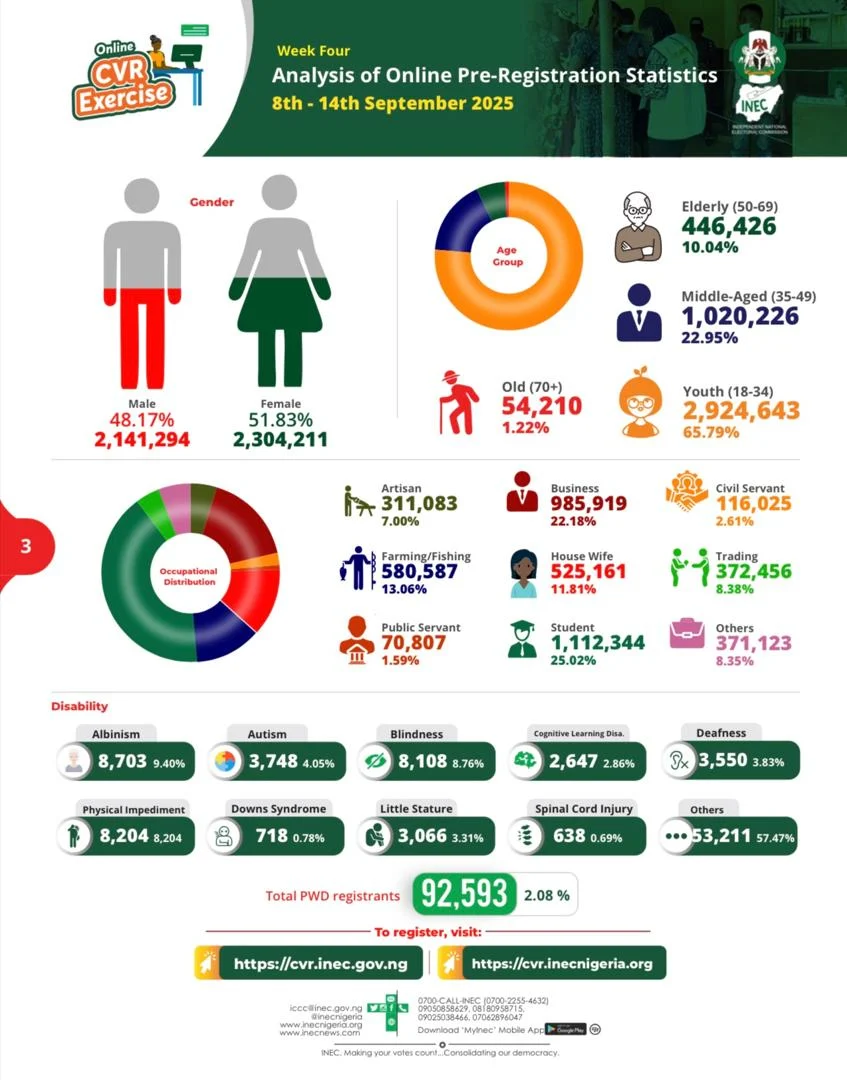
The Independent National Electoral Commission (INEC) says more than 4.4 million Nigerians have registered online in the ongoing Continuous Voter Registration (CVR) exercise, with women slightly outnumbering men in participation.
In a statement on Monday, National Commissioner and Chairman of the Information and Voter Education Committee, Sam Olumekun, disclosed that 4,445,505 citizens had completed online registration as of September 14, 2025. Out of this figure, 509,929 have successfully finalized the process by completing both online pre-registration and in-person verification.
The data shows that women accounted for 51.83 percent of online registrations, while men represented 48.17 percent. Young Nigerians between 18 and 34 years dominated the exercise, making up 65.79 percent of registrants, while students alone constituted 25.02 percent.
For completed registrations, youths again led the figures with 74.15 percent, and students represented the largest occupational group at 38.54 percent.
Olumekun noted that registration in Anambra State has been suspended until after the November 11 governorship election, while online pre-registration in the Federal Capital Territory (FCT) has been paused to allow ward-level registration ahead of the February 2026 Area Council elections.
He added that a comprehensive breakdown of registration figures by state, gender, age, occupation, and disability has been published on INEC’s official platforms for public access.“As earlier announced by the Commission, the online voter pre-registration in the FCT ends today, Monday, 15th September 2025.
For the next two weeks, the physical (in-person) option will be at the designated venues,” Olumekun said.“Thereafter, the Commission will devolve the registration to all the 62 Wards in the FCT from 29th September to 8th October 2025.
Detailed addresses of the centres have already been uploaded to our official platforms.”The CVR exercise is part of INEC’s preparations ahead of the 2027 general elections, with officials urging Nigerians to take advantage of the opportunity to register and update their voter records.
After dishonouring earlier invitations, Blessing Onuh Committee issues the minister 48-hour ultimatum to appear
The House of Representatives Committee on Land Transport has given the Minister of Transportation, Mr Sa’idu Alkali, 48 hours to appear over the Abuja-Kaduna train derailment.
Chairman of the committee, Rep. Blessing Onuh (APC-Benue), issued the ultimatum on Tuesday during an investigative hearing in Abuja.
It would be recalled that the Kaduna-bound train derailed on Aug. 26 at 11:09 a.m. between Kubwa and Asham stations.
Also summoned are the Managing Director of the Nigerian Railway Corporation, Mr Kayode Opeifa, and the Managing Director of China Civil Engineering Construction Corporation (CCECC) Nigeria Ltd., Mr Guan Shuai.
Onuh explained that the ultimatum followed the minister’s failure to honour earlier invitations to explain the incident.
She said it was unacceptable for the minister to “turn his back on Nigerians at a time they needed him most.”
“A toad does not run in the daytime for nothing. We are on recess, but many cut their break and travelled from Lagos over this tragedy.
“Only for the minister to snub parliament. We strongly object. Our people were endangered. This is not a joke. He must appear within 48 hours,” she declared.
Onuh stressed that the committee seeks not only the immediate cause of the derailment, but also the remote and root causes to prevent future occurrences.
Rep. Cyril Hart (PDP-Rivers) condemned the minister’s absence, saying that Alkali, as a former parliamentarian, should not be seen to dishonour the House.
“Over 618 Nigerians could have died. This raises grave questions about the safety of our rail system.
“For a former lawmaker to shun this committee when Nigerians need answers is betrayal. We cannot allow anyone to toy with lives,” Hart said.
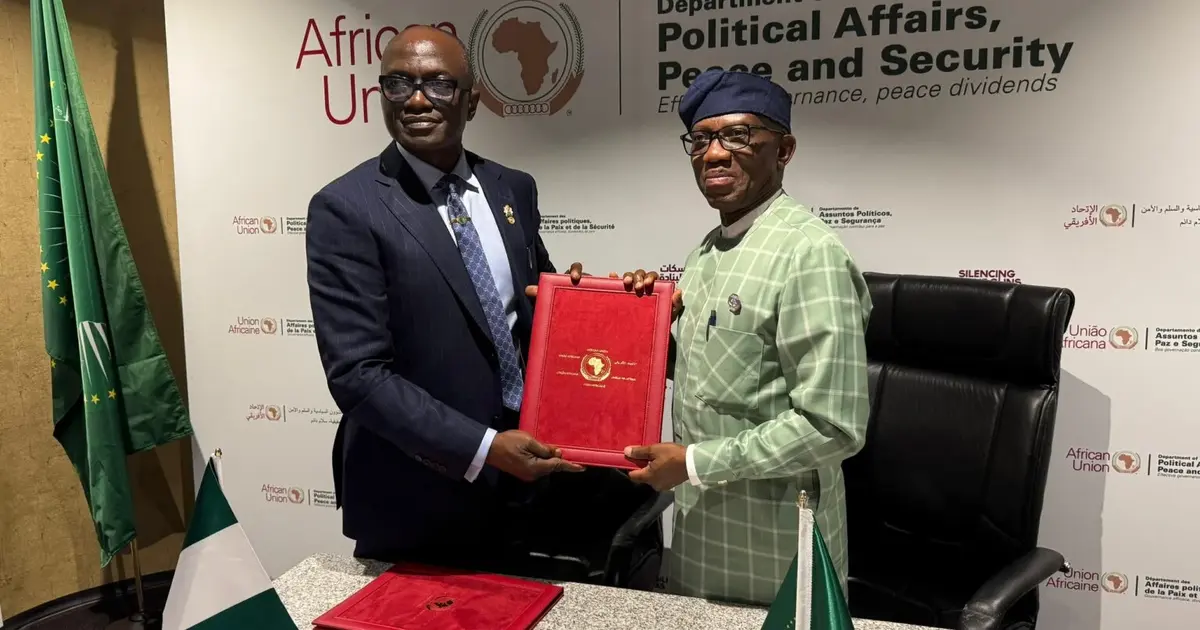
The African Union (AU) Commission and Nigeria’s National Counter Terrorism Centre (NCTC) on Monday signed a Memorandum of Understanding (MoU) to boost collaboration against terrorism and violent extremism across Africa.
This is contained in a statement by Mr Paschal Chem-Langhee, Communication Coordinator, PAPS, African Union Commission and made available to newsmen in Abuja.
The MoU was endorsed by Amb. Bankole Adeoye, AU Commissioner for Political Affairs, Peace and Security, and Maj.-Gen. Adamu Garba Laka, National Coordinator of the NCTC.
In his remarks, Adeoye commended Nigeria’s leadership role in West Africa and the Sahel.
He noted that the country’s advanced facilities and expertise at the NCTC had “greatly contributed to regional and continental security.
“The AU is proud to formalise this partnership with Nigeria, a key anchor state in the fight against terrorism.
“The NCTC’s leadership and state-of-the-art technology have set a benchmark for counterterrorism efforts in Africa,” he said.
On his part, Laka said the MoU reflected Nigeria’s commitment to advancing the Abuja Process Declaration of April 2024 and deepening regional collaboration.
According to him, by working with the African Union, we intend to strengthen regional capacities, harmonise strategies and demonstrate Nigeria’s resolve in ensuring peace and security across the continent,” he said.
The MoU will be jointly implemented by the AU Counterterrorism Centre (AUCTC) and Nigeria’s NCTC.
“Areas of cooperation include real-time intelligence sharing, secondment of experts, joint research, support for victims of terrorism, and programmes on deradicalisation and reintegration.
“It will also reinforce AU-backed initiatives such as the Nouakchott Process, the Accra Initiative, the UFL-Sahel Joint Force, and the Multinational Joint Task Force (MNJTF).
“A Joint Working Group will monitor implementation,” it added.